


What Does Uneven Tire Wear Mean? Causes and Next Steps
What Does Uneven Tire Wear Mean? Causes and Next Steps
Uneven tire wear means one part of a tire, or one tire compared with the others, is wearing faster than expected. For Raleigh drivers, the important point is that a visible pattern is a clue, not a diagnosis. Pressure history, rotation history, alignment angles, road impacts, tire condition, suspension and steering condition, and driving conditions can all play a part. Start with simple visual checks and cold tire pressure, then arrange inspection when wear is pronounced, getting worse, limited to one tire, or paired with pulling, vibration, noise, repeated air loss, or a tire-pressure warning.
Quick Answer: uneven tire wear is a clue, not a confirmed cause
Uneven tread can point toward several possibilities: low or high inflation pressure, missed or unsuitable rotation, alignment concerns, tire balance concerns, or suspension and steering issues. Check visible tire condition and cold pressure against the vehicle placard or owner’s manual, but do not assume the tread pattern identifies the failed part. Inspection and testing are what separate a clue from a confirmed cause.
The National Highway Traffic Safety Administration says to check the pressure of all tires, including the spare, at least once a month when the tires are cold, meaning the vehicle has not been driven for at least three hours. NHTSA also says the correct pressure is the vehicle manufacturer’s recommendation on the driver-door placard or in the owner’s manual, not the maximum pressure on the tire sidewall.
What do tire wear patterns actually show?
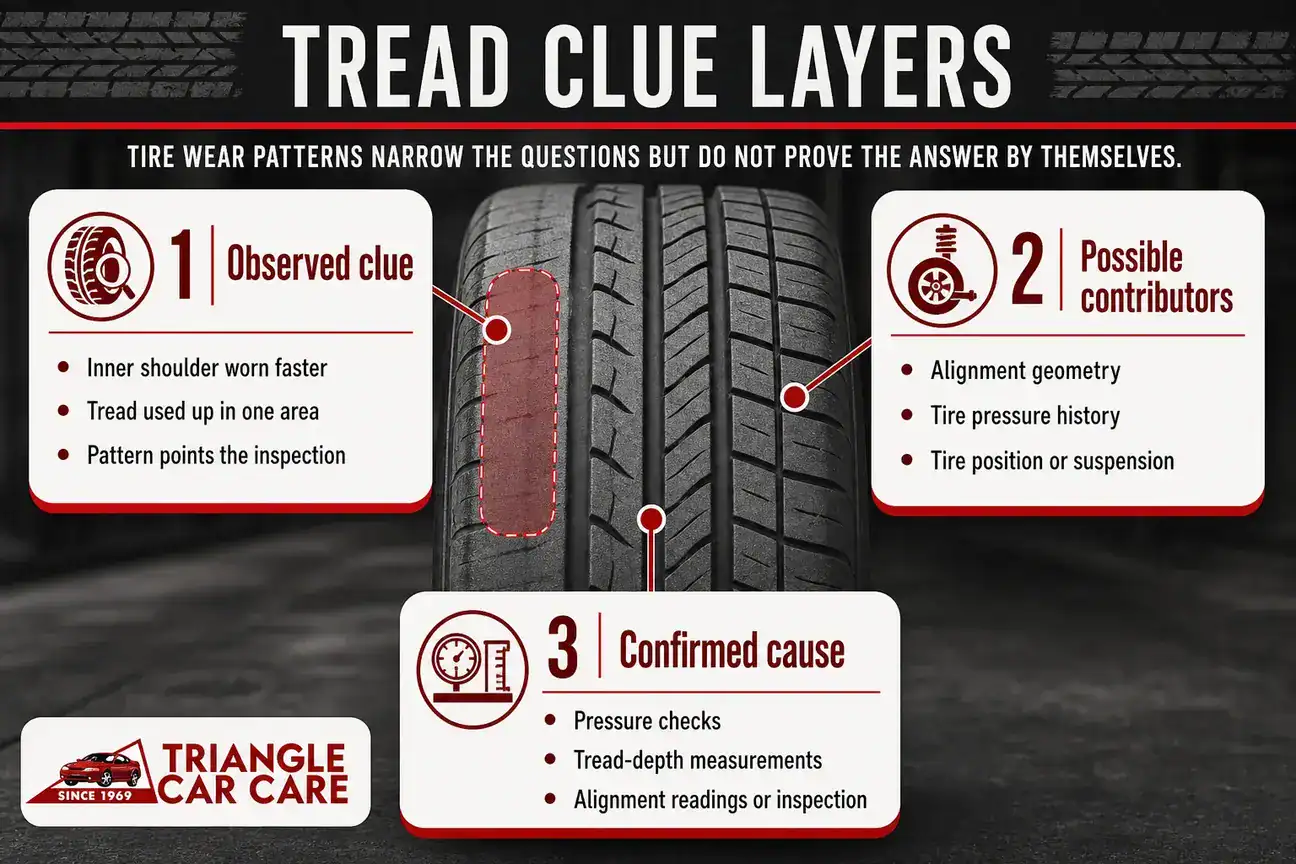
Tire wear patterns show where the tread is being used up faster. The pattern may be across the center, across both shoulders, on one edge, in patches, or in a saw-tooth feel across the tread ribs. That appearance helps narrow the questions a shop should ask, but it does not prove the answer by itself.
Think of the process in three layers:
- Observed clue: The inner shoulder is worn more than the center of the tread.
- Possible contributors: Alignment geometry, tire pressure history, tire position, suspension or steering condition, an impact, load, tire construction, or maintenance history.
- Confirmed cause: Verified through pressure checks, tread-depth measurements, tire inspection, alignment readings, and component testing when needed.
This distinction matters because two vehicles can show similar edge wear for different reasons. One may need an alignment check after a curb impact. Another may have a pressure-loss history. A third may have a worn or damaged component that lets alignment change after it is adjusted. Diagnosis before assumptions keeps the repair conversation grounded in evidence.
How to read tire wear patterns without overdiagnosing
The table below gives plain-language clues. It is meant to help you describe what you see, not to identify a part with certainty. If you notice more than one pattern, such as shoulder wear plus vibration, the combination matters.
| Pattern you see | What it may suggest | Why it is not a diagnosis |
|---|---|---|
| Center tread worn faster | Pressure history may be too high for the vehicle’s specification | The correct pressure, tire history, and tread depth still need to be verified |
| Both shoulders worn faster | Pressure history may be too low, or load and maintenance history may be involved | A leak, temperature change, valve issue, or repeated low-pressure condition may contribute |
| Inner or outer edge worn faster | Alignment-related concern, impact history, or related component condition | Alignment readings and steering or suspension inspection may be needed |
| Scalloped dips or patchy high-low spots | Balance, tire condition, suspension movement, or other contact irregularity | The visible pattern does not identify a specific failed part |
| Saw-tooth feel across tread ribs | Possible toe-angle concern or rotation-related wear | Toe readings and component condition must be checked |
| One tire worse than the others | Position-specific wear, pressure loss, impact, or component concern | The tire’s history and the vehicle’s condition both matter |
NHTSA’s tire safety guidance treats pressure, tread, damage, rotation, balance, and alignment as connected parts of tire care. Its summer driving guidance also notes that uneven tread wear can signal that tires need rotation or that wheels may be out of alignment. That is helpful because it points to the next checks without pretending that the tread pattern alone identifies the root cause.
Inside tire wear and outside tire wear on one edge
Inside tire wear means the inner shoulder or inner tread ribs are wearing faster than the rest of the tire. Outside tire wear means the outer shoulder or outer tread ribs are wearing faster. Either pattern can be consistent with an alignment-related concern, but alignment is not the only possible contributor.
Inside tire wear can be harder for a driver to see because the worn area may face inward toward the vehicle. You might notice it during a wash, while checking pressure, or when a technician points it out during service. Outside tire wear is often easier to spot because the outer shoulder is visible when you walk around the vehicle.
If inside tire wear or outside tire wear appears on one tire only, the tire position, pressure-loss history, road-impact history, and related components matter. If the same edge wear appears on both front tires, alignment readings become an important part of the inspection. If the pattern follows a tire after rotation, the tire’s history may be part of the story.
Tire cupping and scalloped tread
Tire cupping describes a scalloped or choppy pattern where the tread has alternating high and low spots. Drivers may also describe a rhythmic humming, thumping, or vibration that changes with road speed. Tire cupping can be associated with balance, tire condition, suspension movement, or other conditions that change how consistently the tire contacts the road.
The key is not to jump straight from tire cupping to a named failed part. A technician may need to inspect the tire, measure tread depth in several places, check for looseness or abnormal movement where appropriate, and consider whether vibration, noise, or steering symptoms are present. If tire cupping is paired with clunks, wandering, or repeated wear after an alignment, a broader suspension and steering inspection may be appropriate.
Tire feathering and a saw-tooth feel
Tire feathering is often felt before it is seen. Run your hand lightly across the tread surface, without reaching into unsafe areas or under the vehicle, and one side of a tread rib may feel sharper while the other side feels rounded. Tire feathering can be consistent with a toe-alignment concern, but it still needs alignment readings and component inspection to confirm what is happening.
Tire feathering may be more noticeable as road noise increases. It may also appear with a steering wheel that no longer sits where it used to, a pull, or a recent pothole or curb strike. Those details help a shop decide whether an alignment check alone is the right starting point or whether other testing should happen first.
Can cold tire pressure create tire wear patterns?
Yes, pressure history can influence tire wear patterns, but one pressure reading today does not tell the whole story. A tire may have been low for weeks and then filled recently. Another may have been adjusted when hot, which can mislead the reading. A third may be losing air slowly from a puncture, valve issue, wheel sealing issue, or another condition.
NHTSA says to check tire pressure when tires are cold and to use the vehicle manufacturer’s pressure specification. That matters because the maximum pressure printed on the tire sidewall is not the same as the vehicle’s recommended pressure. If your vehicle has a spare tire, include it in the pressure check when applicable.
Pressure readings are also affected by conditions around the tire. Driving warms tires, and outdoor temperature changes can change what you see on a gauge or tire-pressure monitor. NHTSA’s winter driving guidance reminds drivers that tires can lose pressure as outside temperatures drop. A pressure warning light is still only a clue. The cause might be a temperature-related pressure change, slow leakage, puncture damage, a valve issue, or a monitoring-system concern.
Pressure correction may prevent future wear, but it cannot put worn tread back on the tire. If both shoulders are already worn, or the center is already noticeably lower than the shoulders, the tire condition still needs to be evaluated. A pressure adjustment alone is not proof that the problem is solved.
How rotation history affects tire wear patterns
Tires do not all work the same way on a vehicle. Front tires handle steering forces. Drive tires handle power delivery. Vehicle load, braking, road crown, suspension design, and tire construction can all influence how each position wears. That is why rotation history matters when comparing tire wear patterns from front to rear or side to side.
Missed or delayed tire rotation can allow position-related wear to become more obvious. On some vehicles, a rear tire may develop a different wear texture than a front tire. On others, front shoulder wear may appear sooner because of steering and cornering forces. The correct rotation pattern and interval come from your vehicle’s maintenance schedule and tire information, not one universal mileage rule.
If the wear is mild and the tires are otherwise in serviceable condition, tire rotation may be part of the maintenance plan. If the wear is severe, near the wear bars, paired with vibration, or limited to one tire, the vehicle and tires should be inspected before deciding whether rotation makes sense. Moving a badly worn tire to a different position can change symptoms without addressing the reason the wear developed.
In practical terms, tire care items work together. Rotation history helps explain where the tire has been; pressure checks and tread measurements help show what condition it is in now. When tread wear is already abnormal, a rotation decision should be based on the tire’s condition and the vehicle’s symptoms, not on a calendar reminder alone.
Could alignment explain inside tire wear or tire feathering?
Alignment describes the angles at which the wheels meet the road and point relative to the vehicle. Toe and camber are two alignment concepts commonly discussed with inside tire wear, outside tire wear, and tire feathering. If those angles are outside the vehicle’s specification, a tire may scrub across the road instead of rolling cleanly.
Still, alignment readings are only part of the story. A pothole or curb strike can change alignment, but worn or damaged steering and suspension parts may also let alignment shift again after adjustment. Tire pressure history, tire position, and previous wear can complicate what the driver sees. That is why a careful shop does not treat inside tire wear as automatic proof of one failed component.
In Raleigh, seasonal temperature swings, stop-and-go traffic, potholes, and curb impacts can make tire checks worth taking seriously. Those conditions do not diagnose your vehicle, but they do give useful context when you explain when the pattern started. If outside tire wear appeared after an impact, or tire feathering showed up with a changed steering-wheel position, mention that when you schedule inspection.
For wear that looks alignment-related, a wheel alignment evaluation can help document the readings and compare them to specification. If there is looseness, clunking, wandering, vibration, or repeated alignment change, inspection of related steering and suspension areas may be needed before any adjustment is expected to hold.
What else should be checked besides alignment?
Alignment is important, but it is not the only possible factor. A tire-wear concern is best approached as a set of checks, starting with the simple and moving toward the more involved only when the symptoms call for it.
- Cold tire pressure: Compare all tires with the door placard or owner’s manual, not the sidewall maximum.
- Pressure-loss history: Repeatedly needing air is a clue that should be investigated.
- Tread depth: Measure across the tire, not just in the center.
- Tread-wear indicators: Wear bars help show when tread is approaching its limit.
- Visible damage: Cuts, bulges, exposed cords, cracking, embedded objects, or tread separation need prompt attention.
- Rotation history: Note when the tires were last rotated and whether the pattern changed afterward.
- Balance-related symptoms: Vibration that changes with speed can guide inspection.
- Steering and suspension condition: Looseness, clunks, wandering, or repeated abnormal wear may require component checks.
NHTSA’s TireWise information recommends checking tire tread at least once a month, and states that tires are not safe and should be replaced when tread is worn down to 2/32 of an inch. Tread-wear indicators and simple tread checks can help you recognize when a tire is near that point, but a full inspection may still be needed if the wear is uneven across the tire.
What can you safely check at home?
There are useful checks you can do without turning a tire concern into a driveway repair job. Keep the checks simple and stay out from under the vehicle. Do not remove suspension, steering, brake, or wheel components, and do not attempt an alignment at home.
- Look across the full tread width you can see. Compare the inner side, center, and outer side as much as visibility allows.
- Compare all four tires. One tire that looks much worse than the others deserves attention.
- Check cold tire pressure. Use the driver-door placard or owner’s manual specification.
- Look for obvious damage. Bulges, cords, cracks, cuts, embedded objects, and separation are warning signs.
- Notice warning lights. A tire-pressure light is a clue, not a cause.
- Review recent events. Note pothole impacts, curb strikes, vibration, new noise, pulling, or steering-wheel changes.
Do not judge the inner shoulder by feel alone if you cannot see it clearly. The inside edge can be hidden by the vehicle body and suspension. If you cannot inspect it without crawling under the vehicle or using unsafe support, leave that inspection to a shop with the right equipment.
When should you stop driving and arrange help?
Stop driving when it is safe to do so if you see a tire bulge, exposed cords, major sidewall damage, severe tread separation, rapid air loss, or a suspected unsafe puncture. The same conservative advice applies if the vehicle has severe vibration, major pulling, steering looseness, or any feeling that you are losing control.
Get to a safe place and arrange towing or roadside help when the tire or steering condition could affect control of the vehicle. Do not keep driving just to see whether the symptom improves. Triangle Car Care is not a towing, roadside, mobile, or 24/7 service provider, so arrange that help separately before scheduling shop service.
How a shop narrows the cause before recommending a repair
A careful inspection starts with what you noticed: which tire, which edge, when it started, and what changed. The tire-wear pattern points the inspection, but it does not replace it. That is especially true when the vehicle also has a warning light, vibration, humming, thumping, pulling, or steering looseness.
A shop may verify pressure, inspect for visible tire damage, measure tread depth at multiple points, compare tire positions, and consider rotation history. If the wear suggests alignment involvement, alignment readings can show whether the current angles are in specification. If symptoms point beyond alignment, a steering and suspension inspection may be needed before deciding what adjustment or repair is appropriate.
For concerns that involve more than the tires, such as vibration plus a warning light or multiple symptoms at once, a broader vehicle diagnostic service may be the right path. The goal is clear communication: what was observed, what was tested, what was confirmed, and what remains uncertain.
Cost and timing depend on what inspection finds, the vehicle design, parts availability if a repair is needed, the condition of the tires, and whether alignment or related component work is involved. The FTC’s auto repair basics guidance encourages drivers to understand repair authorizations and ask questions before work is performed. Triangle Car Care provides ASE-certified personnel and a 24-month/24,000-mile warranty on most qualifying work; ask which warranty terms apply to your specific repair.
What to tell the shop before the appointment
The more specific you can be, the easier it is to reproduce the symptom and inspect the right areas. You do not need to diagnose the problem. Just describe what you see and feel.
| What to note | Why it helps |
|---|---|
| Which tire looks abnormal | Helps compare tire position and wear history |
| Which part of the tread is worn | Separates center, shoulder, inside edge, outside edge, cupping, and feathering clues |
| When you first noticed it | Helps judge whether the change is gradual or rapid |
| Pulling, vibration, noise, or steering change | Helps decide whether alignment, balance, suspension, or diagnostic checks are needed |
| Tire-pressure light or repeated air loss | Helps identify pressure history as a possible contributor |
| Recent pothole or curb impact | Gives context for possible alignment or component concerns |
| Last rotation or alignment | Helps interpret whether the wear stayed with the tire or appeared in a position |
If you are in Wake County and notice a wear pattern during routine maintenance or before an inspection trip, do not wait for the tread to become severe. You can request an appointment and describe the tire wear patterns, any pressure warning, and whether the vehicle pulls, vibrates, or makes noise. Triangle Car Care confirms the appointment time; you can also call 919-787-0966.
6 practical safe next steps for tire wear patterns
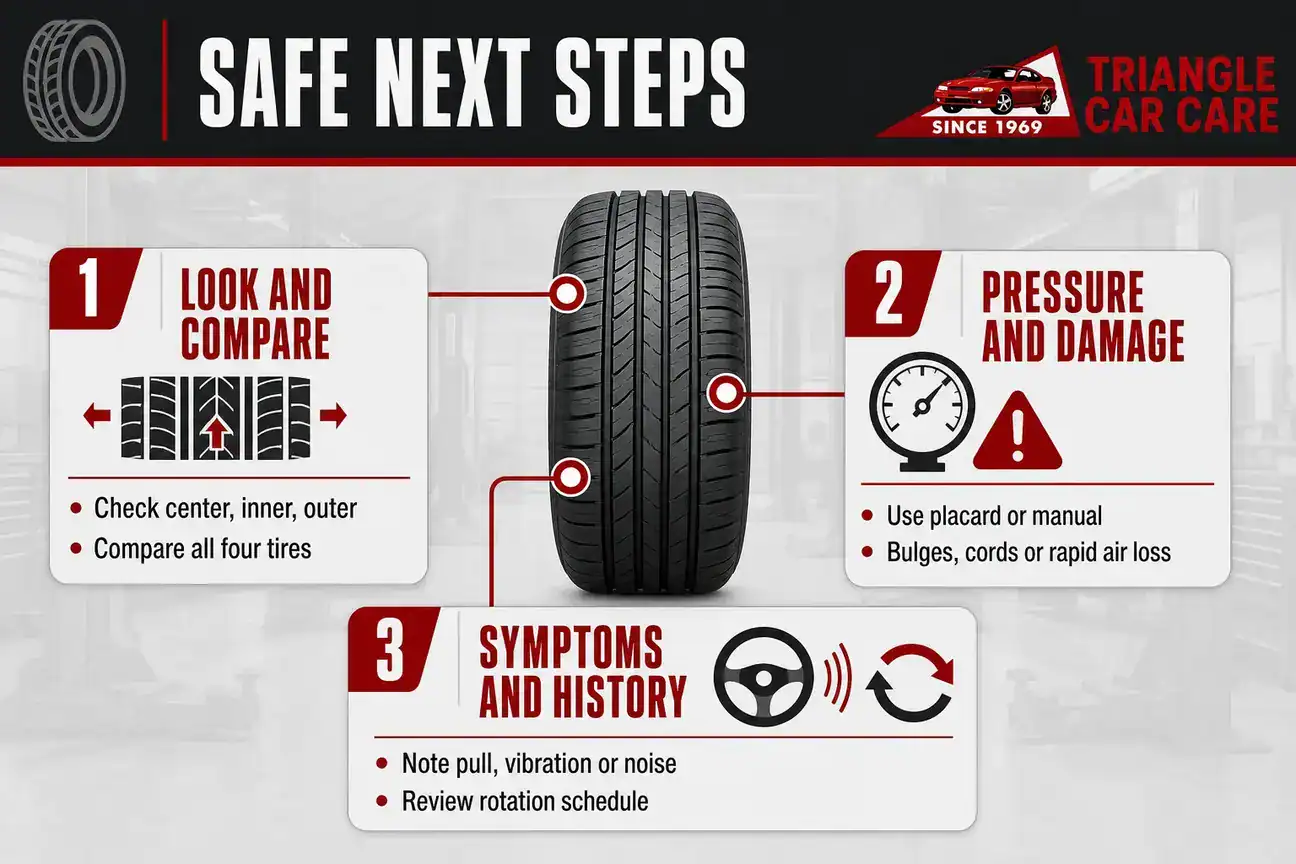
- Confirm what you can see. Look at the center, inner shoulder, and outer shoulder where visible, and compare all four tires.
- Check cold pressure. Use the vehicle placard or owner’s manual, and include the spare when applicable.
- Look for damage. Bulges, exposed cords, major cuts, cracking, separation, or rapid air loss call for conservative action.
- Write down symptoms. Pulling, vibration, tire noise, steering looseness, or a changed steering-wheel position helps guide inspection.
- Review rotation history. Follow your vehicle’s maintenance schedule rather than a universal interval.
- Arrange inspection when the pattern is pronounced. Alignment readings, tread measurements, pressure checks, and component inspection are how the cause is confirmed.
These steps work whether you are trying to describe inside tire wear, outside tire wear, tire cupping, tire feathering, or other tire wear patterns. They also keep the conversation focused on facts instead of guesswork.
What Raleigh-area drivers should take from this
Triangle Car Care is an independent auto repair shop on Glenwood Avenue, serving Raleigh since 1969. For tire-wear concerns, the practical next step is not to assume the tire pattern proves one failed part. It is to verify pressure, measure tread, inspect the tire and related vehicle systems, and use alignment readings or other testing when the symptoms call for it.
If you see inside tire wear, outside tire wear, tire cupping, or tire feathering, note the pattern and the conditions around it. If the vehicle also pulls, vibrates, makes a rhythmic noise, loses pressure, or recently struck a pothole or curb, mention that when scheduling. For a calm next step, request an appointment or call 919-787-0966 with the tire location, visible pattern, warning lights, and driving symptoms. The shop confirms the appointment time.
This article is general automotive information, not a diagnosis of your vehicle. Follow your owner’s manual, and have a qualified technician inspect the vehicle when a symptom could affect safe operation.
Frequently Asked Questions
Is uneven tire wear dangerous?
It can be, especially when tread is near the wear bars, cords are visible, the tire has damage, air is dropping quickly, or the vehicle has major vibration, pulling, or steering symptoms. Treat the pattern as a warning sign and arrange inspection rather than assuming the vehicle can keep being driven normally.
Does inside tire wear always mean bad alignment?
No. Inside tire wear may be consistent with an alignment-related concern, but alignment readings and inspection are needed. Suspension or steering condition, impact history, tire pressure history, tire position, and previous maintenance can also contribute.
What causes tire cupping?
Tire cupping may suggest a balance-related concern, tire condition issue, suspension movement, or another condition that affects how consistently the tire contacts the road. The pattern does not identify a failed part by itself, so inspection and testing are needed.
Can low tire pressure cause shoulder wear?
Chronic underinflation may be associated with both shoulder edges wearing faster. Check pressure cold against the vehicle placard or owner’s manual, and arrange inspection if pressure repeatedly drops or the wear is already pronounced.
Can overinflation cause center tire wear?
Center tread wear may be associated with pressure being too high for the vehicle’s specification. Verify the correct pressure from the driver-door placard or owner’s manual rather than using the maximum pressure printed on the tire sidewall.
Should tires be rotated when wear is uneven?
Rotation may be appropriate in some cases, but substantial or symptom-related wear should be inspected first. Follow the vehicle manufacturer’s maintenance schedule and tire guidance rather than one universal interval.
Will a wheel alignment fix uneven tire wear?
An alignment may address an alignment-related cause, but it will not restore tread that has already worn away. A shop should also check tire pressure, tire condition, tread depth, and suspension or steering condition when symptoms indicate those areas.
Sources


