


Exhaust System Repair in Raleigh, NC
Your vehicle's exhaust system carries combustion gases away from the engine and passenger area, reduces exhaust noise, and supports emissions control. Depending on the vehicle, it may also contain sensors that provide information used by the engine-management system.
Triangle Car Care provides exhaust-system diagnosis and repair in Raleigh for most makes and models. A loud exhaust, ticking sound, rattle, leak, exhaust odor, warning light, or emissions-related trouble code can point technicians toward an area to inspect, but none of those symptoms automatically proves which component needs replacement.
The repair should be based on the vehicle's actual exhaust layout and what inspection and testing reveal—not simply on the sound the driver hears or a code stored by the vehicle computer.
What Does a Vehicle Exhaust System Actually Do?
An exhaust system is more than a muffler and tailpipe. Its exact layout varies by engine, emissions package, drivetrain, model year, vehicle configuration, and manufacturer.
Routes Exhaust Gases
Exhaust piping directs combustion gases from the engine toward the rear or designated outlet of the vehicle and away from the normal passenger area.
Reduces Noise
Mufflers, resonators, pipe design, chambers and other features help control the sound produced by exhaust pulses without assuming every vehicle uses the same arrangement.
Supports Emissions Control
Catalysts and other emissions-related components help reduce regulated pollutants when the engine and emissions system are operating as designed.
Provides Sensor Information
Many vehicles use oxygen or other exhaust-related sensors to provide feedback used for fuel-control, catalyst monitoring, or other engine-management functions.
Maintains a Sealed Exhaust Path
Gaskets, flanges, clamps, welds, pipes and flexible sections work together to keep exhaust gases traveling through the intended path.
Controls Movement
Hangers, brackets and flexible sections allow controlled movement as the engine moves and the exhaust system expands with heat.
Parts That May Be Included in an Exhaust System
Not every vehicle contains every component listed below, and the order and design can vary significantly. Inspection should be based on the specific vehicle.
Exhaust Manifold
Collects exhaust gases from engine cylinders and directs them into the downstream exhaust path. Some vehicles use integrated or multi-piece designs.
Gaskets & Flanges
Seal connections between exhaust components. Leakage at a flange or gasket can create ticking, hissing, noise, or fumes.
Flex Sections
Flexible sections help accommodate engine movement and vibration. Damage can create noise or leaks and may affect nearby exhaust components.
Catalytic Converter
A catalyst helps reduce certain exhaust pollutants. A catalyst-related code is evidence of a detected condition, not automatic proof that the converter itself has failed.
Oxygen & Exhaust Sensors
Depending on the vehicle, sensors may monitor oxygen content, temperature, pressure or other exhaust conditions used by the engine or emissions-control system.
Exhaust Pipes
Pipes connect exhaust components and carry gases through the system. Corrosion, impact, damaged connections, or failed supports can lead to leaks or movement.
Resonator
Some vehicles use a resonator to control specific sound frequencies. Other vehicles may not use a separate resonator at all.
Muffler
Helps reduce exhaust noise. A loud vehicle may have a muffler problem, but leaks or damage elsewhere in the system can create a similar sound.
Hangers & Brackets
Support the exhaust while allowing limited movement. A broken hanger can allow piping or a muffler to rattle or contact the vehicle body.
Clamps & Connections
Some systems use clamps or bolted connections between sections. Loose or damaged connections may contribute to leakage or movement.
Tailpipe
Directs exhaust toward the designed outlet. Damage, blockage, modification, or incorrect routing can affect safe exhaust flow.
Heat Shields
Heat shields help protect nearby components and vehicle structures. Loose shields can sometimes create rattles that sound like internal exhaust damage.
Signs Your Exhaust System May Need Inspection
Exhaust-system symptoms often overlap. The same noise or warning can come from more than one component, so these signs are starting points for inspection rather than remote diagnoses.
Louder-Than-Normal Exhaust
A sudden roar or deeper exhaust note may indicate a leak, damaged pipe, separated joint, failed flex section, muffler concern, or another opening in the system.
Ticking or Hissing
A leak near a manifold, gasket, flange, flex section or pipe can create a ticking or hissing sound that changes with engine speed or temperature.
Rattling Under the Vehicle
Loose heat shields, damaged hangers, internal component damage, loose clamps, contact with the body or another mechanical issue can create rattles.
Exhaust Odor
An unusual exhaust smell around or inside the vehicle can indicate a leak or routing problem. Carbon monoxide itself is odorless, so odor should not be used as a CO detector.
Check Engine Light
Oxygen-sensor, catalyst-monitoring, air-fuel, misfire, fueling or other conditions can trigger diagnostic trouble codes related to exhaust or emissions operation.
Visible Corrosion or Damage
Holes, separated joints, damaged brackets, impact damage, heavy corrosion or missing components are reasons to have the exhaust inspected.
Exhaust Leaks Can Be More Than a Noise Problem
Vehicle exhaust can contain carbon monoxide. Carbon monoxide is colorless and odorless, so you cannot rely on smell to determine whether CO is present.
If exhaust gases are entering the passenger compartment, the issue deserves prompt attention. Headache, dizziness, weakness, confusion, nausea, or other symptoms that occur while a vehicle is running can be medically important and should not be ignored.
- Exhaust odor inside the cabin: get fresh air and avoid unnecessary continued driving until the source can be evaluated.
- Suspected major exhaust leak near the passenger area: do not assume the vehicle is safe because it still runs normally.
- Headache, dizziness or illness while inside a running vehicle: move to fresh air and seek appropriate medical help when needed.
- Never run a vehicle in an enclosed garage: exhaust gases can accumulate even when a vehicle appears to be operating normally.
How an Exhaust-System Concern May Be Evaluated
The exact diagnostic process depends on the symptom, vehicle design, condition of the exhaust system and whether an emissions or warning-light concern is also present.
Confirm the Concern
Determine whether the complaint involves noise, odor, vibration, leakage, visible damage, warning lights, emissions operation, or a combination of symptoms.
Inspect the Exhaust Path
Examine accessible manifolds, flanges, gaskets, flex sections, pipes, catalysts, resonators, mufflers, hangers and connections as appropriate.
Test Related Systems
If the problem involves emissions or a warning light, diagnosis may include scan data, sensor information, leak evaluation, fuel-control information or other vehicle-specific tests.
Recommend the Repair
Once the source is supported by evidence, the appropriate repair or replacement options can be explained before work proceeds.
Exhaust Components, Warning Signs & Diagnosis
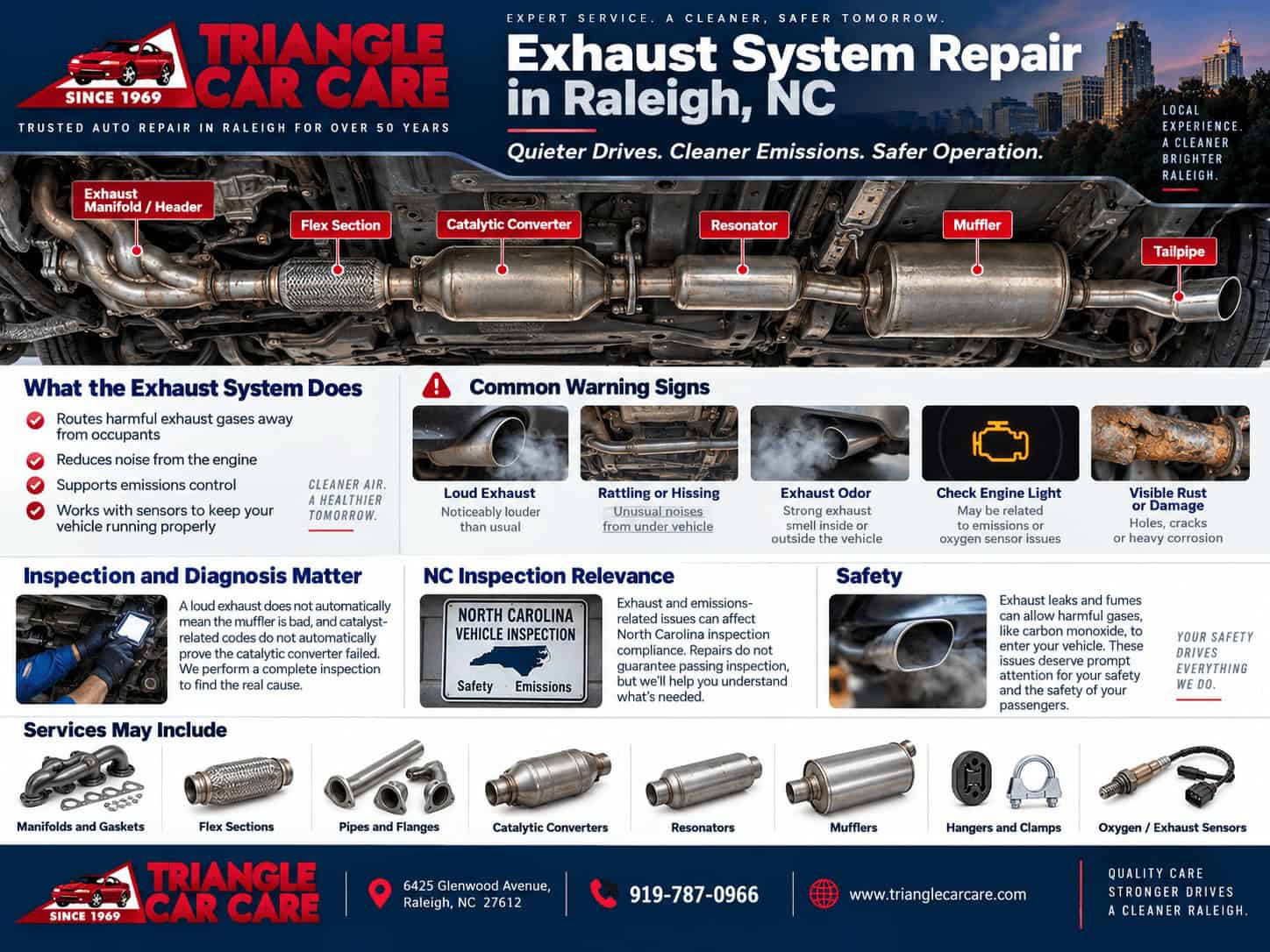
This visual guide shows common exhaust components, warning signs and inspection considerations. Actual exhaust layouts vary by vehicle.
Noise Type Matters
A roar, tick, hiss or rattle can point toward different areas, but the sound still needs to be located and matched with physical findings.
Look at the Entire Path
A damaged muffler is only one possibility. Manifolds, gaskets, flex sections, pipes, hangers, heat shields and connections can create similar complaints.
Codes Are Clues
An emissions or catalyst-related diagnostic code identifies a detected condition. It does not prove which component needs to be replaced.
A Catalyst Code Does Not Automatically Mean “Replace the Converter”
The vehicle computer can detect conditions suggesting that catalyst performance is outside the expected range. That information is useful, but the diagnostic trouble code alone does not establish why the condition exists.
Misfires, abnormal fuel control, exhaust leaks, oxygen-sensor information, engine operating conditions, contamination, previous repairs, wiring concerns and an actually degraded catalyst are among the possibilities that may need to be considered depending on the vehicle and code.
Replacing a converter without identifying a condition that could damage the replacement may leave the original problem unresolved. The correct approach is to diagnose the underlying cause and evaluate the catalyst as part of the whole system.
Required Emissions Controls Should Not Be Bypassed or Disabled
Federal law prohibits tampering with required vehicle emissions controls and the sale or installation of devices intended to defeat those controls.
That includes removing or rendering required emissions-control equipment inoperative when the law prohibits doing so. A missing, damaged or malfunctioning catalytic converter should be addressed through compliant diagnosis and repair—not by bypassing the system.
North Carolina inspection rules also address missing, disconnected, altered or inoperative emissions-control components on applicable vehicles.
Exhaust Repair and NC Vehicle Inspection in Wake County
North Carolina's annual safety inspection includes the exhaust system and emissions-control components. State inspection rules identify exhaust-system conditions such as leaking joints, holes, leaking seams, certain bypass arrangements, missing required mufflers and improper routing as inspection concerns.
Wake County is also one of the North Carolina counties requiring an emissions inspection for applicable vehicles. Vehicle age, fuel type, weight, mileage and other exemptions can affect whether an emissions inspection is required.
Repairing an exhaust defect may address one inspection problem, but no exhaust repair by itself guarantees that a vehicle will pass every safety or emissions requirement.
What Common Exhaust Symptoms Can Suggest
These examples help organize an inspection. They are not substitutes for diagnosis.
| What You Notice | Possible Areas to Inspect | Why Diagnosis Matters |
|---|---|---|
| Loud exhaust or sudden roar | Pipe, flange, flex section, muffler, resonator, manifold, gasket or another opening in the exhaust path. | The muffler is only one possible source. |
| Ticking that changes with engine speed | Manifold area, gasket, flange, pipe connection or another engine-speed-related leak. | Noise location and temperature behavior can help narrow the inspection. |
| Rattle from underneath | Heat shield, hanger, bracket, clamp, pipe contact, internal muffler or catalyst component, or another loose part. | A rattle does not automatically mean the catalytic converter has failed. |
| Exhaust odor inside the vehicle | Exhaust leak, body sealing issue, damaged exhaust routing or another path allowing gases toward the passenger area. | Treat cabin exhaust intrusion as a safety concern and arrange inspection. |
| Check engine light with catalyst or sensor code | Catalyst operation, sensor information, exhaust leakage, fueling, misfire, wiring or another engine-management issue. | A stored code identifies a detected condition; it does not prove which part should be replaced. |
| Visible hole, separated pipe or hanging exhaust section | Exhaust piping, supports, clamps, flanges or related components. | Physical damage can worsen and may create safety or inspection concerns. |
Exhaust Noise Can Start Before the Muffler
Drivers often use the word “muffler” to describe the entire exhaust system. In reality, the muffler is only one component. A leak or separation closer to the engine can make the vehicle dramatically louder even if the muffler itself is still intact.
Resonators and mufflers can also develop internal rattles, corrosion, impact damage, loose connections or other problems. Supports and hangers should be considered as part of the system because an exhaust component that contacts the body can transmit noise throughout the vehicle.
An Oxygen-Sensor Code Does Not Automatically Mean the Sensor Is Bad
Oxygen sensors and other exhaust-related sensors supply information to the engine-management system. A diagnostic trouble code may identify a circuit, signal range, heater condition, response issue, mixture condition or catalyst-monitoring problem depending on the vehicle.
Wiring, connectors, exhaust leaks, engine operation, fuel control, sensor contamination and the sensor itself are among the factors that may need to be considered.
If the check engine light is the main concern rather than a confirmed exhaust leak or exhaust noise, the dedicated Check Engine Light Diagnostic page is the better starting point.
Rattles, Odors and Performance Problems Can Come From Other Systems
Not every underbody rattle is an exhaust problem. Heat shields, suspension components, drivetrain parts, engine mounts and other components can create similar noises.
Odors can also come from oil, coolant, fuel, brakes, electrical components or debris contacting a hot surface. Performance concerns can originate from engine, ignition, fuel, intake, transmission or electronic systems.
When the system responsible for the complaint is unclear, visit our Diagnostic Service page for broader vehicle diagnosis.
Why Exhaust System Repair Cost Varies
A national average cannot tell you what a specific vehicle at Triangle Car Care will need. Cost depends on the diagnosis, vehicle and repair scope.
A flange or gasket concern is a different repair from a converter, muffler, manifold, flex section or longer exhaust assembly.
Exhaust layouts, number of converters, sensor locations, access and component integration vary by engine and vehicle.
Rusted fasteners, damaged connections or deterioration in adjacent exhaust sections can change the repair scope.
Catalysts, sensors and emissions-related components may require additional diagnosis or vehicle-specific replacement requirements.
There Is No Universal Exhaust-System Replacement Interval
Mufflers, pipes, catalysts and other exhaust components generally are not replaced simply because a universal mileage number has been reached. Service is based on vehicle-specific maintenance information, inspection findings, damage, leakage, corrosion, codes and operating condition.
Drivers can still help catch problems early by paying attention to new noises, unusual fumes, warning lights, impact damage, loose components and visible deterioration.
When Raleigh Drivers Often Notice Exhaust Problems
Exhaust symptoms may become easier to notice in different driving situations. A leak near the front of the vehicle may become more obvious during acceleration. A loose heat shield may rattle at a specific engine speed. A worn hanger may allow contact over bumps or during engine movement.
Stop-and-go commuting, highway driving, parking-lot maneuvering and road impacts do not by themselves diagnose or prove the cause of an exhaust problem. They simply provide useful conditions for describing when the symptom appears.
When scheduling service, note whether the sound or odor changes while accelerating, idling, starting the engine cold, driving over bumps or after the vehicle reaches operating temperature.
Exhaust System Service From an Established Raleigh Repair Shop
Triangle Car Care has served the Raleigh area since 1969 from its location at 6425 Glenwood Avenue, Raleigh, NC 27612. The shop services most makes and models and uses a diagnosis-first approach to determine what a vehicle actually needs.
Triangle Car Care's published TechNet warranty information lists exhaust systems and emission-control systems among qualifying repair categories. Most qualifying work is covered by a 24-month / 24,000-mile warranty, subject to applicable warranty terms.
Related Automotive Services in Raleigh
These related pages help separate exhaust-system repair from check-engine-light, engine, cooling and general diagnostic intent.
Exhaust System Repair Raleigh NC FAQs
Common questions about exhaust leaks, mufflers, catalytic converters, warning lights, emissions systems and North Carolina inspection requirements.
What are the signs of an exhaust system problem?
Common signs can include louder exhaust noise, ticking, hissing, rattling, exhaust odor, visible corrosion or holes, a hanging exhaust component, or a check engine light. These symptoms can have multiple causes, so inspection is needed before deciding which exhaust component requires repair.
Does a loud exhaust mean I need a new muffler?
No. A damaged muffler can make a vehicle louder, but leaks can also occur at the exhaust manifold, gasket, flange, flex section, pipe, resonator, catalytic-converter area or another connection. The source of the noise should be located before a muffler or other component is replaced.
Is an exhaust leak dangerous?
An exhaust leak can become a safety concern, particularly if gases can enter the passenger compartment. Vehicle exhaust can contain carbon monoxide, which is colorless and odorless. Exhaust odor inside the vehicle, suspected cabin intrusion, headache or dizziness during vehicle operation are reasons to get fresh air and arrange appropriate inspection.
Does a catalyst code mean the catalytic converter is bad?
Not automatically. A catalyst-related diagnostic trouble code identifies a condition detected by the vehicle computer. Exhaust leaks, engine misfires, fuel-control problems, sensor information, wiring issues and actual catalyst deterioration are among the possibilities that may need to be evaluated before replacement.
Can a bad oxygen sensor cause a check engine light?
An oxygen-sensor problem can trigger a check engine light, but a sensor-related code does not automatically prove the sensor itself has failed. Exhaust leaks, wiring, connectors, engine operation, fuel-control conditions and other factors can affect sensor readings, so diagnosis should identify the actual cause.
Why does my exhaust rattle underneath the car?
Rattling can come from a loose heat shield, broken hanger, damaged bracket, loose clamp, internal muffler or catalytic-converter component, pipe contacting the vehicle body, or another underbody part. The noise should be reproduced and located before assuming which component needs repair.
Can an exhaust problem cause a vehicle to fail North Carolina inspection?
Yes. North Carolina safety inspection requirements include the exhaust system and emissions-control components. Conditions such as leaking joints, holes, leaking seams, certain bypass arrangements, missing required components or disabled emissions equipment can affect inspection. Repairing one exhaust problem does not guarantee that every inspection requirement will pass.
Does Wake County require emissions inspection?
Wake County is currently one of the North Carolina counties that requires emissions inspection for applicable vehicles. Exemptions can depend on factors such as vehicle age, mileage, fuel type, weight and registration classification, so current NCDMV guidance should be used for a specific vehicle.
Can a catalytic converter legally be removed or bypassed?
Required vehicle emissions-control equipment generally cannot be removed, disabled or bypassed in violation of federal and applicable state law. EPA rules prohibit tampering with required emissions controls and the sale or installation of devices intended to defeat those controls. Repairs should maintain compliant emissions-system operation.
How often should an exhaust system be replaced?
There is no universal replacement interval for an entire exhaust system. Exhaust components are generally evaluated based on vehicle design, condition, corrosion, leakage, damage, diagnostic findings and manufacturer information. Individual components may require attention at different times rather than replacing the entire system.
How much does exhaust system repair cost in Raleigh?
Exhaust repair cost depends on the vehicle, location of the leak or damage, component involved, corrosion, parts requirements, access and whether emissions-related diagnosis is needed. A generic national price range is not a Triangle Car Care quote. Inspection is needed before the repair scope can be determined.
Does Triangle Car Care repair exhaust systems on most makes and models?
Triangle Car Care provides exhaust-system diagnosis and repair for most makes and models from its Raleigh location at 6425 Glenwood Avenue. The specific repair available depends on the vehicle's exhaust design, diagnostic findings, parts requirements and scope of work.
Loud Exhaust, Rattle or Exhaust Odor? Start With the Source.
Contact Triangle Car Care for exhaust-system diagnosis and repair in Raleigh. Whether the concern involves a leak, muffler, flex section, exhaust pipe, catalyst-related condition, sensor, hanger or another exhaust component, the appropriate repair starts by identifying what is actually wrong.
Sources & Further Reading
- North Carolina Division of Motor Vehicles — Vehicle Safety Inspection
- North Carolina Division of Motor Vehicles — Vehicle Emissions Inspection
- North Carolina Safety and Emissions Inspection Regulations Manual
- U.S. Environmental Protection Agency — Vehicle Emissions Tampering and Defeat Devices
- U.S. Environmental Protection Agency — Transportation and Vehicle Emissions FAQ
- Centers for Disease Control and Prevention — Carbon Monoxide Poisoning Basics
- Triangle Car Care — TechNet Nationwide Warranty
- Triangle Car Care — About Us


