


Auto Diagnostic Service in Raleigh, NC
Automotive diagnosis is the process of identifying the cause of a vehicle concern before deciding what should be repaired. That may begin with a warning light or trouble code, but it can also begin with a noise, vibration, leak, smell, starting problem, loss of power, intermittent electrical issue, or another change in vehicle behavior.
Triangle Car Care provides diagnostic service for most makes and models from its Raleigh location on Glenwood Avenue. The diagnostic path depends on the vehicle and the symptom. A scan tool may be useful, but inspection, measurements, system-specific testing, and verification can also be necessary.
The objective is not to guess which part might be bad. It is to gather enough evidence to make an appropriate repair recommendation.
Vehicle Problems That May Need Diagnostic Service
General diagnostic service is most useful when the cause is uncertain, the problem crosses several possible systems, or the vehicle has an intermittent or unusual symptom that needs to be reproduced and tested.
Starting Problems
No-start, slow-crank, hard-start, or intermittent starting conditions can involve battery, connection, starter, fuel, ignition, security, control, or other systems.
Electrical Problems
Intermittent accessories, low-voltage symptoms, communication issues, blown fuses, wiring concerns, or unexplained battery discharge may require targeted electrical testing.
Drivability Changes
Hesitation, surging, rough operation, stalling, reduced power, or unusual behavior under certain loads can have several possible mechanical or electronic causes.
Unusual Noises
Clicking, clunking, knocking, squealing, grinding, humming, or rattling can come from different systems. Location and operating conditions are important clues.
Leaks, Odors or Smoke
Fluid spots, fuel odor, burning smells, smoke, or other visible changes should be evaluated by source and severity rather than identified from appearance alone.
Intermittent Problems
Problems that appear only when hot, cold, wet, turning, braking, accelerating, idling, or after extended driving may require more context to reproduce and isolate.
Scanning a Vehicle and Diagnosing a Vehicle Are Not the Same Thing
A scan tool can provide valuable information, but the data still has to be interpreted in the context of the vehicle, symptom, operating conditions, and other test results.
What a Scan May Provide
- Stored or active diagnostic trouble codes when supported
- Freeze-frame information captured around certain faults
- Live sensor and system data
- Monitor or module status information
- Communication information from supported vehicle systems
Those results can narrow the investigation, but they do not automatically identify which part should be replaced.
What Diagnosis May Add
- Confirmation of the customer's actual concern
- Visual inspection for relevant physical evidence
- Electrical circuit or voltage-drop testing when appropriate
- Pressure, temperature, mechanical, or other measurements
- Comparison of commanded behavior with actual system behavior
- Repair verification after the cause is addressed
The appropriate tests depend on the system and the vehicle. There is no single universal diagnostic procedure for every complaint.
How a Vehicle Concern May Be Diagnosed
The exact workflow changes with the vehicle and complaint, but sound diagnosis generally moves from understanding the symptom toward increasingly targeted testing.
Confirm the Concern
Gather symptom details and, when appropriate and safe, determine when or how the condition occurs.
Inspect & Gather Data
Look for relevant physical evidence and retrieve vehicle data or diagnostic information when it applies to the complaint.
Test the Likely Causes
Use appropriate electrical, mechanical, pressure, temperature, system-specific, or other tests to narrow the possibilities.
Explain the Findings
Once the available evidence supports a cause, the repair path can be explained before work is authorized.
Different Problems Require Different Tests
A diagnostic appointment does not mean every vehicle receives every test below. Testing should be chosen according to the actual symptom and vehicle design.
Computer & Module Information
Trouble codes, freeze-frame information, live data, readiness status, and module communication may provide useful clues on supported vehicles.
Electrical Measurements
Voltage, voltage drop, resistance, current, signal behavior, power, ground, connector, and circuit integrity may be checked when relevant.
Mechanical Testing
Mechanical-condition testing may be used when the symptom points toward engine, drivetrain, braking, steering, suspension, or other physical components.
Pressure & Flow Checks
Some fuel, lubrication, cooling, air-conditioning, hydraulic, and other systems require pressure or flow information to evaluate operation.
Physical Inspection
Leaks, looseness, corrosion, damaged wiring, worn components, broken mounts, deteriorated hoses, and other visible conditions can provide important evidence.
Functional Verification
Depending on the repair and system, additional operation checks or test driving may be appropriate to verify whether the original concern has been resolved.
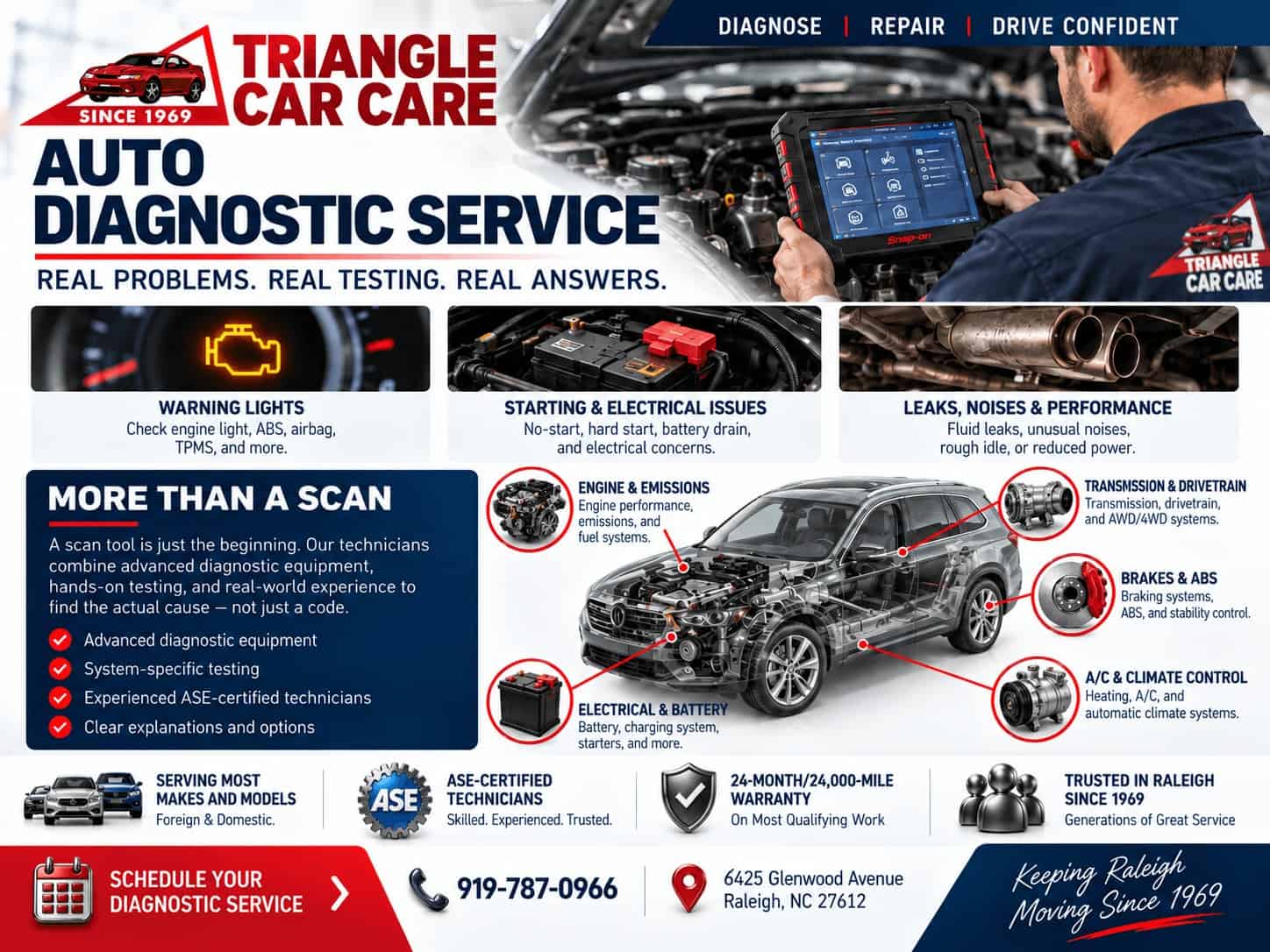
More Than Codes: A Vehicle Diagnostic Overview
This visual guide shows how warning lights, starting problems, electrical concerns, noises, leaks, performance symptoms, and different vehicle systems can lead to different diagnostic paths.
Start With What the Vehicle Is Doing
The timing, location, frequency, temperature, speed, load, and conditions surrounding a problem can be as useful as the symptom itself.
Narrow the Possibilities
Diagnostic information is most useful when it is compared with physical inspection and targeted tests related to the suspected system.
Let Evidence Guide the Repair
A repair recommendation should follow the available evidence rather than jumping directly from a symptom or code to a replacement part.
Why Some Diagnostic Problems Take More Investigation
A problem that is present all the time is often easier to observe than one that appears only under a narrow set of conditions. Intermittent symptoms may disappear before the vehicle arrives, occur only after a long drive, or require a particular temperature, speed, load, steering position, road surface, or electrical condition.
When possible, details about exactly when the problem happens can help narrow the diagnostic path.
One Symptom Can Point Toward Several Systems
These examples illustrate why remote diagnosis from a symptom alone can be unreliable.
| What You Notice | Possible Areas Involved | Best Starting Point |
|---|---|---|
| Vehicle will not start | Battery, connections, starting system, fuel, ignition, security, engine management, or mechanical condition. | Confirm whether the engine cranks and diagnose from there. |
| Vibration while driving | Tires, wheels, suspension, drivetrain, engine operation, mounts, brakes, or another rotating component. | Note vehicle speed, acceleration, braking, and steering conditions when it occurs. |
| Vehicle hesitates or lacks power | Fuel, ignition, airflow, exhaust, engine management, mechanical engine condition, transmission, or drivetrain. | Diagnosis should consider both operating data and the conditions under which the symptom occurs. |
| Fluid spot under the vehicle | Engine oil, coolant, transmission fluid, brake fluid, power-steering fluid on applicable vehicles, A/C water condensation, or another source. | Identify the fluid and source before assuming which component is leaking. |
| Warning light appears | Depends on the warning. Different lights represent different systems and different levels of urgency. | Follow the owner's manual and use the dedicated service page when the warning clearly identifies the system. |
| Fuel odor, smoke, major fluid loss, overheating, steering loss, or reduced braking ability | Potentially safety-critical or damage-sensitive conditions. | Stop when safely possible and arrange appropriate assistance rather than continuing to drive. |
Some Symptoms Should Not Wait for a Normal Diagnostic Appointment
If a vehicle has lost braking ability, loses steering control, displays an oil-pressure warning, is clearly overheating, produces smoke or a strong fuel odor, experiences major fluid loss, or becomes difficult to control, continuing to drive may increase risk or damage.
Reach a safe location when possible, follow the vehicle owner's manual, and arrange appropriate roadside or towing assistance when driving the vehicle would be unsafe.
No webpage can determine whether a specific vehicle is safe to continue driving without appropriate inspection.
Useful Details to Share Before Diagnostic Service
You do not need to diagnose the vehicle yourself. Simply describing what happened and when it happened can make the starting point clearer.
First start of the day, after warm-up, during acceleration, braking, turning, highway driving, or another repeatable condition.
Note new sounds, smells, vibrations, warning messages, loss of power, leaks, or changes in starting and drivability.
A recent repair, battery replacement, collision, jump-start, fluid service, accessory installation, or other change may be relevant.
If a warning message disappears before the appointment, a safe photo of the dashboard message or exact wording can sometimes be helpful.
Already Know Which System Is Causing the Concern?
This Diagnostic Service page is intentionally broad. When the primary symptom clearly belongs to a specific system, the dedicated service page provides more focused information and keeps each Triangle Car Care page aligned with a distinct search intent.
If the Check Engine Light Is the Main Concern, Use the Dedicated Page
The check engine light is one type of diagnostic concern, but it represents a distinct search intent from general vehicle diagnosis. OBD-II information can include trouble codes, freeze-frame data, readiness status, and other monitored information.
Those data points can help guide diagnosis, but they do not turn every check-engine-light concern into a general diagnostic-service query.
For a steady, flashing, recurring, or recently cleared check engine light, visit the dedicated Check Engine Light Diagnostic page .
Why Vehicle Diagnostic Cost Can Vary
There is no single diagnostic procedure for every problem, so the effort required can vary considerably. Generic national averages are not Triangle Car Care quotes.
A constant warning light may take a different path than a noise or failure that appears only once every few days.
System architecture, component access, module networks, and manufacturer procedures vary by vehicle.
Electrical measurements, mechanical checks, pressure testing, disassembly for access, or extended verification may affect the diagnostic scope.
A fault that is not currently present may require additional information or reproduction before the cause can be confirmed.
Local Driving Conditions Can Help Explain When a Symptom Appears
Raleigh drivers experience hot summer temperatures, stop-and-go traffic, short trips, highway driving, heavy rain, and changing road conditions. Those conditions do not diagnose a vehicle problem, but they can help explain when a symptom becomes repeatable.
Telling the technician that a concern appears only after sitting in traffic, only during highway acceleration, only on a cold start, or only during wet weather provides more useful context than simply saying the vehicle “acts strange.”
Vehicle Diagnosis From an Established Raleigh Auto Repair Shop
Triangle Car Care has served the Raleigh area since 1969 and operates one location at 6425 Glenwood Avenue, Raleigh, NC 27612. The shop provides maintenance, diagnosis, and repair services for most makes and models.
Triangle Car Care's published warranty information includes qualifying electrical, electronic engine-management, engine-performance, drivability, starting and charging, steering, suspension, and other repair categories. Warranty coverage depends on the specific qualifying work and applicable terms.
Auto Diagnostic Service Raleigh NC FAQs
Common questions about scan tools, warning lights, diagnostic testing, intermittent problems, costs, and what to expect from vehicle diagnosis.
What is automotive diagnostic service?
Automotive diagnostic service is the process of identifying the cause of a vehicle symptom before deciding what should be repaired. Depending on the concern, diagnosis may involve confirming the symptom, visual inspection, scan data, electrical measurements, mechanical checks, pressure testing, or other system-specific tests. The appropriate process varies by vehicle and problem.
Is reading a trouble code the same as diagnosing my car?
No. A diagnostic trouble code identifies a condition or monitored circuit detected by the vehicle's onboard system. It can provide an important clue, but it does not automatically prove that a specific component has failed. Scan data and codes often need to be compared with inspection and testing before a repair is recommended.
Can a car have a problem without storing a trouble code?
Yes. Not every mechanical, electrical, noise, vibration, leak, or drivability concern will necessarily store a diagnostic trouble code. ASE diagnostic task standards specifically include diagnosing drivability and emissions problems both with and without stored DTCs. The symptom and system determine what testing is appropriate.
What problems can automotive diagnostics help investigate?
Diagnostic service may help investigate starting problems, intermittent electrical issues, warning lights, rough running, hesitation, loss of power, unusual noises, vibration, leaks, odors, smoke, charging concerns, or other unexplained changes in vehicle behavior. These symptoms can have multiple possible causes and are not diagnoses by themselves.
Why are intermittent vehicle problems harder to diagnose?
Intermittent problems may not be present when the vehicle reaches the shop. Some appear only at a specific temperature, speed, load, road condition, steering position, or after a certain amount of driving. Details about when the symptom occurs can help reproduce the problem and narrow the diagnostic path.
Should I get a diagnostic test every year even if nothing is wrong?
There is no universal rule requiring every vehicle to receive a generic diagnostic scan once a year. Maintenance and inspection requirements vary by manufacturer, vehicle, age, use, and operating conditions. Follow the owner's manual for scheduled maintenance and seek diagnosis when a warning, symptom, inspection result, or manufacturer procedure calls for it.
What should I tell the technician about my vehicle problem?
Describe what you notice and when it happens. Useful details include whether the vehicle is hot or cold, the speed or engine load, whether you are braking or turning, how often the problem occurs, dashboard messages, recent repairs, and whether weather or road conditions seem to affect the symptom.
Does a check engine light mean I should use general diagnostic service?
A check engine light is a specific OBD-II and engine-management concern, so Triangle Car Care has a dedicated Check Engine Light Diagnostic page for that intent. General diagnostic service is broader and is most useful when the vehicle has an unexplained problem and the responsible system is not yet clear.
How long does vehicle diagnosis take?
There is no universal diagnostic time. A constant and easily reproduced problem may follow a different path from an intermittent electrical issue or symptom that appears only under specific conditions. Diagnostic time depends on the vehicle, symptom, testing required, access to the system, and whether the concern can be reproduced.
How much does auto diagnostic service cost in Raleigh?
Diagnostic cost depends on the vehicle, symptom complexity, testing required, accessibility, and whether the condition is intermittent. A generic national average is not a Triangle Car Care quote. The appropriate diagnostic scope depends on the specific vehicle and concern.
Can diagnostic testing tell me exactly which part to replace?
Sometimes testing can isolate a failed component, but diagnosis may also identify wiring, connections, mechanical conditions, power or ground problems, control issues, or interactions between systems. The purpose of diagnosis is to establish the cause with appropriate evidence rather than assume that a symptom or code automatically identifies the replacement part.
Does Triangle Car Care provide diagnostic service for most makes and models?
Triangle Car Care provides automotive diagnosis and repair for most makes and models from its Raleigh location at 6425 Glenwood Avenue. The specific tests and services appropriate for a vehicle depend on its design, symptoms, system involved, and diagnostic findings.
Something Is Wrong With Your Vehicle? Start With the Cause.
Contact Triangle Car Care when your vehicle has an unexplained warning, noise, vibration, leak, starting problem, electrical issue, drivability concern, or other symptom. The right repair begins with understanding what is actually happening.
Sources & Further Reading
- National Institute for Automotive Service Excellence — Automobile & Light Truck Study Guide
- U.S. Environmental Protection Agency — Performing On-Board Diagnostic System Checks
- U.S. Environmental Protection Agency — Vehicle Emissions Inspection and OBD Resources
- Triangle Car Care — About Us
- Triangle Car Care — Warranty Information


