


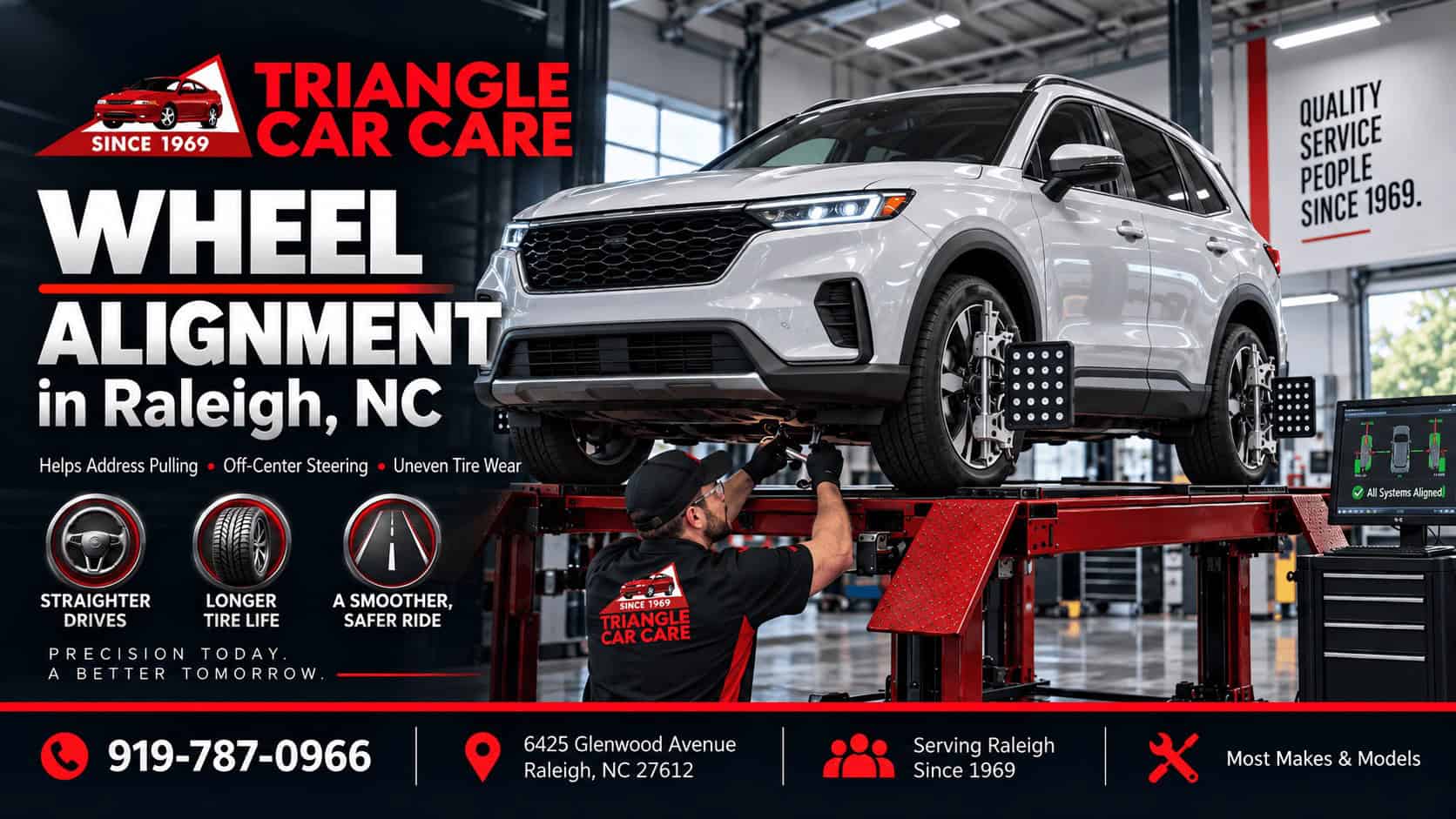
WHEEL ALIGNMENT IN RALEIGH, NC • STEERING & TIRE WEAR CHECKS • MOST MAKES & MODELS
Steering, Tire Wear & Vehicle Tracking
Wheel Alignment Service in Raleigh, NC
Wheel alignment measures how the wheels are positioned relative to the vehicle and compares those measurements with specifications for the specific vehicle. When applicable adjustments are outside specification, they can be corrected when the vehicle design and component condition allow it.
How Do You Know If Your Vehicle May Need an Alignment Check?
An alignment check may be appropriate if the vehicle consistently pulls or drifts on a reasonably straight, level road, the steering wheel remains noticeably off-center while traveling straight, certain uneven tire-wear patterns appear, or the vehicle behaves differently after a significant pothole or curb impact. These signs are reasons to inspect the vehicle, not proof that alignment is the only cause.
Serving Raleigh Since 1969
Local automotive maintenance and repair from our Glenwood Avenue location.
ASE-Certified Personnel
Alignment concerns considered alongside tire, steering, and suspension condition.
Most Makes & Models
Wheel alignment and related automotive service for many cars, trucks, and SUVs.
919-787-0966
Call or request an appointment online for wheel alignment service in Raleigh.
Alignment Fundamentals
What Is a Wheel Alignment?
Wheel alignment is the process of measuring wheel and suspension geometry and comparing the measurements with the specifications for the vehicle. Modern alignment equipment can measure extremely small differences in wheel position that cannot be judged accurately by simply looking at the tires.
If applicable angles are outside specification, adjustments may be made where the vehicle provides an adjustment and the steering and suspension components are in suitable condition.
Not every alignment angle is adjustable on every vehicle. If a non-adjustable measurement is significantly outside specification, the cause may involve a worn, bent, damaged, shifted, modified, or incorrect component rather than a simple adjustment.
The key idea: alignment should begin with measurement. The goal is not to make every displayed number identical; it is to compare the vehicle with the correct specifications and determine whether adjustment or further diagnosis is appropriate.
Understanding Alignment Measurements
Toe, Camber, and Caster Explained
These are three of the alignment measurements drivers hear about most often. Their correct values vary by vehicle, suspension design, ride height, and manufacturer specification.
Toe
Toe describes whether the front edges of paired wheels point slightly toward or away from one another when viewed from above. Excessive toe can contribute to tire scrub and irregular tread wear because the tires may not roll in precisely the intended direction.
Camber
Camber is the inward or outward tilt of the wheel when viewed from the front. Camber affects how the tire contacts the road, but the correct amount depends on the vehicle. An abnormal reading may sometimes point to suspension, ride-height, or component concerns.
Caster
Caster describes the steering-axis angle when viewed from the side of the vehicle. It can influence directional stability, steering return, and how the vehicle feels while traveling straight. Caster is not directly adjustable on every vehicle.

Triangle Car Care wheel alignment guide for Raleigh drivers covering alignment measurements, tire wear, steering symptoms, and suspension considerations.
Signs Your Vehicle May Need an Alignment Check
Alignment problems do not always produce an obvious symptom, and the symptoms below can have several possible causes. They are useful clues, but they should not be treated as a diagnosis by themselves.
Vehicle Pulls to One Side
A consistent pull or drift on a reasonably straight, level road can be associated with alignment. Tire pressure, tire construction, tire wear, brakes, suspension, steering, road crown, and other conditions can also affect directional behavior.
Steering Wheel Is Off-Center
If the vehicle travels straight but the steering wheel remains noticeably left or right of center, alignment may need to be checked. Previous repairs, tires, steering components, and suspension geometry may also influence steering-wheel position.
Uneven Tire Wear
Certain irregular wear patterns may be associated with alignment, but inflation pressure, tire design, suspension condition, rotation history, loading, and driving habits can also affect tread wear.
Pothole or Curb Impact
A significant impact can affect a tire, wheel, suspension component, steering component, or alignment. New pulling, vibration, tire-pressure loss, visible damage, or steering changes after an impact justify inspection.
Recent Suspension or Steering Work
Some steering and suspension repairs affect wheel position or alignment geometry. Depending on the component and procedure, an alignment check may be appropriate after the repair.
Changed Vehicle Behavior
If steering behavior changes noticeably after tire replacement, suspension work, an impact, or another event, alignment may be one of several areas worth checking.
What Can Cause Wheel Alignment to Change?
Alignment measurements can change because of impacts, component wear, repairs, changes in ride height, or damaged parts. The cause depends on the vehicle and what has happened to it.
| Possible Factor | Why It May Matter |
|---|---|
| Pothole or road impact | A severe impact may affect tires, wheels, steering parts, suspension parts, or alignment. |
| Curb contact | The effect depends on impact speed, angle, wheel position, and vehicle design. |
| Worn steering or suspension parts | Excessive movement can change wheel position or prevent the vehicle from holding alignment consistently. |
| Bent or damaged components | A wheel, control arm, strut, tie rod, mounting point, or other component may affect measurements if damaged. |
| Ride-height changes | Springs, worn components, modifications, loading, or incorrect parts can alter suspension geometry. |
| Previous repair work | Some steering, suspension, tire, wheel, or collision repairs can affect wheel positioning. |
What Happens During a Wheel Alignment?
1. Understand the Complaint
Pulling, steering-wheel position, tire wear, recent impacts, and previous repairs provide useful information before measurements are interpreted.
2. Consider Tire Condition
Tire pressure, tire wear, tire damage, and tire characteristics can influence how the vehicle behaves on the road.
3. Measure Alignment Angles
Alignment equipment measures applicable angles so they can be compared with specifications for the exact vehicle.
4. Adjust Where Appropriate
Adjustable angles can be corrected when appropriate and when the surrounding steering and suspension components are in suitable condition.
5. Review Final Measurements
Final readings can be reviewed after adjustments to verify the measured condition of the vehicle.
Why Suspension and Steering Condition Matter Before Alignment
Alignment depends on the components that locate and control the wheels. If a component has excessive movement, is bent, or is damaged, an alignment adjustment by itself may not address the underlying problem.
Depending on the vehicle, potentially relevant components can include tie rods, ball joints, control arms, bushings, struts, springs, steering components, wheel bearings, subframes, and mounting points.
If you are experiencing chassis or steering symptoms, learn more about Triangle Car Care's suspension and steering service .
Different Services, Different Purposes
Wheel Alignment vs. Tire Rotation vs. Wheel Balancing
Alignment, rotation, and balancing are often discussed together because they all involve tires and wheels, but they address different conditions. One service does not automatically mean the others are required.
| Service | What It Addresses | Common Reason to Consider It |
|---|---|---|
| Wheel Alignment | Measures and adjusts applicable wheel and suspension geometry. | Pulling, off-center steering, certain tire-wear patterns, suspension work, or road impacts. |
| Tire Rotation | Moves eligible tires to different positions on the vehicle. | Manufacturer-recommended tire maintenance intended to help distribute normal tread wear. |
| Wheel Balancing | Corrects mass imbalance within a tire-and-wheel assembly. | Vibration or tire and wheel service where balancing is appropriate. |
For routine tire-position maintenance, see our tire rotation service in Raleigh .
Front-End Alignment vs. Four-Wheel Alignment
The terms “front-end alignment” and “four-wheel alignment” are sometimes used loosely. The correct alignment procedure depends on the design of the vehicle.
Some vehicles primarily provide front alignment adjustments, while many modern suspension designs require the technician to consider the relationship between all four wheel positions. Rear-wheel measurements can influence thrust angle and how the vehicle tracks.
A “four-wheel alignment” does not necessarily mean every angle on every wheel is adjustable. If an angle is outside specification but the vehicle does not provide a normal adjustment for it, further diagnosis may be needed.
Will a Wheel Alignment Fix a Car That Pulls?
It can when alignment measurements are contributing to the directional problem, but a vehicle pull is not automatically an alignment diagnosis.
Manufacturer technical guidance has documented cases where tire-generated lateral force can cause a vehicle to pull even when alignment is not the underlying cause. Tire inflation, tread wear, tire construction, brakes, steering or suspension components, wheel condition, road crown, and vehicle loading can also influence directional behavior.
A pulling vehicle needs diagnosis, not guessing. Performing an alignment without identifying the cause may not resolve the complaint if the actual problem lies elsewhere.
Can Wheel Alignment Fix Steering-Wheel Vibration?
Vibration should not automatically be treated as an alignment problem. Wheel balance is one possible cause, but vibration may also involve tire damage, bent wheels, tire runout, wheel bearings, suspension components, brake-related conditions, drivetrain components, or other rotating parts.
NHTSA distinguishes wheel balancing from alignment: balancing addresses mass distribution in the wheel-and-tire assembly, while alignment concerns wheel geometry. If vibration is the main complaint, the pattern and conditions under which it occurs should help guide diagnosis.
Can Alignment Help With Uneven Tire Wear?
Correct alignment can help address alignment-related geometry that contributes to abnormal tire wear. However, an alignment cannot restore tread that has already worn away.
Uneven wear can also involve inflation pressure, tire condition, suspension components, wheel balance, rotation history, loading, vehicle use, and driving habits. The wear pattern should be interpreted alongside the condition of the vehicle.
If a tire already has severe irregular wear, correcting the underlying cause may help prevent additional abnormal wear, but the tire itself may still need replacement depending on tread depth, damage, and overall condition.
Raleigh Potholes, Curbs, and Road Impacts
Raleigh driving can include neighborhood streets, highway commuting, construction zones, pavement repairs, curbs, and occasional potholes. Those conditions do not create a universal Raleigh-specific alignment schedule.
What matters is how the individual vehicle responds after an impact. A hard pothole or curb strike can potentially affect tires, wheels, steering, suspension, or alignment.
If a significant impact is followed by a new pull, an off-center steering wheel, tire-pressure loss, visible tire or wheel damage, unusual vibration, or a change in handling, an inspection is appropriate.
How Often Should Wheel Alignment Be Checked?
There is no single calendar or mileage interval that applies to every vehicle. The appropriate time for an alignment check depends on the vehicle manufacturer, tire wear, steering behavior, suspension condition, road impacts, repair history, vehicle use, and other factors.
An alignment check may be reasonable when symptoms or tire wear appear, after certain steering or suspension repairs, after a significant road impact, or when manufacturer guidance recommends it.
When Alignment Alone May Not Be the Right Next Step
A sudden or severe steering problem should not automatically be treated as routine alignment. A damaged tire, bent wheel, broken suspension part, loose steering component, brake problem, or another mechanical condition may need attention first.
If steering control is significantly reduced, a tire is rapidly losing air, a wheel or tire is visibly damaged, or a suspension or steering component appears broken or displaced, avoid continuing to drive when doing so could be unsafe. Have the vehicle inspected before returning to normal operation.
Why Choose Triangle Car Care for Wheel Alignment in Raleigh?
Serving Raleigh Since 1969
Triangle Car Care provides automotive maintenance and repair from one Raleigh location at 6425 Glenwood Avenue.
Diagnosis Before Assumptions
Pulling, uneven tire wear, and steering concerns can have multiple causes, so alignment should be considered alongside tires, steering, suspension, brakes, and other relevant conditions.
Most Makes & Models
Triangle Car Care services most makes and models while using vehicle-specific specifications where applicable.
Triangle Car Care offers a 24-month/24,000-mile warranty on most qualifying work. Warranty applicability depends on the particular service or repair.
Schedule Wheel Alignment Service in Raleigh, NC
If your vehicle is pulling, wearing tires unevenly, sitting with an off-center steering wheel, or behaving differently after a pothole or curb impact, Triangle Car Care can help determine whether alignment or another tire, steering, or suspension condition needs attention.
Triangle Car Care
6425 Glenwood Avenue, Raleigh, NC 27612
Wheel Alignment FAQ
Frequently Asked Questions About Wheel Alignment
How do I know if my car needs a wheel alignment?
Possible signs include a persistent pull on a reasonably level road, an off-center steering wheel while traveling straight, or certain uneven tire-wear patterns. A significant pothole or curb impact can also justify an inspection. These signs do not prove misalignment because tires, brakes, steering, suspension, road crown, and other conditions can create similar symptoms.
How often should I get a wheel alignment?
There is no single alignment interval that applies to every vehicle. Follow manufacturer guidance and consider an alignment check when tire wear, steering behavior, suspension repairs, road impacts, or other vehicle conditions suggest one may be appropriate.
Will a wheel alignment stop my car from pulling?
It can when alignment measurements are contributing to the pull. However, tires, unequal inflation, brake drag, steering or suspension problems, wheel condition, loading, and road crown can also influence directional behavior. The cause should be identified before assuming alignment will correct it.
What are toe, camber, and caster?
Toe describes whether paired wheels point slightly toward or away from one another when viewed from above. Camber is the inward or outward wheel tilt when viewed from the front. Caster describes the steering-axis angle when viewed from the side. Correct specifications vary by vehicle.
Is wheel alignment the same as wheel balancing?
No. Wheel alignment concerns wheel and suspension geometry. Wheel balancing corrects mass imbalance in a tire-and-wheel assembly. Vibration is commonly associated with balance or rotating-component issues, while alignment can influence tracking and certain tire-wear patterns.
Is wheel alignment the same as tire rotation?
No. Tire rotation moves eligible tires to different positions on the vehicle to help distribute normal tread wear. Alignment measures and, where possible, adjusts wheel angles. Rotating tires does not correct an alignment problem.
Do I need an alignment after hitting a pothole?
Not automatically. A severe pothole impact can affect tires, wheels, steering, suspension, or alignment. If new pulling, vibration, tire-pressure loss, steering-wheel position changes, visible damage, or unusual tire wear appears afterward, the vehicle should be inspected.
Can worn suspension parts affect wheel alignment?
Yes. Components that locate and control the wheels can affect alignment measurements and the vehicle's ability to maintain alignment. Loose, worn, bent, or damaged parts may need repair before final alignment adjustments are made.
Can wheel alignment fix uneven tire wear?
Alignment can correct alignment-related geometry that may contribute to abnormal wear, but it cannot restore tread that has already worn away. Tire pressure, tire condition, suspension, balance, rotation history, loading, and driving habits can also influence tire wear.
Where can I get a wheel alignment in Raleigh, NC?
Triangle Car Care provides wheel alignment and related automotive services at 6425 Glenwood Avenue in Raleigh, North Carolina. Call 919-787-0966 or request an appointment online.


