


Transmission Repair in Raleigh, NC
Triangle Car Care provides transmission repair Raleigh NC drivers can turn to for slipping, delayed engagement, harsh or abnormal shifting, shuddering, transmission-fluid concerns, warning lights and other changes in vehicle operation.
The transmission helps manage the relationship between engine output, vehicle speed and torque delivered through the driveline. Modern designs vary widely, so a symptom that feels like a transmission failure does not automatically prove that an internal transmission component has failed.
Diagnosis may need to consider fluid condition and level, electrical controls, sensors, solenoids, hydraulic operation, mechanical condition, engine performance, mounts, axles, driveline components and other vehicle-specific factors.
Triangle Car Care services most makes and models from its Raleigh location at 6425 Glenwood Avenue. The repair path depends on the vehicle design and what inspection and testing actually find.
Signs That May Point Toward a Transmission Concern
Transmission repair Raleigh NC drivers search for often begins with a change in shifting, engagement, acceleration, sound or fluid condition. These symptoms can overlap with other vehicle systems, so they should be treated as clues rather than automatic diagnoses.
Slipping or Engine Flare
Engine speed that rises without the expected increase in vehicle speed can be associated with transmission operation, but the cause still needs to be confirmed.
Delayed Engagement
A noticeable delay after selecting Drive or Reverse can involve fluid, hydraulic, electronic, mechanical or other transmission-related conditions.
Harsh or Abnormal Shifting
Firm, abrupt, mistimed or inconsistent shifts can have mechanical, hydraulic, electronic or engine-management influences.
Shuddering or Vibration
A shudder under load can involve transmission operation, but tires, mounts, axles, driveline components and engine performance can also create vibration.
Fluid Leaks
Transmission fluid can leak from several locations. Fluid color varies by product and condition, so the source should be identified instead of relying on color alone.
Warning Lights or Messages
Transmission or powertrain warnings can store useful diagnostic information, but a code identifies a detected condition rather than proving a specific repair.
Whining, Grinding or Clunking
Noises can originate from the transmission, differential, drivetrain, wheel assemblies, mounts, engine accessories or other components.
Poor or Unexpected Acceleration
Reduced acceleration can involve the transmission, but fuel, ignition, airflow, engine management, mechanical engine condition and drivetrain operation can produce similar complaints.
Burning Odor or Excess Heat
A burning smell can have several automotive sources. Smoke, major fluid loss or a strong worsening odor deserves conservative attention.
Some Transmission Symptoms Should Not Be Driven Through
A minor shift-quality change and a vehicle that suddenly loses propulsion are not the same situation. No webpage can determine whether a specific vehicle is safe to continue driving without appropriate inspection.
- Sudden loss of propulsion: reach a safe location when possible and arrange assistance.
- Vehicle will not remain in gear or move normally: do not repeatedly force operation in an attempt to keep driving.
- Unexpected rolling or Park does not hold: treat the condition as a safety concern and secure the vehicle appropriately.
- Severe grinding, banging or rapidly worsening operation: continuing to drive can increase the chance of additional damage.
- Major fluid loss, smoke or strong burning odor: stop when safely possible and arrange appropriate assistance.
- Vehicle becomes difficult to control: prioritize reaching a safe location rather than continuing a normal trip.
Not Every Transmission Operates the Same Way
Transmission design affects normal operating feel, fluid requirements, diagnostic procedures and maintenance. A recommendation that is appropriate for one transmission may be wrong for another.
Stepped Automatic Transmissions
Many conventional automatics use planetary gearsets, hydraulic controls and a torque converter, but designs and control strategies vary significantly by vehicle.
Continuously Variable Transmissions
CVTs can operate differently from stepped automatics and may require dedicated fluid specifications, service procedures and diagnostic interpretation.
Dual-Clutch Designs
Some vehicles use electronically controlled clutch and gear systems that should not be diagnosed or serviced as though they were a conventional torque-converter automatic.
Hybrid & Vehicle-Specific Transaxles
Hybrid and electrified vehicles can use specialized transaxle arrangements with operating principles and fluids that differ from conventional transmissions.
Vehicle-Specific Information Matters
Triangle Car Care services most makes and models, but the exact transmission design, fluid, checking procedure, maintenance schedule and repair options should be identified for the specific vehicle before service decisions are made.
How a Transmission Concern May Be Diagnosed
Good transmission repair Raleigh NC service starts by understanding exactly when the problem happens and then narrowing the possible causes with vehicle-appropriate inspection and testing.
Confirm the Complaint
Determine whether the concern is slipping, delayed engagement, harsh shifting, shuddering, a warning message, a leak or another operating change.
Inspect & Gather Information
Review relevant fluid condition, visible leaks, electrical data, trouble codes, mounts, wiring and other evidence that applies to the vehicle.
Test the Likely Causes
Depending on the transmission, diagnosis can involve electrical, hydraulic, mechanical, pressure, temperature or functional testing.
Explain the Repair Path
Once the evidence supports a cause, appropriate maintenance, repair, further testing or replacement options can be discussed.
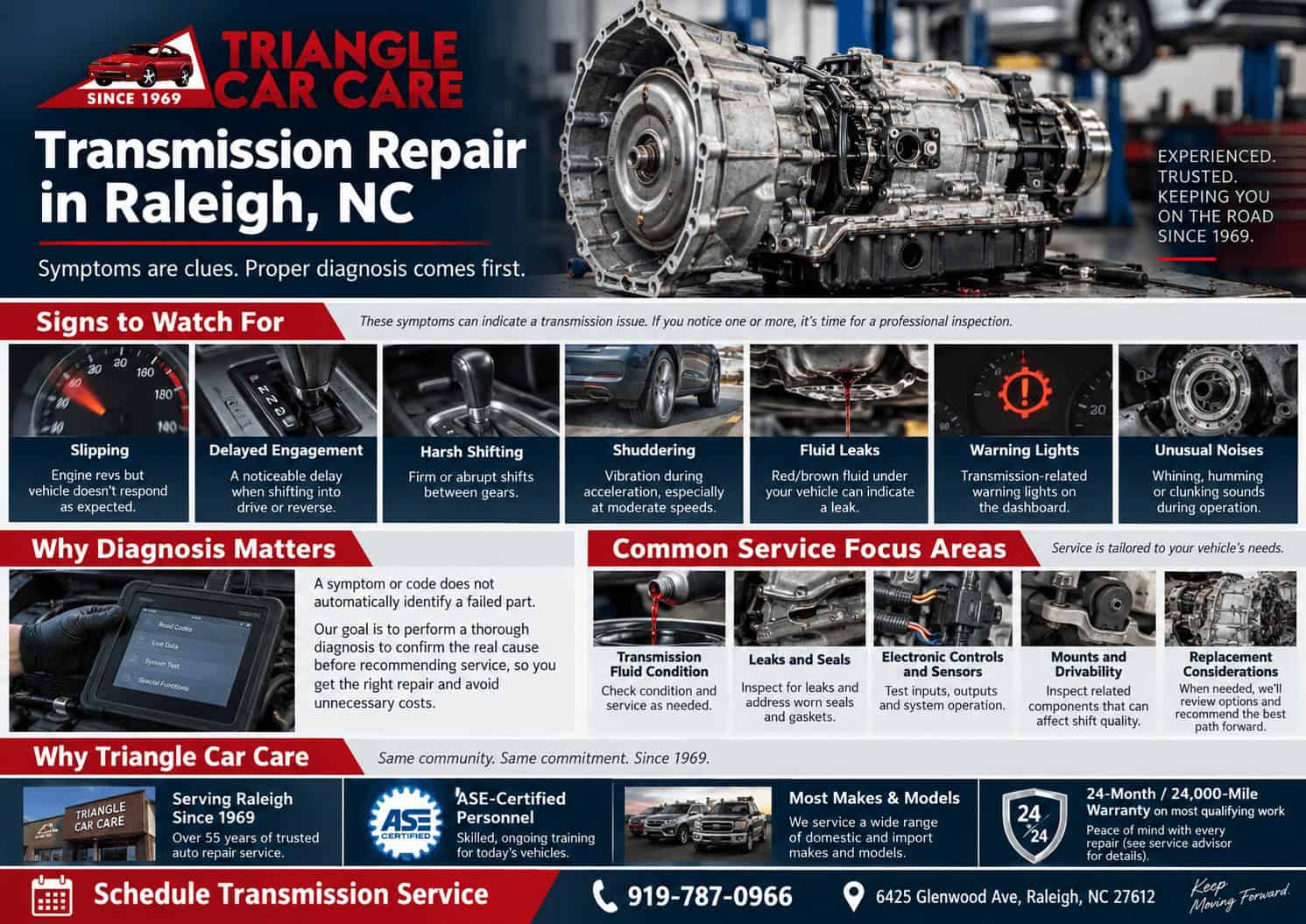
Transmission Warning Signs, Diagnosis & Service
This visual guide covers common symptoms, diagnosis and service areas. It is educational and cannot identify the cause of a problem in a specific vehicle.
Describe What Changed
Tell the shop whether the concern happens cold, hot, during light throttle, under acceleration, at highway speed or when selecting a gear.
Narrow the Cause
Codes, fluid condition and a test drive can provide clues, but targeted inspection and measurements may still be needed.
Match the Repair to the Evidence
Maintenance, external repair, further diagnosis or replacement should follow confirmed findings rather than assumptions.
Does Rising Engine Speed Mean the Transmission Is Slipping?
A driver may describe “slipping” when engine speed rises more than expected without a matching increase in road speed. On some transmissions, that can point toward a transmission concern. However, transmission design matters, and some CVTs intentionally allow engine speed to behave differently from a traditional stepped automatic.
Poor acceleration can also involve engine performance, traction-control intervention, drivetrain problems or other vehicle systems. The symptom should be reproduced and evaluated before deciding the transmission requires internal repair or replacement.
A Delay Into Drive or Reverse Deserves Diagnosis
If a noticeable delay develops after selecting Drive or Reverse, useful diagnostic details include whether it happens only when cold, after the vehicle is hot, every time, intermittently or after the vehicle has been parked for a particular length of time.
Depending on the transmission, possible areas can include fluid level or condition, hydraulic pressure, electrical controls, solenoids, internal mechanical operation or another vehicle-specific issue.
A Hard Shift Does Not Automatically Mean the Transmission Needs Replacement
Harsh shifting can result from several categories of problems. ASE's current Automatic Transmission/Transaxle material reflects the need to understand hydraulic operation, pressure, sensors, electronic controls, torque-converter operation and mechanical transmission components.
Engine-management data can also influence shift behavior on some vehicles. That means a transmission-related complaint can sometimes require diagnosis beyond the transmission housing itself.
Not Every Vibration Is a Transmission Failure
A vibration during acceleration can feel as though it comes from the transmission because the transmission and drivetrain are carrying load at that moment.
Depending on when the vibration appears, diagnosis may also need to consider engine operation, mounts, CV axles, driveshafts, differentials, tires, wheels or another rotating component.
Note whether the vibration follows engine speed, road speed, acceleration, deceleration, gear selection or a particular operating temperature. Those details can help separate transmission symptoms from related systems.
Fluid Color Alone Does Not Identify a Transmission Leak
Transmission fluids can be red, amber, brown or other colors depending on the product, age and transmission design. Other vehicle fluids can also appear similar once they are dirty or spread across underbody components.
A useful leak inspection identifies the fluid and where it is escaping. Depending on the vehicle, possible leak locations can include seals, gaskets, cooler lines, fittings, pans, cases or other transmission components.
A significant loss of transmission fluid can affect lubrication, hydraulic operation and transmission behavior. If the leak is large or the vehicle begins shifting abnormally, avoid repeatedly driving it to “see if it gets better.”
A Trouble Code Identifies a Detected Condition, Not a Failed Part
Modern transmission and powertrain modules can monitor electrical, hydraulic, speed, temperature and operating conditions. When a monitored value falls outside the expected range, a trouble code or warning message may be stored.
That information can narrow the investigation, but it still must be interpreted. A code naming a circuit, ratio, pressure condition, speed sensor or shift performance issue does not automatically prove the component named in the code needs replacement.
Transmission Fluid Service Must Match the Vehicle
There is no single transmission fluid, level-check procedure, service method or replacement interval that applies to every vehicle.
Correct Fluid Specification
Different transmissions require different friction characteristics and fluid specifications. A fluid should be selected according to the applicable vehicle information rather than appearance alone.
Correct Level Procedure
Some vehicles use a dipstick; others require checking fluid through plugs at a specified temperature or operating condition. Procedures vary.
Correct Service Method
Depending on manufacturer guidance and transmission design, appropriate service may involve a drain-and-fill, fluid exchange or another vehicle-specific procedure.
Correct Maintenance Interval
Maintenance schedules can depend on the exact vehicle, transmission and operating conditions. Follow the applicable manufacturer schedule rather than a universal mileage rule.
Fluid Condition
Fluid condition can provide useful information, but color or odor by itself does not prove the internal condition of every transmission.
Leaks Before Service
If the transmission is low because of a leak, identifying the source may be more important than simply adding fluid.
Why Fluid Specification Matters
Manufacturer documentation illustrates how specific modern transmissions can be. For example, Honda specifies HCF-2 for certain CVT applications and warns against mixing other transmission fluids. Other vehicles use different products and procedures. The point is not that every vehicle uses Honda fluid—it is that the exact vehicle determines the correct fluid.
There Is No Universal Transmission Fluid Change Interval
Maintenance requirements can vary by manufacturer, model year, transmission design and operating conditions. Some manufacturers use maintenance-monitor systems, while others publish mileage- or time-based schedules.
Severe or specialized operating conditions may also change maintenance recommendations on certain vehicles. The appropriate schedule should come from information that applies to the exact vehicle rather than a generic rule such as “every 30,000 miles.”
One Symptom Can Point Toward Several Systems
These examples help explain why transmission repair Raleigh NC diagnosis should start with the conditions surrounding the symptom.
| What You Notice | Possible Areas Involved | Why Testing Matters |
|---|---|---|
| Engine revs rise but acceleration feels weak | Transmission operation, engine performance, traction control, drivetrain or another power-delivery concern. | The symptom alone does not prove internal transmission failure. |
| Delay when selecting Drive or Reverse | Transmission fluid, hydraulic operation, electronic control, solenoids, internal operation or another condition. | Temperature and frequency can help narrow the cause. |
| Hard or abrupt shift | Transmission controls, sensors, hydraulic pressure, solenoids, internal components or engine-management inputs. | A hard shift does not automatically mean replacement is required. |
| Vibration under acceleration | Transmission, torque-transfer components, engine operation, mounts, axles, driveshafts, tires or wheels. | Road speed, engine speed and load provide useful clues. |
| Fluid spot under vehicle | Transmission, engine, cooling system, brake system or another fluid source. | Identify the fluid and leak source before deciding what needs repair. |
| Vehicle suddenly loses propulsion or will not move normally | Transmission, drivetrain, axle, engine or another major power-delivery problem. | Reach a safe location when possible and arrange appropriate assistance. |
Transmission, Drivetrain, Engine or General Diagnosis?
Similar symptoms can come from different systems. Using the most specific service page helps keep the diagnostic starting point clear.
Transmission Repair
Use this page for slipping, delayed engagement, abnormal shifts, transmission-fluid concerns, transmission warnings and confirmed transmission replacement needs.
Drivetrain Repair
Use the Drivetrain Repair page for CV axles, CV joints, driveshafts, differentials, transfer cases and related driveline concerns.
Engine Repair
Hesitation, weak acceleration and unusual noises can also begin with engine operation. Visit Engine Repair when the concern is primarily engine-related.
Diagnostic Service
If it is not clear which system is responsible, start with Diagnostic Service rather than guessing.
When Is Transmission Replacement Considered?
Triangle Car Care's current service information lists transmission replacement among its auto-repair services. Replacement is not the correct conclusion for every slipping, code or shift-quality complaint.
Whether replacement is appropriate depends on the confirmed condition, available repair options, vehicle design, extent of damage, parts availability and the overall repair scope.
A replacement decision should follow diagnosis rather than being assumed from a warning light or symptom alone.
Local Driving Conditions Can Help Explain When a Symptom Appears
Raleigh driving can include summer heat, stop-and-go traffic, short trips, long commutes and sustained highway operation. Those conditions do not diagnose a transmission problem, but they can change when a developing symptom becomes noticeable.
Telling the shop that a concern appears only after sitting in traffic, only during highway acceleration, only on the first cold start or only after an extended drive can be more useful than simply saying the transmission “acts strange.”
Why Transmission Repair Cost Can Vary
A generic national price range is not a Triangle Car Care quote. Transmission cost depends on the actual diagnosis, vehicle design and repair scope.
Conventional automatic, CVT, dual-clutch and other transaxle arrangements can involve different parts and procedures.
A fluid-service need, leak, sensor or control issue and a replacement transmission represent very different repair scopes.
Vehicle layout, component access, mounts, cooler lines and related components can affect the work required.
Replacement components, fluids, programming or calibration needs where applicable, and verification requirements vary by vehicle.
Diagnosis Comes Before a Meaningful Estimate
“My transmission is slipping” does not establish whether the vehicle needs fluid service, an electrical repair, an external transmission repair, additional testing or replacement. A useful estimate depends on identifying the actual repair scope first.
Transmission Service From an Established Raleigh Auto Repair Shop
Triangle Car Care has served the Raleigh area since 1969 and operates one location at 6425 Glenwood Avenue, Raleigh, NC 27612. The shop provides maintenance, diagnosis and repair for most makes and models.
Triangle Car Care's published service information includes transmission maintenance and transmission replacement. The appropriate service depends on the specific transmission and diagnostic findings.
Triangle Car Care also publishes a 24-month / 24,000-mile TechNet warranty for most qualifying work. Warranty applicability depends on the particular repair and applicable terms, so ask whether coverage applies to the work being performed.
Related Vehicle Services in Raleigh
Transmission Repair Raleigh NC FAQs
Common questions about slipping, delayed engagement, transmission fluid, warning lights, shuddering, replacement and diagnosis.
What are common signs of a transmission problem?
Possible signs include slipping, delayed engagement, harsh or irregular shifting, shuddering, warning lights, fluid leaks, unusual noises or changes in acceleration. These symptoms are not specific to one failed part, and some can come from engine, drivetrain or electronic-control problems. Inspection and vehicle-specific testing are needed before deciding what repair is appropriate.
Does transmission slipping mean I need a new transmission?
No. A slipping sensation can have several possible causes, and different transmission designs behave differently. Fluid condition, hydraulic operation, electrical controls, sensors, solenoids, mechanical components, engine performance or other conditions may need to be evaluated. Transmission replacement should follow diagnosis rather than being assumed from the symptom alone.
Why is there a delay when I shift into Drive or Reverse?
Delayed engagement can involve fluid level or condition, hydraulic pressure, electronic controls, solenoids, mechanical transmission operation or another vehicle-specific condition. Whether the delay occurs when the vehicle is cold, hot, every time or only intermittently can help guide the diagnostic process.
Why is my transmission shifting hard?
Harsh shifting can involve transmission controls, sensors, solenoids, hydraulic pressure, mechanical components, fluid condition or engine-management inputs. A hard shift by itself does not prove that the complete transmission has failed. The vehicle should be evaluated according to its specific transmission design and operating conditions.
Does a transmission trouble code tell me which part to replace?
No. A diagnostic trouble code identifies a condition the vehicle detected in a monitored system or circuit. It does not automatically prove that the component named in the code is defective. Codes, live data, electrical testing, fluid information and other transmission-specific checks may be needed to determine the cause.
How often should transmission fluid be changed?
There is no universal transmission-fluid interval for every vehicle. The correct schedule depends on the year, make, model, transmission design, manufacturer recommendations and sometimes operating conditions. Some vehicles use maintenance-monitor systems while others publish specific intervals. Follow information applicable to the exact vehicle rather than a generic mileage rule.
Can any automatic transmission fluid be used in my vehicle?
No. Modern transmissions can require highly specific fluid formulations. CVTs, conventional automatics, dual-clutch designs, hybrids and other transmissions may use different fluids. The correct product should meet the specification required for the exact vehicle and transmission rather than being chosen by fluid color or a generic label.
Is a transmission fluid exchange appropriate for every vehicle?
Not necessarily. Transmission-fluid service should follow the applicable manufacturer information, transmission design, condition and service procedure. Some vehicles may use a drain-and-fill, fluid exchange or another procedure. The correct method and fluid should be determined for the specific vehicle rather than applying one universal service to every transmission.
Can a transmission problem cause shuddering or vibration?
Yes, a transmission-related condition can contribute to shuddering, but transmission problems are not the only possibility. Engine operation, mounts, CV axles, driveshafts, tires, wheels and other drivetrain components can also cause vibration. When the vibration occurs and whether it follows engine speed, road speed or load are useful diagnostic clues.
How much does transmission repair Raleigh NC service cost?
Cost depends on the vehicle, transmission design, confirmed problem, required diagnosis, parts, fluid, labor access and whether the appropriate solution is maintenance, repair, additional testing or replacement. A generic national average is not a Triangle Car Care quote. The repair scope should be established before a meaningful estimate is provided.
Does Triangle Car Care replace transmissions?
Triangle Car Care's current service information lists transmission replacement among its automotive repair services. Whether replacement is appropriate depends on the vehicle, diagnosis, parts requirements and available repair options. A slipping symptom, warning light or trouble code alone does not automatically mean the transmission needs replacement.
Does Triangle Car Care service transmissions on most makes and models?
Triangle Car Care provides automotive maintenance, diagnosis and repair for most makes and models from its Raleigh location at 6425 Glenwood Avenue. Transmission service depends on the specific vehicle design, fluid or parts requirements, diagnostic findings and scope of work.
Need Transmission Repair in Raleigh?
Triangle Car Care provides transmission repair Raleigh NC drivers can turn to for shifting concerns, transmission-fluid service, diagnostic evaluation and transmission replacement when appropriate. The right starting point is identifying what the vehicle is actually doing and why.
Visit Triangle Car Care at 6425 Glenwood Avenue, Raleigh, NC 27612, request an appointment online or call 919-787-0966.
Sources & Further Reading
- National Institute for Automotive Service Excellence — 2026 Automobile & Light Truck Study Guide
- National Institute for Automotive Service Excellence — Automobile Test Series
- Honda Owner Information — Transmission Fluid Specifications
- Honda Owner Information — Maintenance Minder Transmission Fluid Guidance
- Triangle Car Care — Diagnostic Service
- Triangle Car Care — Drivetrain Repair
- Triangle Car Care — Auto Repair Services
- Triangle Car Care — TechNet Nationwide Warranty


