


Ford Repair in Raleigh, NC
Triangle Car Care provides Ford maintenance, diagnostics, and repair services for many supported Ford cars, trucks, and SUVs in Raleigh, North Carolina. Whether you're planning routine maintenance, noticing a new warning light, or dealing with changes in braking, handling, engine performance, or shifting, our team can help determine the appropriate next step.
Serving Raleigh drivers since 1969, our independent repair shop emphasizes accurate diagnosis, vehicle-specific maintenance, clear explanations, and practical repair recommendations. Service availability depends on your Ford's model year, configuration, and requested work.
Ford Maintenance and Repair Begins With Understanding Your Vehicle
Ford vehicles are available with a wide range of engines, transmissions, drivetrains, electronic systems, and equipment. The same warning light or driving symptom can mean different things depending on the Ford you're driving.
A rough idle doesn't necessarily mean a spark plug has failed. A delayed shift doesn't automatically mean the transmission needs replacement. And a charging-system warning doesn't prove that the alternator is the source of the problem.
Appropriate diagnostic testing helps separate possible causes from verified findings. For routine maintenance, the right starting point is the manufacturer's guidance for the exact model year, engine, and operating conditions.
When contacting Triangle Car Care, provide your vehicle's year, model, engine or powertrain if known, current mileage, and a description of the concern. Our team can discuss the service request and confirm whether the work is within shop capabilities.
Ford Repair, Diagnostics, and Preventive Maintenance Services
From everyday maintenance to investigating performance changes, Triangle Car Care offers a range of automotive services that may be appropriate for supported Ford vehicles.
The required inspection, repair method, components, fluids, and procedures depend on the specific vehicle. Contact us to confirm availability for the service you need.
Oil Changes & Maintenance
Oil and filter service, maintenance checks, and service planning based on the applicable Ford owner's manual, vehicle condition, mileage, and use.
Explore oil change service →Brake Inspection & Repair
Grinding, squealing, vibration, pulling, brake warnings, and pedal changes may require inspection of friction, hydraulic, or electronic braking components.
Explore brake repair →Engine Diagnostics & Repair
Hard starting, rough running, reduced power, unusual noise, or performance concerns may involve fuel, ignition, airflow, mechanical, or electronic-control systems.
Explore engine repair →Transmission Service & Repair
Delayed engagement, harsh shifts, transmission warnings, or changes in drivability may require checks of fluid condition, control systems, or components.
Explore transmission repair →Air Conditioning Repair
Weak cooling, intermittent operation, poor airflow, or unusual A/C noises can involve refrigerant, electrical, airflow, or mechanical conditions.
Explore A/C repair →Cooling System Repair
Temperature warnings, coolant loss, visible leaks, or heater problems may require evaluation of cooling-system components and operating conditions.
Explore cooling system repair →Steering & Suspension
Loose steering, uneven tire wear, clunking, excessive bouncing, or handling changes may indicate steering, suspension, or related tire concerns.
Explore steering and suspension →Battery & Electrical Concerns
Slow cranking, electrical warnings, intermittent starting, or repeated battery discharge may require testing of multiple related systems.
Explore battery service →Check Engine Light Diagnosis
A trouble code identifies a detected condition, not a proven failed part. Vehicle information and additional testing may be needed to establish the actual cause.
Explore warning-light diagnosis →Which Ford Vehicles Can Triangle Car Care Service?
Triangle Car Care provides repair and maintenance for many Ford vehicles. However, the vehicle name alone does not establish whether every system, engine, configuration, or repair is supported.
The model examples below help owners describe their vehicles when requesting service. They do not represent a guarantee that every version or requested repair is available.
Ford Cars
Cars may differ considerably by engine, transmission, age, and equipment. Contact the shop about the exact service required for your vehicle.
Ford SUVs & Crossovers
Drivetrain, braking, cooling, suspension, and electronic systems can vary by generation and configuration. Confirm service availability before scheduling.
Ford Light-Duty Pickups
Truck maintenance requirements can depend on engine choice, drivetrain, operating conditions, towing use, and vehicle configuration. Certain work may require additional capability confirmation.
A model badge does not determine maintenance intervals or repair procedures. Be ready to provide the model year, engine, drivetrain, and symptoms. Use the correct Ford owner's manual to identify applicable requirements.
What Ford Symptoms Should You Have Checked?
A symptom helps guide diagnosis, but no warning light, noise, leak, or drivability change identifies its cause by itself.
Check Engine Light
A steady warning may indicate a monitored fault requiring evaluation. A flashing light can signal a more urgent condition, especially with severe shaking or substantial power loss.
Brake Noise or Changed Pedal Feel
Squealing, grinding, vibration, pulling, or a pedal that feels different may arise from several braking-system conditions. Reduced braking requires urgent attention.
Rough or Delayed Shifting
Harsh shifts, slipping sensations, or delays in engagement may be caused by mechanical, hydraulic, or electronic conditions. Diagnosis is necessary.
Engine Temperature Warnings
Coolant loss, leaks, fan problems, restricted flow, or other conditions may contribute to overheating. Continued driving may damage the engine.
Starting & Charging Problems
Slow starting, intermittent no-start conditions, or charging warnings can involve the battery, connections, charging system, or related controls.
Vibration or Handling Changes
Wheel and tire conditions, brakes, drivetrain components, suspension, or steering faults may contribute to vibration or unstable handling.
When Should You Stop Driving Your Ford?
Stop in a safe location as soon as practicable if you experience a loss of braking or steering control, serious overheating, an oil-pressure warning, significant smoke, a strong fuel odor, or major fluid loss. Arrange towing when further driving may be unsafe.
A flashing check engine light with severe shaking or major power loss also calls for urgent attention. Follow the safety instructions in your vehicle's owner's manual. No page or remote description can establish that a vehicle is safe to continue driving.
How Is a Ford Vehicle Problem Diagnosed?
The proper diagnostic process depends on the concern and vehicle. Accurate testing can prevent conclusions based only on a warning light or assumed component failure.
Describe the Concern
Information about when the problem started, which conditions trigger it, recent work, dashboard warnings, and changes in vehicle performance helps establish the initial diagnostic direction.
Inspect Relevant Systems
Depending on the concern, evaluation may involve inspecting visible components, checking fluid conditions, reviewing service history, or obtaining available onboard diagnostic information.
Use Appropriate Testing
Additional electrical, mechanical, cooling-system, or other system-specific tests may help confirm or rule out potential causes. A code scan by itself is not a complete diagnosis.
Discuss Findings & Next Steps
Once the evidence supports a diagnosis, the recommended service can be discussed in the context of the actual vehicle, repair requirements, and applicable authorization or warranty considerations.
For example, a code related to an engine sensor might require checks of wiring, connectors, supply voltage, airflow, operating conditions, or other components. Replacing the part named in a code description without confirming the cause may not resolve the concern.
Ford Maintenance, Repair Services & Warning Signs at a Glance
This landscape infographic illustrates common automotive repair categories and symptoms worth discussing with a repair professional. It is general education, not a diagnosis or a statement that every Ford vehicle or repair is supported.
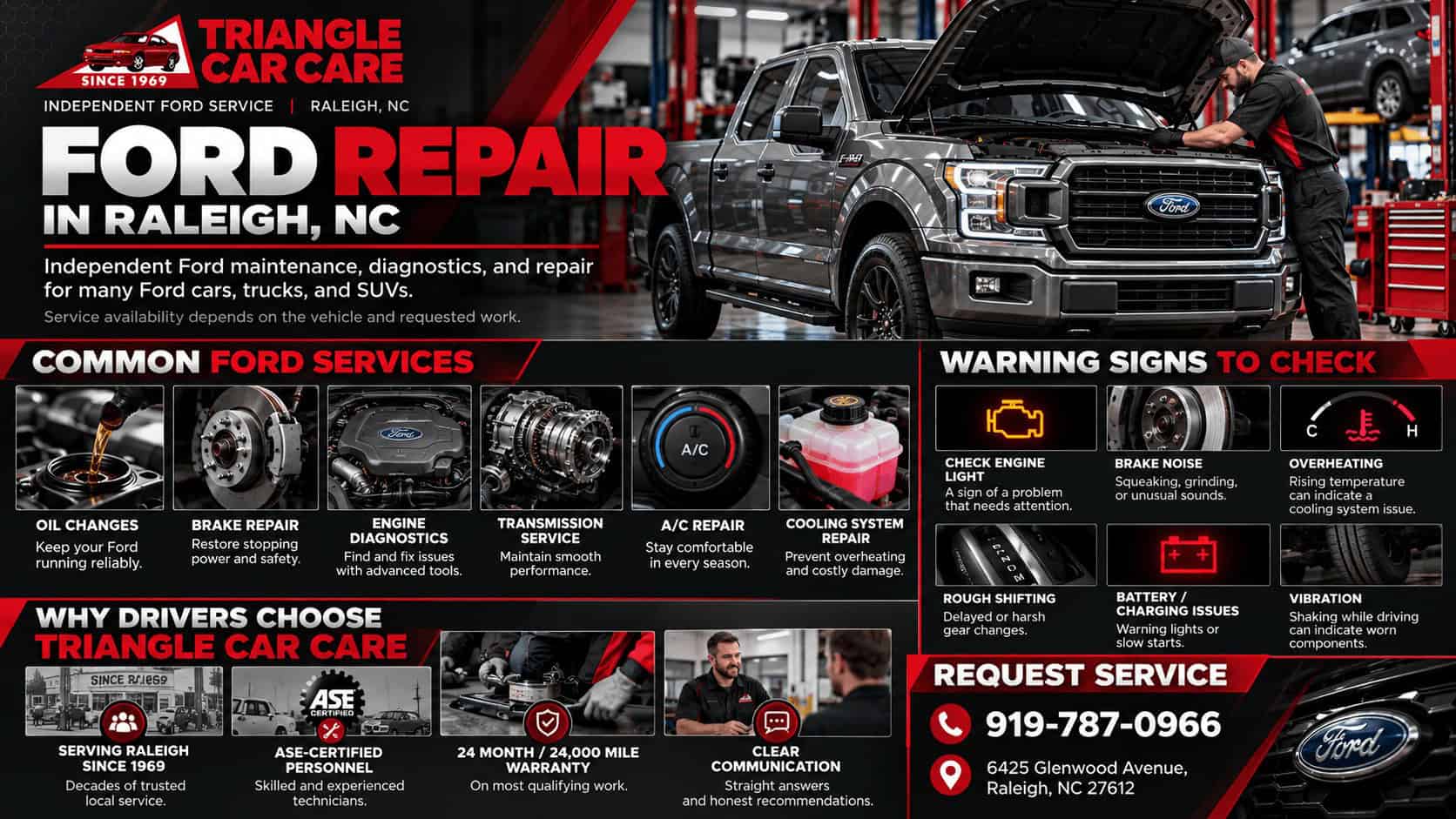
Vehicle eligibility, repair availability, and warranty coverage require confirmation for the specific service.
How Often Does Your Ford Need Maintenance?
The correct maintenance schedule depends on your Ford's model year, engine, drivetrain, equipment, and driving conditions. There is no single oil-change, fluid-replacement, or inspection interval appropriate for every Ford vehicle.
Many Ford vehicles provide an Intelligent Oil-Life Monitor or other maintenance information. Follow your particular owner's manual for how those systems work, what actions are required after a service, and any maximum time or mileage limits. An oil-life indicator does not replace checking the oil level when directed.
For Raleigh drivers, frequent stop-and-go traffic, short trips, summer heat, longer highway commutes, and towing may influence vehicle use. Whether a different maintenance schedule applies should be determined using Ford's instructions for the exact vehicle and operating conditions.
| Service Area | What to Monitor | How Service Is Determined |
|---|---|---|
| Oil and filter | Oil level, oil-life messages, service records. | Ford schedule and correct oil specification. |
| Brakes | Pad wear, noise, pedal changes, brake warnings. | Inspection results and vehicle guidance. |
| Tires | Inflation, tread wear, vibration, tire condition. | Vehicle tire information and inspection. |
| Transmission | Leaks, operating symptoms, maintenance history. | Correct fluid specification and model schedule. |
| Cooling system | Coolant level, temperature warnings, leaks. | Vehicle-specific coolant and service requirements. |
| Battery and charging | Slow starts, warnings, abnormal discharge. | Electrical testing when indicated. |
| Filters, belts and hoses | Wear, leaks, airflow concerns, service history. | Scheduled service and documented condition. |
| Steering and suspension | Noise, uneven tire wear, steering changes. | Inspection findings and applicable specifications. |
Why Ford Maintenance Schedules Vary
A Ford used primarily for local errands may operate differently from a similar vehicle that spends long periods on highways. Frequent towing, heavy loading, extensive idling, or operating conditions identified in the manual may change recommended service. The actual schedule must be checked against the vehicle's configuration and use.
Ford engines and drivetrains also differ in the type and quantity of required fluids, filter design, cooling-system requirements, and service procedures. Using an unsuitable fluid or an incorrect procedure may cause problems rather than prevent them.
What Determines the Right Repair for a Ford?
Two Ford vehicles with similar symptoms may require different testing, components, or repair procedures. The right decision depends on findings, not generic claims about what always goes wrong on a model.
Factors That Influence Repair Decisions
- Vehicle year, model, engine and drivetrain
- The symptoms and conditions under which they occur
- Diagnostic test results and inspection findings
- Existing wear or damage to related components
- Parts suitability and manufacturer specifications
- Required programming, resets or calibration
- Safety requirements and warranty terms
For example, a cooling-system leak may involve a hose, connection, radiator, pump, or another component. Its location and cause matter before selecting a repair. Likewise, a rough shift can be caused by more than one kind of transmission or drivability condition.
The objective is to recommend work supported by the actual condition of the vehicle, rather than guess based on a symptom shared by many different possible problems.
Can an Independent Shop Maintain Your Ford Under Warranty?
In general, having routine maintenance performed at an independent repair shop does not automatically void your Ford's manufacturer warranty. The Federal Trade Commission explains that a manufacturer cannot simply deny warranty coverage because you used an independent service provider.
However, warranty conditions and maintenance requirements still apply. If improper work or a defective replacement part causes damage, the manufacturer may have grounds to deny coverage for that damage. Keep accurate records and refer to the specific warranty documents for your vehicle.
Triangle Car Care offers a 24-month/24,000-mile warranty on most qualifying work . The applicable terms, exclusions, and coverage should be confirmed for the individual repair.
Manufacturer-paid warranty work, safety recalls, and certain campaigns may require an authorized Ford dealer or the manufacturer.
Why Consider Triangle Car Care for Ford Repair in Raleigh?
Choosing a repair shop is about finding clear information, appropriate capabilities, and service recommendations that match the condition of your vehicle.
Raleigh Service Since 1969
Triangle Car Care has served drivers in the Raleigh area since 1969 as an independent automotive repair business.
ASE-Certified Personnel
ASE-certified personnel contribute professional automotive knowledge to the shop's service and repair operations.
Diagnosis-Focused Approach
Symptoms are evaluated in context, helping distinguish observed conditions from assumptions about a particular component.
Vehicle-Specific Maintenance
Service requirements depend on the manufacturer's instructions and the vehicle's year, equipment, and operating conditions.
Qualifying Repair Warranty
Most qualifying repairs carry a 24-month/24,000-mile warranty, subject to applicable conditions and exclusions.
One Convenient Raleigh Location
Triangle Car Care is located at 6425 Glenwood Avenue, Raleigh, NC 27612. Call to discuss your Ford.
Frequently Asked Questions About Ford Repair in Raleigh
Useful answers about Ford maintenance, diagnosis, vehicle coverage, warning signs, warranties, and appointments.
Does Triangle Car Care repair Ford vehicles in Raleigh, NC?
Yes. Triangle Car Care provides repair, maintenance, and diagnostic services for many supported Ford cars, SUVs, and light-duty pickups from its Raleigh location at 6425 Glenwood Avenue. The specific work available depends on the vehicle's year, configuration, equipment, and repair needs. Call 919-787-0966 with the vehicle details so the shop can confirm whether the requested service is within its capabilities.
Which Ford models can Triangle Car Care service?
Triangle Car Care works with many Ford vehicles, but no model list guarantees coverage for every configuration or repair. Owners of Ford vehicles such as the Fusion, Escape, Explorer, F-150, Ranger, and other cars, SUVs, and light-duty pickups may contact the shop about their service needs. Specialized equipment, larger vehicles, unusual powertrains, or specific repairs may not be supported. Confirm eligibility before scheduling.
Can Triangle Car Care diagnose a Ford check engine light?
Triangle Car Care offers check engine light diagnostics for supported Ford vehicles. A trouble code identifies a detected condition or system, but it does not prove that a particular part is defective. Additional inspection or testing may be needed to find the underlying cause. A flashing warning light, especially with severe shaking or power loss, requires prompt attention under the vehicle manufacturer's guidance.
How often does my Ford need an oil change?
Oil-change timing depends on the Ford's model year, engine, oil requirements, driving conditions, and manufacturer maintenance instructions. Many Ford vehicles use an oil-life monitoring system, but that system must be followed according to the specific owner's manual, including any applicable time or mileage limits. Owners should also monitor oil level as directed. No single universal oil-change interval applies to all Ford vehicles.
Why is my Ford shifting hard or hesitating?
Harsh shifting, delayed engagement, or hesitation can have several possible causes. Depending on the vehicle, they may involve transmission fluid condition, electronic controls, mechanical components, or other drivability concerns. The symptom alone does not establish that a transmission replacement, fluid service, or specific component repair is needed. Professional diagnosis helps identify the condition before a repair decision is made.
What should I do if my Ford overheats?
If your Ford is overheating, safely stop driving as soon as practicable and follow the owner's manual. Continued operation can cause severe engine damage. Do not remove a hot cooling-system pressure cap. Leaks, cooling fan problems, coolant circulation, and other faults are possible causes, but diagnosis is required to identify the actual problem. Arrange towing if driving further may be unsafe.
Can Triangle Car Care service Ford hybrid or electric vehicles?
Service availability for Ford hybrid and electric vehicles must be confirmed individually. High-voltage propulsion systems, traction batteries, charging equipment, and specialized electronic systems can require additional tools, training, and safety procedures. General Ford repair capability does not mean every hybrid or electric system is supported. Contact Triangle Car Care with the exact model and requested service before arranging an appointment.
Will independent maintenance void my Ford warranty?
Routine maintenance at an independent repair shop does not automatically void a manufacturer's vehicle warranty. However, proper maintenance, suitable parts, correct procedures, and warranty terms still matter. Coverage can be affected if faulty work or an unsuitable component causes damage. Keep maintenance records and check your specific Ford warranty documents. Manufacturer warranty repairs and safety recall remedies may need to be handled through an authorized dealer.
What factors affect Ford repair costs in Raleigh?
Ford repair costs depend on the vehicle's configuration, the concern being investigated, diagnostic findings, required parts, labor, and whether programming, calibration, or additional work is needed. A routine maintenance service is different from an intermittent electrical or transmission diagnosis. Published internet averages are not Triangle Car Care quotes. Contact the shop to discuss the vehicle and the process for determining applicable charges.
How do I request a Ford repair appointment?
Call Triangle Car Care at 919-787-0966 or use its online appointment request form. Include the Ford's model year, model, mileage, requested service, and relevant symptoms or warning lights. An online submission is a request rather than an automatically confirmed appointment. Wait for the shop to confirm the date and time before arriving. Triangle Car Care is located at 6425 Glenwood Avenue, Raleigh, NC 27612.
Need Ford Repair or Maintenance in Raleigh?
Tell us about your Ford and what you've noticed. Our team can discuss the concern, confirm whether the requested work is available, and help you take the next step toward scheduling.
Online appointment requests require confirmation from the shop. Available appointment times may differ from the posted shop hours.
Ford Maintenance, Warranty, and Safety Resources
These manufacturer and government resources can help Ford owners find vehicle-specific guidance. Always follow information applicable to your exact model and year.
- Ford — Owner's Manuals — Find maintenance instructions, vehicle warnings, specifications, and operating guidance.
- NHTSA — Safety Recall Lookup — Check for open vehicle safety recalls using identifying vehicle information.
- Federal Trade Commission — Auto Warranties and Service Contracts — Guidance about independent maintenance, warranties, and service contracts.
Triangle Car Care is an independent repair business and does not claim to be a Ford-authorized dealership or manufacturer-certified repair facility. Ford is a trademark of Ford Motor Company.
The banner and infographic are AI-generated illustrative visuals. They are not photographs of Triangle Car Care's actual facility, technicians, or completed customer repairs.
Explore other vehicle makes on the All Makes & Models page.


