


Suspension Repair Raleigh NC & Steering Service
Triangle Car Care provides suspension repair Raleigh NC drivers can turn to for clunks, pulling, loose steering, uneven tire wear, ride-quality concerns and other suspension or steering symptoms.
Our suspension repair Raleigh NC approach starts by identifying the source of the symptom before recommending parts or repairs.
Your vehicle's suspension and steering systems work together to control wheel movement, directional response, ride quality and how the tires stay positioned relative to the road.
Depending on the vehicle, relevant components may include shocks, struts, springs, control arms, bushings, ball joints, tie rods, steering racks or gears, steering shafts, knuckles, stabilizer components, mounts, bearings, hydraulic power-steering parts, electric-assist components and related hardware.
Triangle Car Care services most makes and models from its Raleigh location on Glenwood Avenue. The appropriate repair depends on the vehicle design and what inspection and testing actually identify.
How Suspension and Steering Work Together
Steering determines the direction the wheels are commanded to point. Suspension controls wheel movement, supports the vehicle and helps the tires maintain useful contact with the road as conditions change.
Control Wheel Movement
Springs, shocks, struts, control arms and related components allow the wheels to move while helping control unwanted body and wheel motion.
Direct the Vehicle
Steering components transfer driver input toward the road wheels. Designs can use hydraulic assist, electric assist or other vehicle-specific configurations.
Maintain Wheel Geometry
Suspension and steering components help establish wheel position. Excessive looseness, wear, damage or ride-height changes can affect alignment measurements.
Influence Tire Contact
Steering, suspension, alignment, tire inflation, tire construction and road conditions can affect tracking and tire wear.
Respond to Weight Transfer
Vehicle weight shifts during braking, acceleration and turning. Worn or damaged components can become more noticeable as loads change.
React to Road Inputs
Bumps, dips, potholes and uneven pavement move the wheels rapidly. Suspension components help control that movement.
Warning Signs That Deserve Inspection
Drivers looking for suspension repair Raleigh NC service may notice clunks, pulling, loose steering, excessive bouncing, vibration or uneven tire wear. These symptoms can also overlap with tires, wheels, brakes, alignment, drivetrain components, hubs and other systems.
Clunking Over Bumps
Bushings, ball joints, stabilizer components, mounts, shocks, control arms, steering parts or other loose or damaged components can create similar noises.
Pulling Left or Right
Tire pressure, tire characteristics, alignment, brake operation, steering, suspension, road crown and loading can affect direction.
Loose or Wandering Steering
Steering linkage, rack or gear mounting, tires, alignment, suspension components and other conditions can influence tracking.
Steering-Wheel Vibration
Tires, wheels, brakes, hubs, bearings, steering, suspension and other rotating components can transmit vibration.
Uneven Tire Wear
Alignment, tire pressure, tire construction, suspension condition, loading, rotation history and driving conditions can influence wear.
Excessive Bouncing
Worn dampers can contribute to poor motion control, but springs, mounts, tires and other conditions may also affect ride behavior.
Heavy Steering Feel
Electric or hydraulic steering-assist problems, tire condition, binding, alignment or other steering components can change effort.
Noise During Turns
Steering joints, mounts, bearings, suspension components, CV axles, tires or other rotating parts can create noise.
Changed Ride Height or Lean
Spring condition, vehicle loading, suspension damage or vehicle-specific ride-control systems can influence stance.
Some Steering Changes Should Not Be Driven Through
A small clunk and a major loss of steering control are very different situations. A webpage cannot determine whether a specific vehicle is safe to drive.
- Loss of steering control: reach a safe location if possible and arrange assistance.
- Sudden severe looseness: do not assume the condition will remain stable.
- Vehicle becomes difficult to control: stop when safely possible and arrange inspection.
- Abnormal wheel position: visible separation, severe lean or obvious damage deserves immediate attention.
- Major impact followed by new handling changes: a tire, wheel, steering, suspension or alignment component may have been affected.
Suspension Parts That May Be Involved
Suspension repair Raleigh NC service can involve different parts depending on whether the vehicle uses an independent, strut-based, multi-link, axle-based or other suspension layout.
Shock Absorbers
Shocks help control spring and wheel movement. Leakage, damage or reduced damping can affect ride control.
Struts & Mounts
Struts can combine structural support with damping. Mounts and bearings can also influence noise and steering.
Springs
Coil, leaf, torsion or other spring designs support vehicle weight and influence ride height.
Control Arms
Control arms locate wheel assemblies while allowing designed suspension movement.
Suspension Bushings
Bushings isolate vibration and allow controlled movement. Their condition should be judged by movement and deterioration.
Ball Joints
Ball joints allow suspension and steering movement through changing angles. Inspection can include looseness, binding and boot condition.
Stabilizer Bars & Links
Stabilizer components help manage body roll and can also become sources of clunks or looseness.
Knuckles & Mounting Points
Knuckles, brackets, subframes and mounting points help establish suspension and steering geometry.
Steering Systems Are Not All Built the Same
Older and newer vehicles can use very different steering designs. Modern electric-assist systems should not be treated as though every vehicle uses a hydraulic pump and fluid reservoir.
Tie Rods
Tie rods transfer steering movement toward the road wheels on many vehicles. Excessive looseness or damage can affect direction.
Rack-and-Pinion Systems
Many vehicles use steering racks with inner and outer tie rods. Designs may be hydraulic or electrically assisted.
Steering Gear Systems
Some vehicles use a steering gear and linkage rather than rack-and-pinion.
Steering Shafts & Joints
Intermediate shafts, couplings and joints transfer steering-wheel movement toward the gear or rack.
Hydraulic Power Steering
Hydraulic systems can use a pump, reservoir, fluid, hoses and a hydraulic steering rack or gear.
Electric Power Steering
Electric steering can use motors, sensors and control electronics rather than conventional hydraulic fluid.
Steering Boots & Seals
Boots protect moving components from dirt and moisture. Hydraulic systems also rely on seals to retain fluid.
Mounts & Fasteners
Rack, gear, shaft and linkage mounting points can influence steering feel if damaged or excessively loose.
How Suspension and Steering Problems Are Evaluated
Effective suspension repair Raleigh NC service begins with identifying when and how the symptom appears rather than replacing parts based on assumptions.
Understand the Symptom
Determine when the vehicle pulls, clunks, vibrates, wanders, bounces or becomes difficult to steer.
Inspect Related Components
Examine relevant steering, suspension, tire, wheel and mounting components based on the complaint.
Check Movement & Condition
Evaluation may include looseness, binding, damage, leakage, ride height, tire wear and other findings.
Recommend the Appropriate Repair
Once the evidence supports a cause, repair or additional testing can be explained before work proceeds.
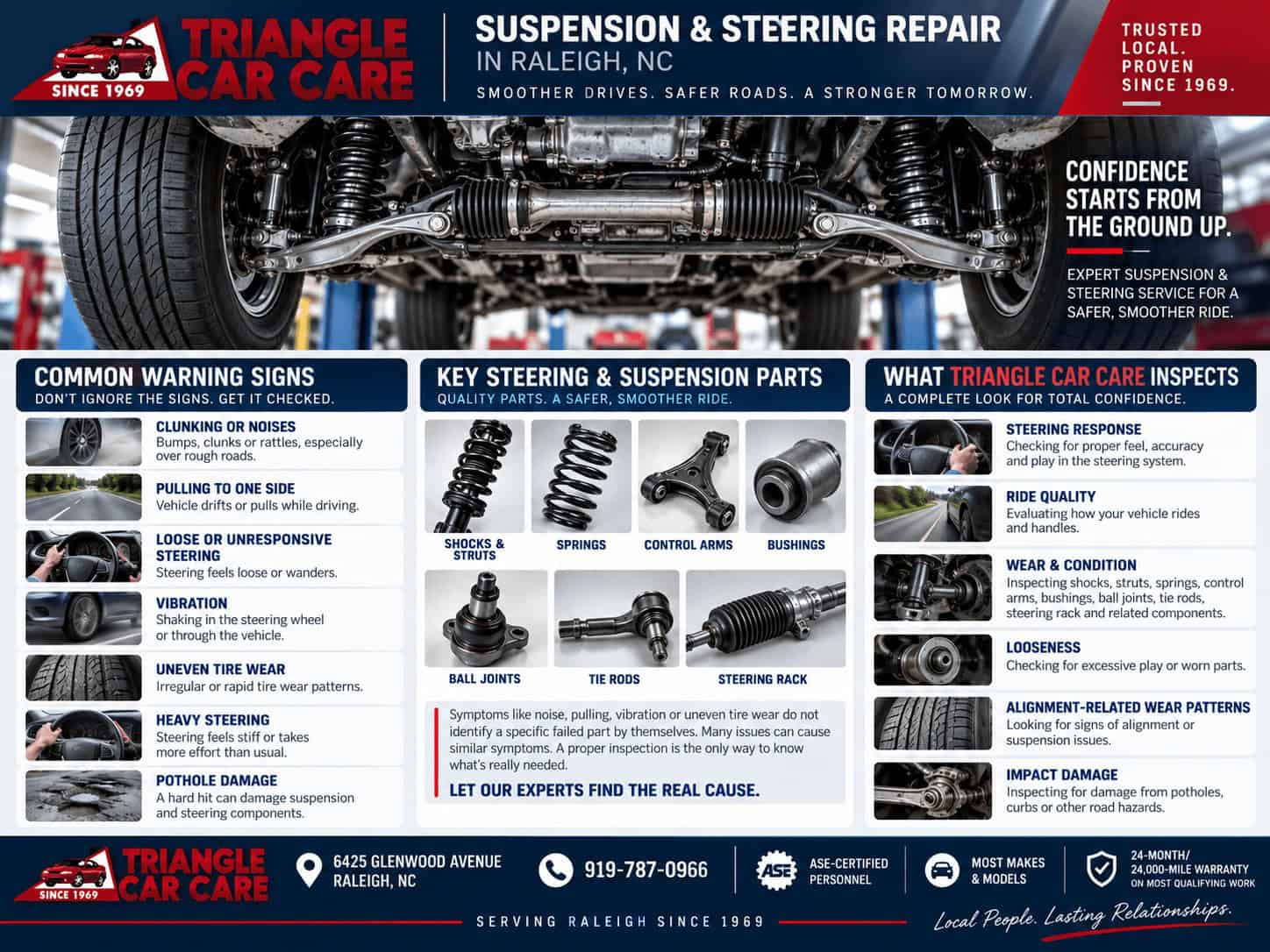
Suspension Repair Raleigh NC Warning Signs & Components
This visual guide shows common steering and suspension parts, symptoms and inspection areas. Actual component design varies by vehicle.
When Does It Happen?
Turning, braking, accelerating, highway driving and traveling over bumps can produce different diagnostic clues.
Consider More Than One System
Tires, brakes, alignment, hubs and drivetrain components can create symptoms that feel like suspension or steering problems.
Repair What the Evidence Supports
Replacing a tie rod, strut, ball joint or another component should follow inspection findings rather than a symptom alone.
A Front-End Clunk Does Not Automatically Mean a Ball Joint Failed
For suspension repair Raleigh NC drivers often describe the sound first: a clunk, knock or rattle over bumps. Those noises can travel through the vehicle body and make the source difficult to identify from the driver's seat.
Possible areas to inspect include stabilizer links or bushings, control-arm bushings, ball joints, strut mounts, shock mounts, springs, steering components, loose hardware, brake components or another source.
A Pull Does Not Automatically Mean You Need an Alignment
A suspension repair Raleigh NC inspection for a pulling complaint should also consider tire pressure, tire construction, tire wear, wheel alignment, brake operation, steering components, road crown and vehicle loading.
A vehicle that drifts while cruising presents a different diagnostic pattern from one that pulls only while braking.
If the vehicle recently struck a pothole or curb, the tire, wheel, steering, suspension and alignment should be considered together.
Loose, Wandering or Heavy Steering Can Have Different Causes
Steering feel depends on more than the steering rack or gear. Tires, alignment, joints, tie rods, steering shafts, mounting points, power assist and suspension condition can influence how a vehicle responds.
Hydraulic steering can develop leaks or pressure concerns. Electric power steering uses different components and may not contain conventional power-steering fluid.
There Is No Universal Replacement Mileage for Every Shock or Strut
Vehicle weight, suspension design, driving conditions and manufacturer guidance vary. A generic mileage number should not be treated as an automatic replacement rule.
Inspection can consider leakage, physical damage, mounting condition, noise, ride control, tire behavior and other vehicle-specific evidence.
Wear Should Be Evaluated Against the Component's Design
Ball joints and bushings are designed to move. The important question is whether there is excessive looseness, binding, deterioration, separation, damage or another condition outside acceptable limits.
A surface crack in a rubber bushing is different from a bushing that has separated or allows excessive movement. A damaged joint boot is also different from a joint confirmed to exceed allowable movement.
Control arms, bushings and ball joints help establish wheel geometry, so significant wear can affect how a vehicle aligns and tracks.
Steering Parts Should Be Diagnosed as a System
Tie rods help transfer steering movement to the road wheels. Depending on the vehicle, other components can include a rack-and-pinion assembly, conventional steering gear, steering shafts or electronically assisted steering components.
Loose steering can come from more than one location. A hydraulic leak can originate from a hose, fitting, seal or another component. Electric-assist faults follow a different diagnostic path.
Potholes and Curb Impacts Can Change the Diagnostic Picture
After a hard impact, suspension repair Raleigh NC evaluation may need to consider the tire, wheel, alignment, steering, suspension and other wheel-area components together.
Not every pothole causes damage. What matters is what changed afterward: a new pull, steering-wheel position change, vibration, tire-pressure loss, clunk, visible damage or altered handling.
What Different Suspension & Steering Symptoms Can Suggest
These examples are diagnostic starting points, not remote diagnoses.
| What You Notice | Possible Areas to Inspect | Why Diagnosis Matters |
|---|---|---|
| Clunk over bumps | Control arms, bushings, ball joints, stabilizer links, mounts, steering parts, brakes or loose hardware. | The sound alone does not identify the failed component. |
| Vehicle pulls while cruising | Tires, alignment, steering, suspension, wheel condition, road crown or loading. | A pull is not proof that alignment is the only problem. |
| Vehicle pulls mainly while braking | Brakes, tires, steering, suspension, hubs or alignment. | Brake input changes the diagnostic pattern. |
| Steering wheel shakes at road speed | Tires, wheels, balance, hubs, bearings, steering, suspension or other rotating components. | Road-speed vibration should not automatically be blamed on suspension wear. |
| Steering feels heavy | Tire condition, hydraulic or electric steering assist, binding, alignment or steering components. | Electric steering may not use hydraulic fluid. |
| Sudden severe looseness or loss of control | Potential major steering, suspension, wheel or related mechanical problem. | Reach a safe location and arrange assistance rather than continuing normal driving. |
Uneven Tire Wear Can Have More Than One Cause
Tire wear is sometimes blamed entirely on alignment, but inflation pressure, tire design, rotation history, loading, suspension condition, steering condition and driving patterns can also affect tread wear.
Certain alignment measurements can contribute to characteristic wear patterns, but the tires and surrounding chassis components should be evaluated together.
Suspension, Alignment, Brakes or Drivetrain?
Suspension repair Raleigh NC service is most appropriate when the primary concern involves suspected steering or suspension wear, ride control, looseness, clunks or chassis-related handling changes.
Suspension & Steering
Start here for clunks, loose steering, heavy steering, suspension noise, excessive movement or suspected chassis wear.
Wheel Alignment
Visit the Wheel Alignment page for alignment measurements, tracking and off-center steering.
Brake Repair
If pulling, vibration or noise occurs mainly during braking, visit the Brake Repair page .
Drivetrain Repair
Clicking during turns, axle concerns, driveshaft vibration or differential symptoms may belong on the Drivetrain Repair page .
Noise and Vibration Can Travel Through the Vehicle
A steering-wheel vibration can originate at a tire or wheel. A front-end clunk can come from a brake or suspension component. Noise during a turn can involve steering, suspension, drivetrain or another rotating component.
If the system responsible for the complaint is unclear, visit our Diagnostic Service page .
What Affects Suspension Repair Raleigh NC Cost?
The cost of suspension repair Raleigh NC drivers need depends on the vehicle design, confirmed component, parts required, labor access, related damage and whether alignment or additional diagnosis is appropriate.
Suspension type, steering-assist design, component integration and access differ between vehicles.
A bushing, tie rod, ball joint, shock, strut, spring or steering component involves a different repair scope.
Impact damage, mounting-point damage, wheel damage or multiple worn components can change the repair plan.
Certain repairs may make alignment measurement or other vehicle-specific procedures appropriate afterward.
Inspection Should Follow Vehicle Condition and Manufacturer Guidance
There is no universal mileage at which every ball joint, tie rod, shock, strut or steering component should automatically be replaced.
Vehicle design, manufacturer information, operating conditions, looseness, leakage, damage, noise and handling symptoms should guide inspection and service decisions.
Why Raleigh Drivers Choose Triangle Car Care for Suspension Repair Raleigh NC
For suspension repair Raleigh NC drivers can use for most makes and models, Triangle Car Care starts with inspection and diagnosis rather than assuming which component needs replacement.
Triangle Car Care has served the Raleigh area since 1969 from one location at 6425 Glenwood Avenue, Raleigh, NC 27612. The shop services most makes and models and has ASE-certified personnel.
Triangle Car Care's published warranty information includes steering and suspension systems among qualifying repair categories. Most qualifying work carries a 24-month / 24,000-mile warranty, subject to the applicable terms for the specific repair.
Related Automotive Services in Raleigh
Suspension Repair Raleigh NC FAQs
Common questions about clunks, pulling, shocks, struts, tie rods, steering systems, potholes, tire wear and suspension diagnosis.
What are signs of a suspension or steering problem?
Possible signs include clunking over bumps, loose or wandering steering, heavy steering effort, pulling, excessive bouncing, uneven tire wear, steering-wheel vibration, changed ride height or new noises during turns. These symptoms can have several causes, so inspection is needed before identifying a failed component.
Does clunking over bumps mean my ball joints are bad?
Not automatically. Ball joints can contribute to clunking, but stabilizer links, bushings, control arms, strut mounts, shock mounts, steering components, brakes, loose hardware and other parts can produce similar sounds. The relevant components should be inspected before replacement is recommended.
Does a car pulling to one side always need an alignment?
No. Tire pressure, tire condition, wheel alignment, brakes, steering, suspension, road crown, wheel condition and vehicle loading can all influence directional pull. A vehicle that pulls only during braking can require a different diagnostic path from one that drifts while cruising.
How do I know if my shocks or struts need replacement?
Shock and strut condition should be evaluated using vehicle-specific evidence such as leakage, physical damage, mounting condition, noise, motion control, tire behavior and manufacturer information. There is no single mileage at which every shock or strut automatically requires replacement.
Can worn suspension parts cause uneven tire wear?
Yes, worn or damaged suspension components can influence wheel position and tire contact, but they are not the only possible cause. Alignment, inflation pressure, tire construction, rotation history, loading and driving conditions can also affect tread wear.
Why does my steering feel loose or wander?
Loose or wandering steering can involve tie rods, steering linkage, rack or gear mounting, tires, wheel alignment, suspension components, steering shafts or other conditions. The source should be confirmed before a steering component is replaced.
Why does my steering feel heavy?
Heavy steering can involve tire condition, mechanical binding, alignment, hydraulic power-steering components, electric steering assist or other steering-system concerns. Modern electric-assist vehicles may not use conventional power-steering fluid.
Can hitting a pothole damage suspension or steering components?
A significant pothole or curb impact can affect a tire, wheel, alignment, steering component, suspension component or another part of the wheel assembly. Not every impact causes damage, but a new pull, vibration, tire-pressure loss, clunk, visible damage or steering change afterward justifies inspection.
Do I need an alignment after suspension or steering repair?
Some suspension and steering repairs can affect wheel position or alignment geometry, so an alignment check may be appropriate after certain procedures. The need depends on the component replaced, repair method and vehicle design.
Can steering-wheel vibration come from suspension problems?
Yes, but suspension is only one possibility. Tires, wheels, wheel balance, hubs, bearings, brakes, steering components and other rotating parts can also transmit vibration into the steering wheel. Whether the vibration occurs while cruising, braking or accelerating helps guide diagnosis.
How much does suspension repair Raleigh NC service cost?
Cost depends on the vehicle design, confirmed component, parts required, labor access, related damage and whether alignment or additional diagnosis is appropriate. A generic national average is not a Triangle Car Care quote. Inspection is needed before the repair scope and applicable cost can be established.
Does Triangle Car Care repair suspension and steering systems on most makes and models?
Triangle Car Care provides suspension and steering diagnosis and repair for most makes and models from its Raleigh location at 6425 Glenwood Avenue. The specific repair available depends on the vehicle design, diagnostic findings, parts requirements and scope of work.
Looking for Suspension Repair Raleigh NC Drivers Can Turn To?
Triangle Car Care provides suspension repair Raleigh NC service from its Glenwood Avenue location for most makes and models. Whether the concern involves shocks, struts, ball joints, control arms, tie rods, steering components or an unexplained handling change, the right repair starts with identifying the cause.
Sources & Further Reading
- National Institute for Automotive Service Excellence — Automobile & Light Truck Certification Tests
- National Highway Traffic Safety Administration — Tire Safety
- Triangle Car Care — Wheel Alignment
- Triangle Car Care — Brake Repair
- Triangle Car Care — Drivetrain Repair
- Triangle Car Care — Diagnostic Service
- Triangle Car Care — TechNet Nationwide Warranty
- Triangle Car Care — About Us


