


TPMS Light On? What Raleigh Drivers Should Check First
TPMS light on? 5 safe checks Raleigh drivers should make first
Quick Answer: If the TPMS light on your dashboard appears, start with tire pressure, not assumptions. NHTSA says an illuminated TPMS symbol means at least one tire is significantly underinflated, and you should inspect the tires and check pressure as soon as possible. Check each tire against the driver-door placard, look for visible damage, and pay attention to pulling, vibration, thumping, or instability. A flashing warning that later stays on may point to a TPMS-system malfunction, but inspection and testing are needed before blaming a sensor or any other part.
Inspection update as of October 29, 2026: Wake County’s emissions requirement still applies for eligible vehicles. North Carolina has enacted legislation intended to end the emissions program statewide, but implementation depends on final EPA approval and DMV action. Annual safety inspections remain. Check current NCDMV safety inspection requirements and NC DEQ Inspection and Maintenance guidance for your vehicle before assuming the rule has changed.
TPMS light on: 5 essential checks before you keep driving
A tire-pressure warning is a clue, not a diagnosis. It can be caused by low tire pressure, a temperature-related pressure drop, a slow leak, wheel or tire damage, or a TPMS-system issue. The right first move is a careful, simple check that helps you decide whether to inflate, drive cautiously for inspection, or stop and arrange professional help.
Here are the five checks to make first, in a safe location and without getting under the vehicle:
- Check the warning behavior. Is the light steady, flashing, or coming and going? A steady TPMS warning light usually means you should check tire pressure promptly. A warning that flashes first and then remains on may indicate a system malfunction.
- Measure all four tire pressures. Use a tire-pressure gauge. Do not rely on appearance alone, because a tire can be significantly underinflated without looking flat.
- Compare the readings with the driver-door placard. Use the vehicle’s cold-pressure specification on the tire pressure placard or the owner’s manual, not the maximum pressure molded into the tire sidewall.
- Look for visible tire or wheel damage. Cuts, bulges, exposed cord, tread separation, a severely damaged wheel, or a tire that is much lower than the others are warning signs.
- Notice how the vehicle feels. New pulling, strong vibration, thumping, instability, or steering changes after a pothole or curb strike can change the urgency of the situation.
If you find visible damage, rapid pressure loss, severe vibration, instability, a strong pull, or you are unsure whether a tire can support the vehicle, get to a safe place and arrange towing or roadside help. Do not keep driving just to see whether the light goes away.
What a TPMS warning light is telling you
The TPMS warning light is part of your tire pressure monitoring system. In plain language, it is there to warn you when tire pressure is low enough to need attention. According to NHTSA tire safety guidance, “When the TPMS symbol appears on your dashboard, it means at least one of your tires is significantly underinflated.” NHTSA also says you should inspect the tires and check tire pressure as soon as possible.
That warning does not tell you why the pressure is low. It does not prove that a tire is punctured, that a valve stem is leaking, that a wheel is bent, or that a sensor has failed. Those are all possibilities in the right circumstances, but they are not conclusions until the tire, wheel, and system have been checked.
A steady TPMS warning light is different from a warning that flashes first. A steady warning points you toward tire-pressure measurement right away. A flashing pattern may mean the system itself is having trouble monitoring pressure, even if one or more tires also need air.
Some vehicles use direct TPMS sensors that measure pressure at the wheel. Others use indirect systems that compare wheel-speed and other data to infer a pressure change. NHTSA describes both types, which is one reason the exact display and reset behavior can vary from vehicle to vehicle. Your owner’s manual controls the details for your specific car, truck, or SUV.
A tire-pressure warning should be treated with the same practical approach Triangle Car Care applies to other warning lights: diagnosis before assumptions. A symptom is a clue, not a diagnosis, and the next step is to gather information without overlooking safety.
Use the tire pressure placard, not the tire sidewall
The tire pressure placard is usually located on the driver-door jamb or nearby door opening area. It lists the vehicle manufacturer’s recommended cold tire pressure for the original tire size and load conditions. The owner’s manual may also list this information and explain whether the spare tire is monitored by the system.
The number molded into the tire sidewall is not the normal target pressure for your vehicle. It is a maximum tire rating, not the inflation specification chosen for that vehicle’s weight, handling, braking, and ride characteristics. Using the sidewall maximum as your normal target can lead to incorrect inflation.
Check pressures when the tires are cold if possible, meaning before the vehicle has been driven much. If you must check after driving, understand that warm tires can show a different reading. The important point is to compare the measured pressure with the correct vehicle specification, not with a guess or with another vehicle’s number.
Check all four tires. Include the spare only if your owner’s manual says your system monitors it or if the vehicle uses a full-size spare that needs to be kept at a specified pressure. Many drivers forget the spare until they need it, but TPMS behavior depends on the vehicle’s design.
If you are writing down readings, note the number on the tire pressure placard next to each measured tire pressure. That simple comparison helps a shop see whether the warning followed actual low tire pressure, a possible system concern, or a combination of clues.
Low tire pressure without a flat-looking tire
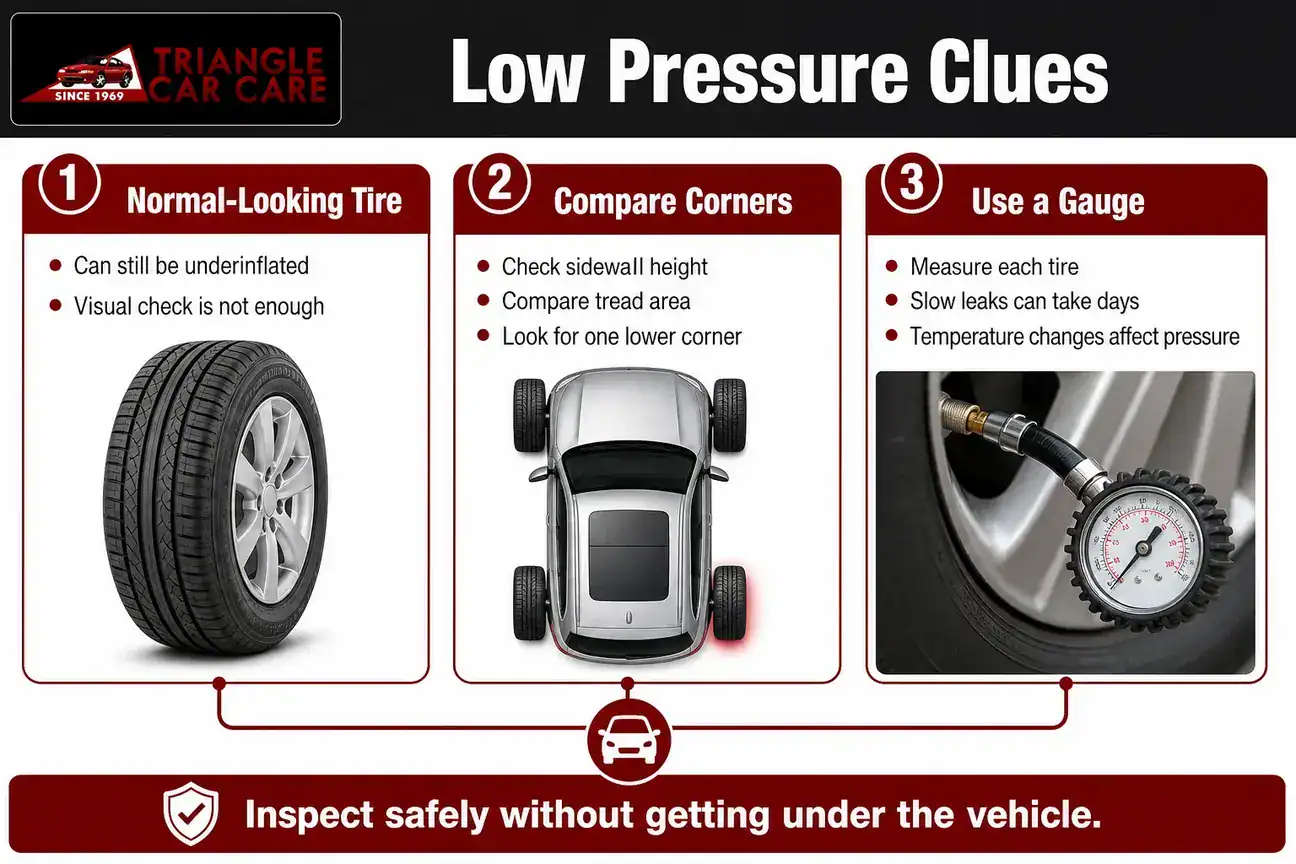
Low tire pressure is not always obvious from a glance across a parking lot. Modern tires can look fairly normal even when they are underinflated enough to trigger the warning. That is why a pressure gauge matters.
A visual check is still useful, but it is not enough by itself. Walk around the vehicle and compare tire shape, sidewall height, tread area, and wheel position. Look for one corner sitting lower than the others, but do not assume everything is fine just because the tire is not visibly flat.
Pressure loss can happen slowly. A small puncture, a valve-area leak, wheel damage, or a bead-sealing issue may let air out over hours or days. Temperature changes can also affect pressure. None of those possibilities can be confirmed from the dashboard light alone.
If you restore pressure to the placard specification and the warning returns, that is useful information. It may point toward continuing low tire pressure, an incorrect initial reading, another tire still being underinflated, a vehicle-specific reset or relearn issue, or a TPMS-system fault. Inspection and testing are what separate those possibilities.
A repeated low tire pressure warning also deserves attention because tire pressure affects handling, tire wear, braking feel, and heat buildup. The dashboard symbol may be your first clue that one tire is changing faster than the others.
Flashing TPMS light: what that pattern can mean
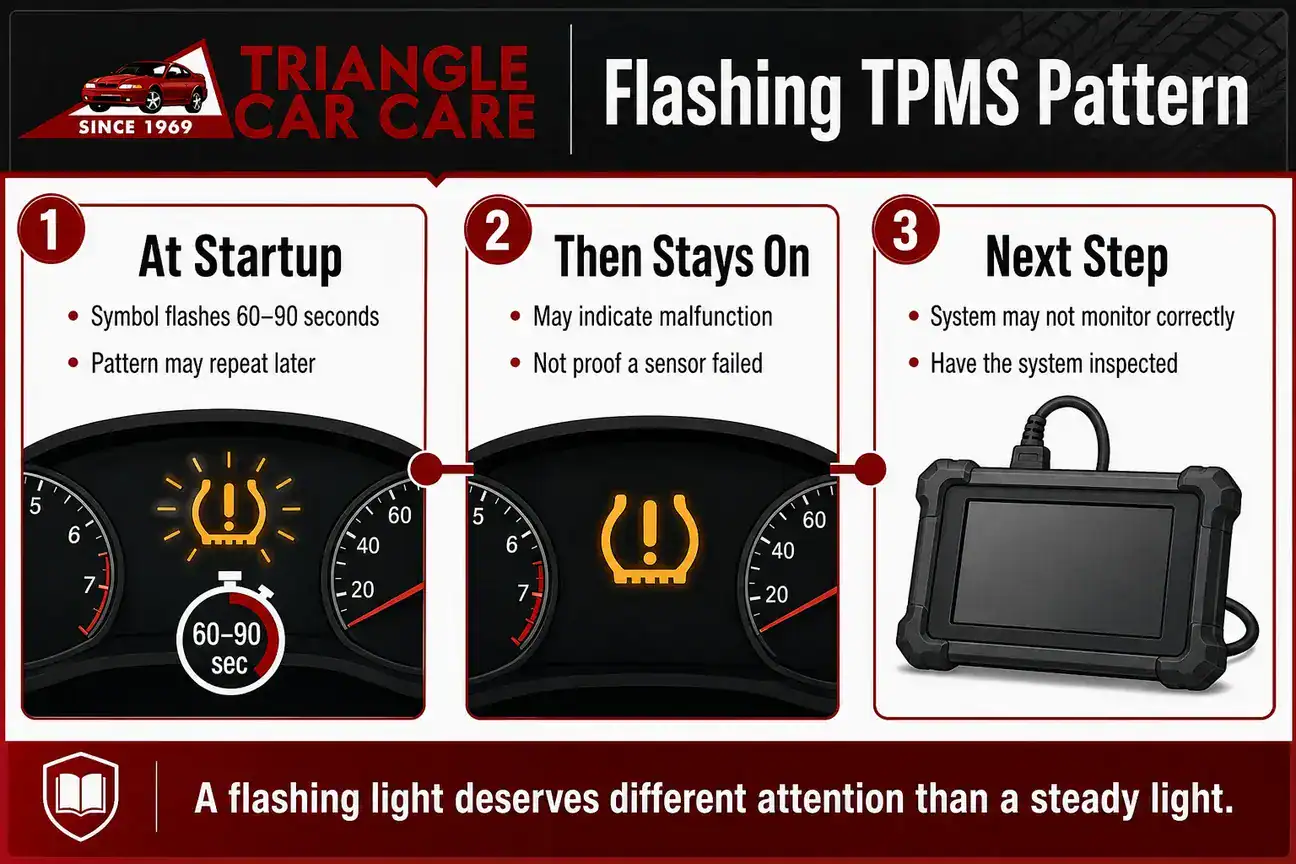
A flashing TPMS light deserves a different kind of attention than a steady light. NHTSA says a system malfunction may be indicated by the TPMS symbol flashing for 60 to 90 seconds with the warning lamp remaining illuminated after the flashing sequence. That wording matters: “may be indicated” is not the same as “the sensor is definitely bad.”
When a flashing TPMS light appears at startup and then stays on, the system may not be able to monitor tire pressure correctly. The flashing sequence may repeat at future startups until the concern is corrected. NHTSA says drivers should contact the vehicle dealer for a system inspection; an independent shop with warning-light diagnostic capability can also evaluate the warning behavior and related symptoms through vehicle diagnostic service.
Do not ignore a flashing TPMS light just because all four tires appear to be inflated. A system issue can keep the vehicle from giving reliable tire-pressure warnings, while an actual pressure issue may still exist at the same time. Check pressure first, then have the system inspected if the warning behavior continues.
Do not assume a sensor replacement is needed. The cause may involve system communication, a relearn requirement after wheel service, a weak or non-reporting sensor, a module or antenna concern, a pressure issue, or a combination of conditions. Testing should lead the recommendation, not guesswork.
A flashing TPMS light is also worth noting exactly as it happens. Write down whether it flashes only at startup, whether it later turns steady, and whether it appears after tire service, battery work, wheel service, or a tire rotation. Those details can shorten the path from symptom to test plan.
Why the warning can appear after weather changes, potholes, or curb strikes
Local driving conditions can provide clues, but they do not prove the cause. Hot, humid summers, occasional cold snaps, stop-and-go traffic, potholes, curb impacts, and seasonal changes can all put tires, wheels, and suspension parts under stress. A pressure warning that appears after one of those events should be taken seriously, but the event itself is not a complete diagnosis.
A cold snap can reduce tire pressure enough to turn on the warning, especially if a tire was already near the low end of the recommended range. That does not mean weather is the only cause. You still need to measure the tires and look for damage or repeated pressure loss.
When weather is involved, compare every reading with the tire pressure placard instead of guessing. One tire that is much lower than the others may point away from a simple weather change and toward a leak, wheel issue, valve-area concern, or another condition that needs inspection.
A pothole or curb strike can coincide with low tire pressure, a damaged tire, a damaged wheel, a new vibration, a pull, or uneven wear. If the vehicle now pulls, the steering wheel sits off-center, or the tires show unusual wear, a wheel alignment check may be part of the next step. If the impact came with steering looseness, clunking, instability, or a strong shake, a suspension and steering inspection may be needed before the vehicle is driven much farther.
Recent maintenance can also affect what to check. Tire rotation, brake work, wheel service, or alignment work may involve moving wheels or changing where sensors are located on the vehicle. That does not mean the work caused the warning. It means the shop should know the service history so it can evaluate whether a vehicle-specific relearn, pressure adjustment, or separate issue is involved.
When to stop driving and arrange professional help
A tire-pressure warning is not automatically an emergency, but some tire and handling symptoms should be treated conservatively. The goal is not to scare you. The goal is to avoid driving on a tire or wheel that may not be able to support the vehicle safely.
Stop as soon as you can do so safely and arrange towing or roadside help if you notice any of the following:
- A tire that is visibly flat or much lower than the others.
- A tire that loses pressure rapidly after inflation.
- A sidewall bulge, deep cut, exposed cord, tread separation, or obvious puncture damage.
- A bent, cracked, or badly damaged wheel.
- Severe vibration, thumping, wobbling, or instability.
- A strong pull or steering problem after a pothole or curb strike.
- Any situation where you are unsure whether the tire can carry the vehicle.
If you are in one of those situations, do not continue driving to test it. Get to a safe place, keep yourself out of traffic, and arrange professional help. Triangle Car Care does not provide towing or roadside rescue, so use the appropriate roadside or towing resource for the situation.
If there is no visible damage, the vehicle feels normal, and pressure can be corrected to the placard specification, you still should not ignore the light. Monitor whether the warning returns, especially if it began as a TPMS warning light after an impact or after repeated pressure changes.
What a shop checks during TPMS and tire-pressure diagnosis
A careful inspection starts with the basics. The shop should confirm the warning pattern, measure each tire, compare pressures with the correct placard specification, and inspect the tires and wheels. If the warning came with a vibration, pull, noise, or impact, those clues guide what gets checked next.
At Triangle Car Care, the emphasis is on clear communication and diagnosis before assumptions. The shop is an independent auto repair shop on Glenwood Avenue, serving Raleigh since 1969, with ASE-certified personnel and a 24-month/24,000-mile warranty on most qualifying work. Ask which warranty terms apply to your repair, because coverage varies by service and repair.
A tire-related evaluation may include looking for visible tread or sidewall damage, checking for signs of air loss, inspecting the valve area, looking for wheel damage, and comparing tire wear patterns. If uneven wear is present, your maintenance history matters. Regular tire rotation can help a shop track wear patterns over time, but it does not replace diagnosis when a warning light is already on.
A TPMS-system evaluation may include checking sensor communication where applicable, confirming whether the system is direct or indirect, reviewing vehicle-specific service information, and following the owner’s manual for reset or relearn behavior. The goal is to determine whether the warning is about actual pressure, system monitoring, or another related condition.
If the warning came after an impact, the tire-pressure check may only be one part of the picture. A bent wheel, alignment change, steering component concern, or suspension issue can create vibration or pulling even after the pressure is corrected. That is why the timing of the symptom matters.
| What you notice | What it may suggest | Why testing matters |
|---|---|---|
| Steady TPMS warning light | At least one tire may have low tire pressure | Pressure readings identify which tire is low and by how much |
| Flashing TPMS light first, then steady warning | A TPMS-system malfunction may be involved | System testing helps avoid guessing at sensors or modules |
| Warning after a cold morning | Temperature-related low tire pressure is possible | Measurement confirms whether pressure is actually below specification |
| Warning after a pothole or curb strike | Tire, wheel, alignment, suspension, or steering concern is possible | Inspection checks for damage and related handling issues |
| Warning returns after adding air | Ongoing air loss, incorrect pressure, reset issue, or system fault is possible | Repeated readings and system checks narrow the cause |
A table like this is only a starting point. For example, a steady TPMS warning light with one low reading is different from a flashing TPMS light with normal readings. In both cases, the warning is a clue that should be matched to pressure readings, vehicle behavior, and inspection results.
What to write down before you request an appointment
The more accurately you describe the warning, the easier it is for a shop to reproduce the concern and choose the right inspection path. You do not need to diagnose it yourself. Just note what happened, when it happened, and what changed.
Before you request service, write down:
- When the light first appeared.
- Whether the warning is steady, intermittent, or flashing before it stays on.
- Whether the warning disappears and returns.
- Each tire-pressure reading, if you checked them.
- The pressure listed on the tire pressure placard.
- Recent weather change, pothole hit, curb strike, or road impact.
- Any pulling, vibration, thumping, noise, or steering change.
- Any visible tire damage, wheel damage, or uneven wear.
- Recent tire rotation, alignment, brake, suspension, or wheel-related service.
- Whether the vehicle is due for an NC safety and emissions inspection.
If the vehicle is not showing stop-driving symptoms, you can request an appointment with Triangle Car Care or call 919-787-0966. Include whether you saw a steady TPMS warning light, a flashing TPMS light, pressure readings if available, and any handling changes. The shop confirms the appointment time; submitting a request is not a confirmed appointment.
How inspection rules relate to warning lights
A TPMS concern is mainly a tire-safety and diagnostic issue, not an emissions diagnosis. Still, some drivers notice warning lights while they are also due for an annual inspection. State rules require an annual safety inspection, and the local emissions requirement remains in place for eligible vehicles as of the date noted above.
NCDMV explains that emissions inspections apply in listed counties for eligible vehicles, while safety inspections remain a separate annual requirement. The NC DEQ page should be checked for the current status of the emissions-program transition. Do not clear warning lights or ignore tire concerns just to get through an inspection. If the vehicle has tire damage, pressure loss, or handling symptoms, address the safety concern first.
For TPMS specifically, inspection requirements and warning-light behavior can depend on vehicle year, equipment, and current state rules. If you are not sure how your warning light affects your inspection, ask before the appointment and bring the same notes you would bring for diagnosis.
Why the light may return after you add air
Many drivers do the right first step: they add air to the placard specification. Then the warning comes back. That can be frustrating, but it is also useful information.
If the warning returns after correction, possible explanations include continued low tire pressure, an inaccurate gauge, filling to the wrong specification, another tire being low, a spare tire being monitored, a reset or relearn requirement, or a TPMS-system issue. Do not jump straight to the most expensive or most convenient explanation. The pattern matters.
Try to separate what you know from what you suspect. You may know that the left rear measured low. You may suspect a puncture, but that is not confirmed until the tire is inspected. You may know the light flashes at startup. You may suspect a sensor, but that still needs system testing.
A returning low tire pressure warning is especially important when the same tire keeps measuring lower than the rest. That pattern can help direct inspection toward a tire, wheel, valve-area, or sealing concern, but it still does not prove the cause from the dashboard alone.
This distinction saves time and helps avoid replacing parts based on a dashboard symbol alone. The warning light tells you something needs attention. Inspection and testing explain what the vehicle actually needs.
What not to do when the pressure warning appears
Do not drive for days with the warning on just because the vehicle feels normal. NHTSA’s guidance is clear that an illuminated TPMS symbol means at least one tire is already significantly underinflated and that drivers should take immediate action. Immediate action can be as simple as safely checking pressure and inspecting the tires, but it should not be ignored.
Do not use the tire sidewall maximum as your target pressure. Use the tire pressure placard and owner’s manual. If the tire pressure placard is missing or unreadable, ask a qualified shop to help identify the correct specification for your vehicle.
Do not assume cold weather is the cause without measuring. Weather can explain some pressure changes, but a slow leak and a temperature drop can happen at the same time. A tire that keeps losing pressure needs inspection.
Do not assume a flashing TPMS light means one specific sensor has failed. It may indicate a system malfunction, but the failed component or condition has to be identified through testing.
Do not crawl under a vehicle supported only by a jack, attempt tire or wheel repair at the roadside, or keep driving on a tire that appears damaged. For this topic, the safe DIY checks are pressure measurement, visual tire inspection from outside the vehicle, and owner’s manual review.
Putting the warning in perspective
The right response to a TPMS warning light is practical and step-by-step. Measure pressure, compare it to the tire pressure placard, inspect the tires, and notice how the vehicle behaves. If the warning is steady and pressure is low, correct it to the vehicle specification and watch whether it returns. If the warning flashes, returns repeatedly, or comes with damage or handling changes, have the vehicle inspected.
For Triangle Car Care’s team, a warning light is the start of a conversation, not a parts order. The important questions are simple: What did the light do? What were the pressure readings? Did anything happen right before it appeared? Is there pulling, vibration, noise, impact history, or visible damage?
If your TPMS light on warning remains after you check pressure, or if you are seeing repeated low tire pressure warnings without an obvious reason, schedule a diagnostic visit before the concern grows into a safety problem. Bring your notes, your pressure readings, and the owner’s manual if you have it handy.
Disclaimer: This article is general automotive information, not a diagnosis of your vehicle. Follow your owner’s manual, and have a qualified technician inspect the vehicle when a symptom could affect safe operation.
Frequently Asked Questions
Can I keep driving with the TPMS light on?
Do not treat it as a blanket yes or no. Check tire pressure and inspect the tires as soon as possible. Stop and arrange professional help if you see visible damage, rapid pressure loss, severe vibration, instability, a strong pull, or any sign the tire may not support the vehicle.
What pressure should I use when the TPMS warning light comes on?
Use the pressure listed on the driver-door placard or in the owner’s manual. Do not use the maximum pressure printed on the tire sidewall as the normal target for your vehicle.
Why is the TPMS light flashing instead of staying steady?
A flashing warning followed by steady illumination may indicate a TPMS-system malfunction. That pattern does not identify the failed part. The tires still need a pressure check, and the system may need inspection and testing.
Can cold weather cause a low tire pressure warning?
Yes, a temperature-related pressure change is one possible reason. Still, measure the tires instead of assuming weather is the cause. A slow leak and a weather change can happen at the same time.
Why did the light come back after I added air?
Possible reasons include continued pressure loss, an incorrect pressure reading, filling to the wrong specification, another tire still being low, a monitored spare, a reset or relearn requirement, or a TPMS-system fault.
Can a pothole or curb strike trigger a tire-pressure warning?
An impact can coincide with pressure loss, tire damage, wheel damage, pulling, vibration, or steering changes. If the warning appears after an impact and the vehicle feels different, avoid continuing to drive and arrange an inspection.
Does the TPMS light mean I need a new sensor?
No. The warning is a symptom, not proof of a failed sensor. The cause may involve pressure, a leak, tire or wheel damage, system communication, or a relearn issue. Testing should identify the cause before parts are recommended.
Sources


