


Can an Independent Shop Void Your Car Warranty?
Independent Shop Warranty: Safe Car Warranty Guide
Quick Answer: No, using an independent shop for service does not automatically mean you must go back to the dealer for routine maintenance or repairs. Independent-shop service does not automatically void a manufacturer warranty, but you still need to follow your vehicle’s maintenance schedule, use the required specifications, and keep detailed records. A factory warranty, a shop repair warranty, and an optional service contract are different forms of coverage, so read the terms before authorizing work.
If you are deciding between dealer maintenance and an independent repair shop, the practical question is not simply “dealer or independent?” It is: Was the right maintenance done, was the correct specification used, and can you prove it later if a warranty question comes up? That is where clear invoices, careful documentation, and diagnosis before assumptions matter.
Independent shop warranty: what actually matters
An independent shop does not automatically void your car’s manufacturer warranty just because it performs maintenance or repair. The warranty booklet, the facts of the repair, the maintenance history, and the cause of the failure all matter. If a later claim is denied, the question is usually whether the manufacturer can connect that specific failure to improper maintenance, incorrect parts or fluids, poor workmanship, missed required procedures, or another exclusion.
The FTC’s auto warranty guidance explains that warranties and service contracts have terms, limits, and covered items. That is why careful documentation is more useful than relying on a verbal “it should be fine.” A clear invoice can show the date, mileage, work performed, and specifications used.
This is especially important when a vehicle still has a factory warranty and the owner is trying to avoid unnecessary dealer maintenance without creating recordkeeping problems. Dealer service may be convenient for some owners, but it is not automatically required for every maintenance item just because a vehicle is still under warranty.
Factory warranty coverage depends on terms and facts
A factory warranty is coverage provided by the vehicle manufacturer for qualifying defects or repairs during the stated time and mileage limits. It is not the same as a maintenance plan, and it does not turn every future repair into covered warranty work. It also does not mean an owner can skip required maintenance and expect every claim to be accepted.
The FTC notes in its Auto Repair Basics guidance that repair warranties may be subject to limits such as time, mileage, deductibles, authorized businesses, and special reimbursement procedures. That same common-sense idea applies when you read any vehicle warranty booklet: the exact terms control the specific claim.
A factory warranty question may come up after an oil-related engine concern, a transmission issue, a warning light, a noise, a leak, or a failed component. The answer should not be guessed. The vehicle needs inspection and testing, the service history should be reviewed, and the warranty terms should be checked before anyone assumes whether the repair is covered.
For drivers in Wake County, the practical takeaway is simple: independent service is not automatically a problem, but missing records can make a later discussion harder. Keep invoices, keep receipts, and ask that important specifications be written clearly on the repair order.
Dealer maintenance is not the same as required maintenance
Dealer maintenance is maintenance performed at a franchised dealer. Required maintenance is the maintenance listed in your owner’s manual or manufacturer schedule for your specific vehicle. Those are not always the same thing.
For example, a vehicle may require a certain oil viscosity, fluid specification, filter type, inspection, software-related procedure, or service interval based on its engine, model year, use, or manufacturer instructions. The important question is whether the maintenance meets the manufacturer’s requirements and is documented. The logo on the building is not the whole story.
That said, some repairs or warranty claims may require a dealer or manufacturer-approved process. Some service contracts may require prior authorization, specific repair locations, or a claims procedure. Before you assume dealer maintenance is mandatory or unnecessary, read the warranty booklet and any auto service contract that applies.
At Triangle Car Care, the practical approach is diagnosis before assumptions. If a Raleigh driver brings in a symptom, warning light, leak, vibration, or noise, a symptom is a clue, not a diagnosis. The goal is to understand what system is involved, what testing shows, and what documentation the owner may need.
Factory warranty, repair warranty, and service contract compared
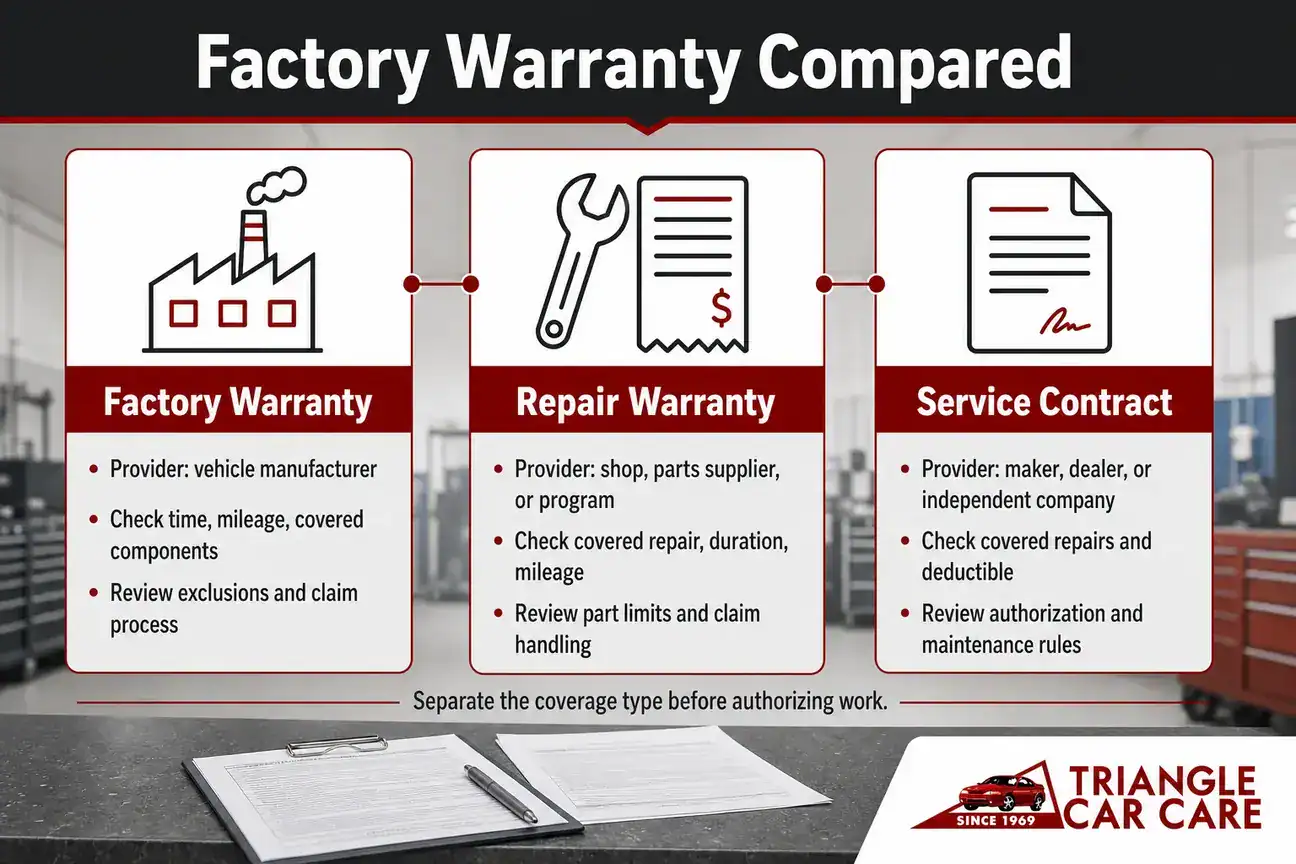
Many warranty misunderstandings start because people use the word “warranty” for several different kinds of coverage. Separating them helps you ask better questions before authorizing work.
| Coverage type | Who provides it? | What to check before authorizing work |
|---|---|---|
| Factory warranty | Vehicle manufacturer | Time, mileage, covered components, exclusions, maintenance requirements, and claim process |
| Repair warranty | Repair shop, parts supplier, or warranty program connected to the repair | Covered repair, duration, mileage, part limitations, exclusions, and how a claim is handled |
| Service contract | Manufacturer, dealer, or independent company | Covered repairs, deductible, authorization requirements, maintenance records, and approved repair locations |
A repair warranty covers qualifying work performed by the shop or covered through a parts or warranty program. Triangle Car Care offers a 24-month/24,000-mile warranty on most qualifying work. Coverage varies by service and repair, so ask which terms apply to your specific work.
A service contract is different. The FTC explains that service contracts are optional agreements sold by vehicle manufacturers, dealers, or independent companies, and they cover only what the contract says they cover. An auto service contract may have a deductible, prior authorization rules, excluded parts, maintenance requirements, or limits on where work may be performed.
Auto service contract terms can change the process
An auto service contract is sometimes marketed as an “extended warranty,” but it is not the same thing as the original factory warranty. The contract language matters. It may require the owner or shop to call for authorization before repairs begin. It may require maintenance records. It may limit coverage to named components or exclude wear items, fluids, diagnostic charges, or pre-existing conditions.
Before authorizing work, ask whether your auto service contract requires pre-approval. If it does, do not assume the shop can start repairs first and sort out paperwork later. The contract may also require specific documentation, such as mileage, diagnosis, part numbers, cause of failure, or maintenance history.
If a warning light or symptom is involved, diagnostic testing may be needed before the covered item can even be identified. A code is a clue, not a diagnosis. For example, a code may point toward a system that needs testing, but it does not prove which part failed or whether the concern is covered by an auto service contract.
Keep a copy of the contract with your vehicle paperwork. If you are scheduling service, bring or upload the contract information when possible. That helps the shop understand whether the conversation is about a factory warranty, a repair warranty, an auto service contract, or ordinary customer-pay maintenance.
Warranty service records should show what was done
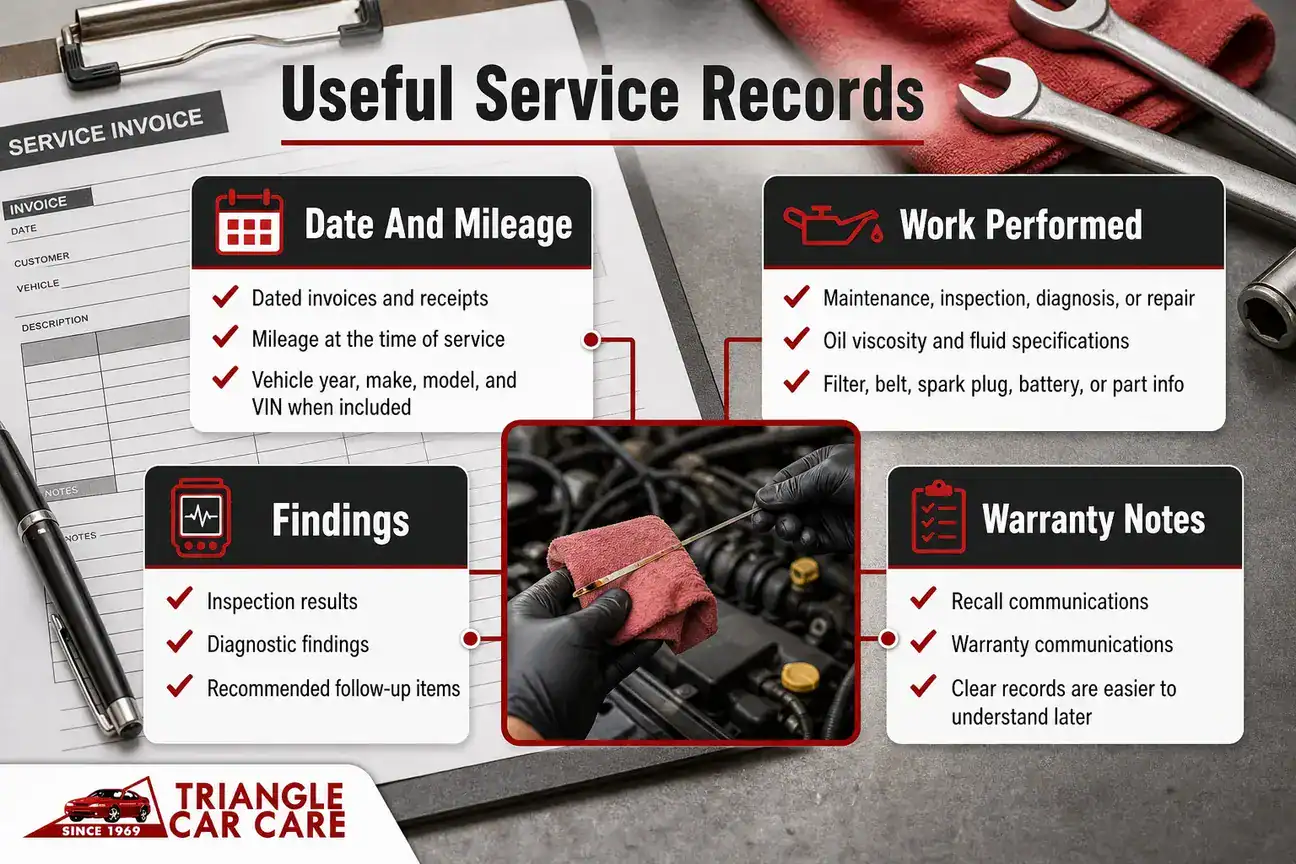
Warranty service records are most useful when they show details, not just a vague line that says “service completed.” A record that lists the date, mileage, work performed, and specifications used is easier to understand months or years later.
Useful warranty service records may include:
- Dated invoices and receipts.
- Mileage at the time of service.
- Vehicle year, make, model, and VIN when included on the paperwork.
- Description of the maintenance, inspection, diagnosis, or repair.
- Oil viscosity and fluid specifications when relevant.
- Filter, belt, spark plug, battery, or part information when supplied.
- Inspection results and diagnostic findings.
- Recommended follow-up items.
- Recall or warranty claim paperwork.
- Digital copies in case paper receipts fade or get lost.
For routine maintenance, the record should connect the work to the manufacturer schedule. For example, an invoice for oil change service is more helpful when it identifies the oil specification used and the mileage than when it simply says “oil service.”
Good warranty service records also help when there are multiple vehicles in a household. If one vehicle is under a factory warranty, another has an auto service contract, and a third is older and out of warranty, the paperwork helps keep each vehicle’s maintenance story straight.
Does maintenance have to use dealer-branded parts or fluids?
Not every maintenance item has to come in a dealer-branded box. The more important question is whether the part, fluid, filter, or procedure meets the manufacturer’s stated requirement for that specific vehicle. Do not turn that into a blanket rule either way. Aftermarket parts are not always automatically acceptable, and dealer-branded parts are not the only detail that matters.
Some vehicles require a specific oil viscosity, coolant type, transmission fluid specification, spark plug design, battery type, belt application, or service procedure. Some systems may also involve programming, calibration, software, or documentation requirements. If the manufacturer or service contract requires a particular process, that process should be understood before work begins.
When the vehicle is still under a factory warranty, ask the shop to document the relevant specification on the invoice where it matters. That is especially helpful for fluids and maintenance items that are tied closely to warranty questions.
For everyday cars, trucks, and SUVs, Triangle Car Care services makes and models we service using a vehicle-specific approach. That means the right answer depends on the year, make, model, engine, symptoms, service history, and manufacturer information rather than a universal maintenance interval.
Questions to ask before authorizing independent-shop work
Before you authorize maintenance, diagnosis, or repair on a vehicle that may still have a factory warranty, ask direct questions. A good conversation up front can prevent confusion later.
- Is this maintenance, diagnosis, or a repair? Maintenance follows a schedule. Diagnosis finds the cause of a symptom. Repair corrects a confirmed problem.
- What does the manufacturer schedule require for this vehicle? Do not rely on a universal mileage rule. Check the owner’s manual and maintenance schedule.
- Which oil, fluid, filter, or replacement part specification will be used? Ask for the specification when it matters to warranty service records.
- What will appear on the invoice? The invoice should identify the work performed, mileage, and relevant specifications.
- Which coverage might apply? Ask whether the conversation involves a factory warranty, repair warranty, auto service contract, or customer-pay work.
- Does the service contract require prior authorization? If yes, that should be handled before covered repairs begin.
- Is inspection and testing needed before identifying the failed component? A symptom, warning light, or code should not be treated as a final diagnosis.
- Will I be contacted before additional work is added? Clear communication matters when diagnosis uncovers more than one concern.
- Can I receive a written estimate when required or requested? In North Carolina, repair estimate rules may apply depending on the situation.
- Are there open recalls for this vehicle? Recall status should be checked by VIN when a suspected safety defect is involved.
These questions are not about making the process complicated. They are about keeping the service history clear enough that you can understand what was done, why it was done, and which coverage might apply.
Recall checks belong in the warranty conversation
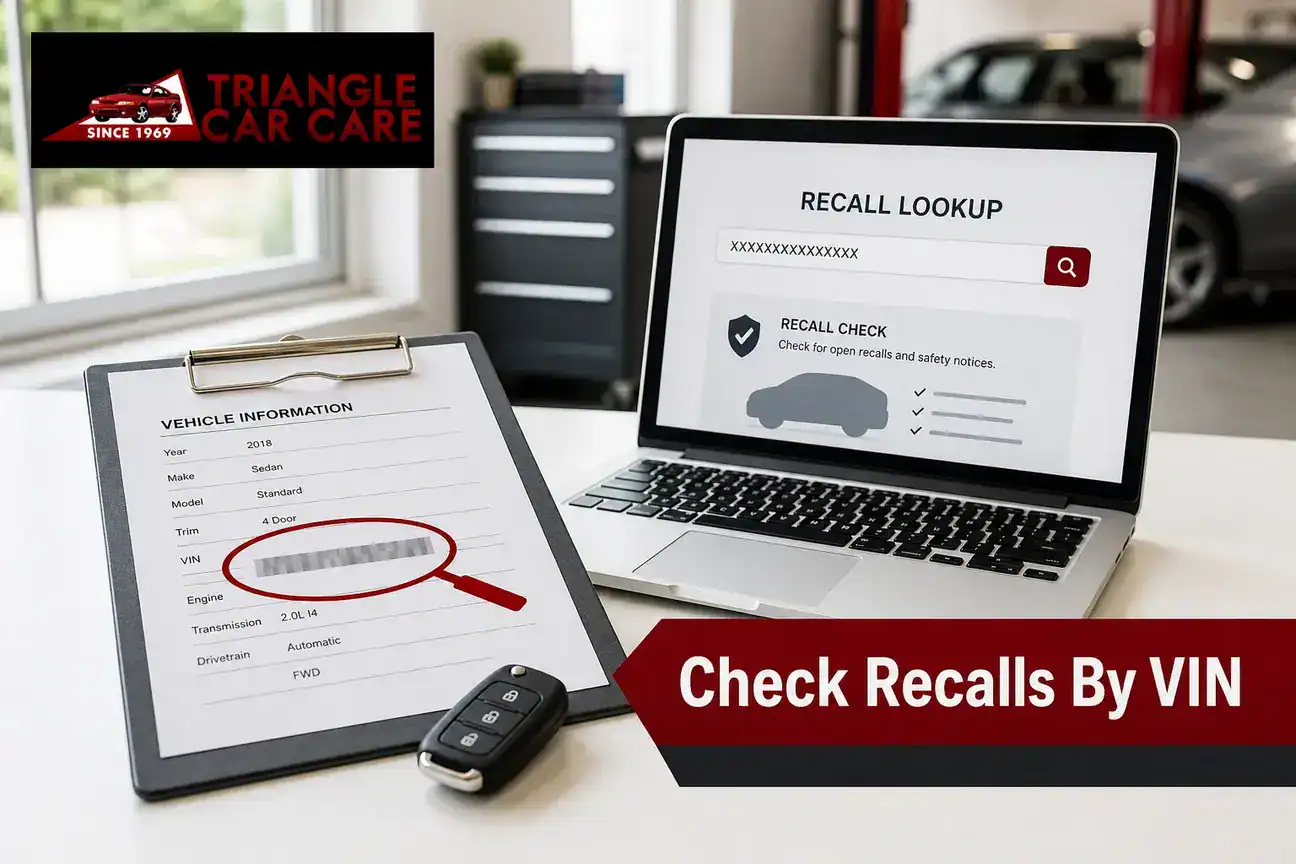
Before paying for a repair that may involve a safety defect, check for open recalls by VIN. The NHTSA recall lookup tool is the official place to check whether a vehicle has an unrepaired safety recall. A recall is different from a technical service bulletin. A bulletin may describe a known repair procedure or condition, but it does not automatically mean a repair is free.
Recall checks are especially useful when a warning light, safety system concern, fuel odor, steering issue, braking issue, or electrical problem appears. The presence of a recall does not diagnose your vehicle, and the absence of a recall does not mean the symptom should be ignored. It is one more piece of information.
If there is no open recall, a shop still needs to inspect and test the vehicle before assuming the cause. If there is an open recall, contact the manufacturer or dealer for the recall process. Keep any recall paperwork with your warranty service records.
What if there is a warning light, noise, vibration, leak, or pull?
A warranty question often starts with a symptom. The car develops a warning light, noise, vibration, leak, pull, smell, or performance change, and the owner wants to know whether it is covered. The right first step is not guessing the failed part. The right first step is inspection and testing.
Triangle Car Care offers vehicle diagnostic service for warning lights, symptoms, and system concerns. Diagnostic work can help identify the system involved, confirm the cause, and separate a maintenance item from a possible warrantable failure, unrelated repair, or safety issue.
Before the appointment, write down when the symptom happens. Helpful details include cold start, hot engine, idle, acceleration, braking, turning, highway speed, stop-and-go driving, or A/C operation. Note whether a warning light is steady or flashing. If a dashboard message or visible leak appears, take a photo when it is safe to do so.
Do not clear codes before diagnosis unless instructed by a qualified professional. Clearing codes can remove useful information that helps identify the system involved and the conditions present when the fault occurred.
If you want help sorting out a symptom, you can request an appointment and describe the vehicle, the symptom, any warning lights, and when the concern appears. You can also call 919-787-0966. The shop confirms the appointment day and time.
When should you stop driving instead of debating warranty coverage?
Some symptoms are safety issues first and warranty questions second. If you have reduced braking, a sinking brake pedal, loss of steering control, overheating or steam, an oil-pressure warning, a flashing check engine light, heavy smoke, a strong fuel odor, or major fluid loss, get to a safe place, shut off the engine when appropriate, and arrange towing or professional help.
Do not open a hot cooling system or pressurized cap. Do not work under a vehicle supported only by a jack. Do not attempt high-voltage hybrid or EV work. If a symptom could affect braking, steering, fire risk, visibility, or engine damage, treat it conservatively.
Triangle Car Care does not provide towing, roadside rescue, mobile repair, or 24/7 emergency service. If the vehicle should not be driven, arrange towing or roadside help through an appropriate provider, then schedule diagnosis once the vehicle can be inspected.
North Carolina repair estimate rules are consumer information
North Carolina has repair estimate rules that may matter when you authorize work. Under North Carolina General Statute § 20-354.3, when requested repair work will exceed $350, the shop must prepare a written repair estimate before diagnostic or repair work, subject to the statute’s exceptions.
The statute addresses what an estimate includes, such as diagnostic work, teardown when applicable, parts, labor, taxes, supplies, overhead, and incidental services. It also includes disclosures about replaced parts and storage charges. This is general consumer information, not legal advice.
Diagnostic work can create practical questions because a shop may need to inspect or test the vehicle before an accurate repair estimate is possible. That is why authorization, communication, and documentation matter. Ask what is being authorized, what the next step is, and when you will be contacted before additional repair work begins.
Raleigh drivers: local use can affect symptoms and records
Raleigh driving conditions can make small symptoms easier to notice. Stop-and-go traffic, hot humid weather, spring pollen, cold snaps, potholes, and curb impacts can all affect when a concern appears. That does not diagnose the vehicle, but it gives the shop useful clues.
For example, a vibration that appears only at highway speed points the conversation in a different direction than a vibration that appears only while braking. A warning light that appears after refueling is different from one that appears during hard acceleration. A leak after parking overnight may leave a clue that is gone after rain or a car wash.
Triangle Car Care is an independent auto repair shop at 6425 Glenwood Avenue, Raleigh, NC 27612, serving Raleigh since 1969. The shop services most makes and models of cars, trucks, and SUVs, has ASE-certified personnel, and focuses on clear communication before assumptions.
If you are comparing dealer maintenance with independent service, bring the owner’s manual, warranty booklet, service contract information, and recent invoices when possible. If you have questions about shop policies, the auto repair FAQs can help you prepare before calling.
How Triangle Car Care documents qualifying repair work
For maintenance and repairs, clear documentation helps the owner understand what was done and why. That is useful for ordinary maintenance, future diagnosis, factory warranty questions, repair warranty questions, and auto service contract claims.
Triangle Car Care’s own warranty should be stated carefully: the shop offers a 24-month/24,000-mile warranty on most qualifying work. Coverage varies by service and repair, so ask which terms apply to your specific repair before authorizing work. Do not assume every part, service, or condition has the same coverage.
Good documentation may include the vehicle information, mileage, date, customer concern, inspection notes, diagnostic findings, work performed, parts or fluid specifications, and warranty terms that apply. If you are trying to preserve warranty service records for a factory warranty, ask that the relevant specification be listed on the invoice when appropriate.
If you are new to the shop, you can learn more about Triangle Car Care and its Glenwood Avenue location before scheduling. Appointment requests can be made online or by calling the shop; a request is not a confirmed appointment until the day and time are confirmed.
How to decide between the dealer and an independent shop
There is no one answer for every vehicle, every repair, or every warranty. The dealer may be the right contact for open recalls, manufacturer-paid warranty repairs, and certain factory-specific processes. An independent shop may be a practical choice for maintenance, diagnosis, and repairs when the work can be performed properly and documented clearly.
Use this decision checklist:
- If the concern may be an open safety recall, check the VIN through NHTSA first.
- If the repair may be covered by the factory warranty, read the warranty booklet and ask what process applies.
- If an auto service contract may apply, check authorization requirements before work begins.
- If the work is routine maintenance, follow the manufacturer schedule and keep detailed invoices.
- If there is a symptom or warning light, request inspection and testing before assuming the failed part.
- If the vehicle has a serious safety symptom, stop driving and arrange professional help.
- If an invoice will matter later, ask for the date, mileage, work performed, and relevant specifications.
That approach keeps the focus where it belongs: maintaining the vehicle correctly, documenting the work clearly, and making warranty decisions from facts rather than assumptions.
Final word on independent service and warranty questions
The independent shop warranty issue is less about fear and more about process. Independent service does not automatically void a factory warranty, but poor records, wrong specifications, skipped maintenance, or unauthorized work under a service contract can create problems. Read the terms, follow the schedule, and keep detailed warranty service records.
If you are unsure whether your next visit is maintenance, diagnosis, or a possible warranty-related repair, gather your owner’s manual, factory warranty booklet, auto service contract, and recent invoices before calling. Describe the symptom clearly, ask what documentation will be provided, and confirm which warranty terms apply to the work being authorized.
This article is general automotive information, not a diagnosis of your vehicle. Follow your owner’s manual, and have a qualified technician inspect the vehicle when a symptom could affect safe operation.
Frequently Asked Questions
Can a dealer deny warranty work because I used an independent shop?
Not automatically. A dealer or manufacturer may review whether the required maintenance was performed correctly and whether the claimed failure is related to prior work, parts, fluids, or missed maintenance. Keep detailed records and read the specific warranty booklet for the claim process.
Do I need dealer oil changes to keep my factory warranty?
Not automatically. Use the oil specification and maintenance schedule required for your vehicle, and keep itemized records showing the date, mileage, and service performed. Do not rely on a universal oil-change interval; follow the owner’s manual and manufacturer schedule.
Are aftermarket parts allowed during warranty service?
There is no one-size-fits-all answer. The relevant questions are whether the part meets the required specification, whether the warranty or service contract has special terms, and whether the part or installation caused the claimed problem. Ask for the specification to be documented when it matters.
What records prove that maintenance was performed?
Dated, itemized invoices are most useful. They should show mileage, vehicle information when available, work performed, and relevant part or fluid specifications. A vague receipt that says only “maintenance” is less helpful than a record that explains what was actually done.
Is an extended warranty the same as an auto service contract?
Usually, an “extended warranty” is a marketing term for an auto service contract. A service contract is a separate agreement with its own covered repairs, exclusions, authorization rules, deductibles, and repair-location requirements. Read the contract before approving work.
Does Triangle Car Care’s warranty cover every repair?
No universal coverage claim should be assumed. Triangle Car Care offers a 24-month/24,000-mile warranty on most qualifying work, with coverage varying by service and repair. Ask which warranty terms apply to your specific repair.
Should I diagnose a warning light before asking about warranty coverage?
You do not need to identify the failed part yourself. A warning light or code is a clue, not a diagnosis. Provide the vehicle’s warranty information and service history, then have the vehicle inspected and tested before deciding whether a factory warranty, repair warranty, or service contract may apply.
Sources


