


Hybrid 12-Volt Battery Problems: What Drivers Should Know
Hybrid 12 volt battery problems: safe driver guide
If your hybrid has a no-start, dim electronics, repeated warning messages, or a confusing electrical fault, the hybrid 12 volt battery is one possible clue, not a diagnosis. Most hybrids use two different battery systems: a conventional low-voltage battery that wakes up computers and accessories, and a high-voltage traction battery that supports electric-drive operation. The symptoms can overlap, so the right next step is careful inspection and testing, not guessing.
Quick Answer: A weak or discharged 12-volt battery can keep some hybrids from completing the startup sequence, even if the high-voltage traction battery is not the failed part. Vehicle maker owner information and your owner’s manual are the right places to confirm what your specific hybrid says about low-voltage battery condition, jump-starting, and startup behavior. Testing may need to evaluate battery condition, cable and ground connections, charging behavior, stored vehicle information, and whether the warning points toward a low-voltage issue or a hybrid-system concern.
Hybrid 12 volt battery basics: two battery systems, two jobs
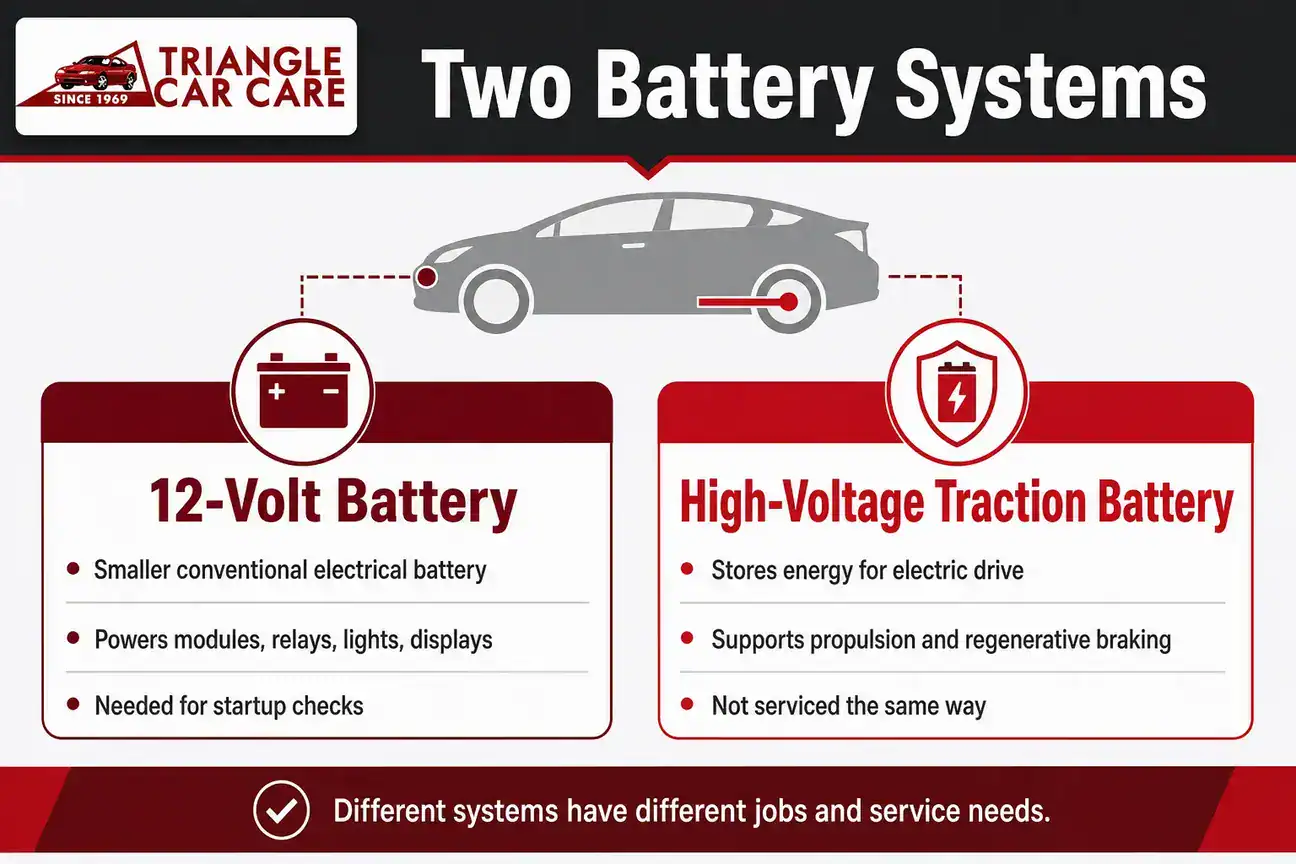
A hybrid’s 12-volt battery is the smaller, conventional electrical battery. It supplies low-voltage power for modules, relays, lighting, displays, locks, security functions, and other electronics. In many vehicles, the computers and control modules need stable low-voltage power before the vehicle can recognize the correct startup conditions.
The high-voltage traction battery is different. It stores energy for the electric drive system and may support propulsion, regenerative braking, and other hybrid functions depending on the vehicle design. It is not simply a bigger version of the 12-volt battery, and it is not serviced the same way.
That distinction matters because a hybrid no start may feel like a major traction-battery failure when the first clue is actually low-voltage power, a connection issue, or a control-system concern. It can also work the other way: a vehicle may show low-voltage symptoms while the root issue is elsewhere. Diagnosis before assumptions keeps the repair path honest.
Battery location, jump-start instructions, warning wording, and charging behavior vary by make and model. Your owner’s manual is the starting point for vehicle-specific directions. Do not assume that a procedure from one hybrid applies to another.
As of October 29, 2026: North Carolina inspection note for hybrid owners
As of October 29, 2026, Wake County’s emissions requirement still applies. North Carolina has enacted legislation intended to end the emissions program in all 19 counties, but the change remains subject to final EPA approval and DMV implementation. Annual safety inspections remain. Check current NC DEQ Inspection/Maintenance Program guidance and NCDMV requirements for your vehicle.
Hybrid electrical warnings and readiness status can matter when an emissions inspection applies. NC DEQ states that eligible 1996-and-newer vehicles in listed counties receive an annual OBD emissions inspection along with a safety/tamper inspection. Triangle Car Care performs NC car inspection services, but a warning light or stored fault should still be treated as a diagnostic clue rather than a reason to clear codes or guess at parts.
12 volt battery symptoms that can show up in a hybrid
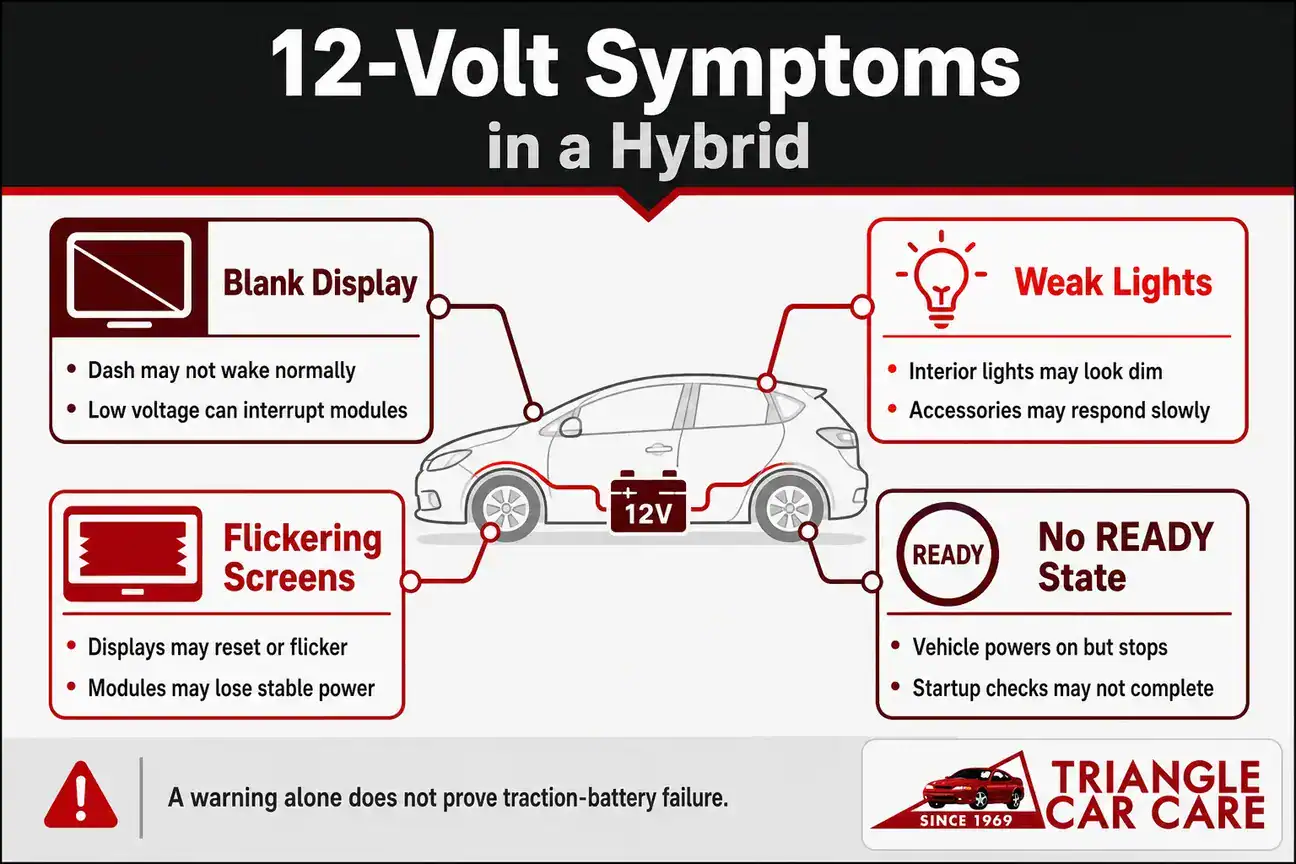
12 volt battery symptoms in a hybrid often look like general electrical trouble. You may see a blank display, weak interior lights, flickering screens, multiple warnings at once, slow accessory response, or a vehicle that powers on but does not reach its required operating state. Some hybrids use a “READY” indication or similar message; others use different wording.
A hybrid battery warning can make the situation feel more serious, and it may be serious. But the warning alone does not prove that the high-voltage traction battery has failed. Low voltage can confuse control modules, interrupt communication, or prevent the vehicle from completing its startup checks.
| Symptom you notice | What it may suggest | What still needs testing |
|---|---|---|
| No response or a no-start | Low 12-volt state, connection problem, authorization issue, or hybrid-system fault | Battery condition, cable connections, stored codes, and the vehicle’s startup state |
| Dim lights or flickering displays | Low voltage, poor connection, or charging-behavior concern | Battery test, voltage-drop testing, grounds, and charging behavior |
| Multiple warnings at once | Possible low-voltage disruption or module communication issue | Module scan, history codes, warning records, and system evaluation |
| Powers on but does not reach READY or equivalent | Startup condition, 12-volt issue, or hybrid-control problem | Owner-manual procedure review and diagnostic testing |
| Warning returns after battery replacement | Charging issue, electrical draw, poor connection, or unrelated fault | Post-repair testing, draw testing, and code review |
A weak battery is only one possibility. A loose terminal, corroded connection, damaged ground, abnormal electrical draw, faulty relay, control-module issue, or charging concern can create similar 12 volt battery symptoms. That is why a battery replacement without testing may not solve the problem.
Hybrid no start: why a dead-looking vehicle may not mean a bad traction battery
A hybrid no start is one of the most common reasons drivers start searching for answers. The vehicle may not unlock normally, may show a blank dash, may flash warning messages, or may seem to wake up halfway and then stop. Those clues often point technicians toward the low-voltage side first, but they still do not identify one failed part.
The 12-volt battery helps power the computers and control circuits that allow the vehicle to decide whether startup conditions are correct. If voltage is too low, unstable, or interrupted by a poor connection, the vehicle may not complete the sequence needed to place the hybrid system into its operating mode. Vehicle-specific owner information may also explain how that make describes a discharged auxiliary or 12-volt battery and what symptoms it may cause.
That does not mean every hybrid no start is a simple 12-volt battery replacement. Possible explanations include a drained battery, poor terminal contact, a body control or security issue, a brake-pedal input concern, a failed relay or fuse, an abnormal parasitic draw, a low-voltage charging concern, or a high-voltage fault that prevents the vehicle from enabling propulsion.
If the vehicle recently sat unused, made several short trips, had accessories left on, received an aftermarket electrical accessory, or needed a jump-start, tell the shop. Those details help narrow the inspection. They do not prove the cause, but they help reproduce the problem and choose the right tests.
Hybrid battery warning messages need context, not guesswork
A hybrid battery warning can mean different things depending on the vehicle. Some warnings refer to the hybrid system broadly. Others may relate to charging, inverter operation, cooling, battery isolation, module communication, or low-voltage power. The wording, color, timing, and whether the warning is steady or intermittent all matter.
Start by reading the exact warning in your owner’s manual. If the warning says to stop, stop. If the vehicle limits power, shuts down, will not enter its normal operating mode, or displays a high-voltage or hybrid-system fault, treat the issue conservatively and arrange qualified help.
A check engine light may also appear with hybrid or electrical symptoms. A code is a clue, not a diagnosis. Triangle Car Care offers check engine light diagnosis, and that process may include code retrieval, freeze-frame review, and testing related to the symptom. Clearing codes to make a warning disappear is not a repair and can make diagnosis harder.
When a hybrid battery warning appears at the same time as dim displays or a no-start, the low-voltage battery and connections deserve attention. When the warning appears while driving, during acceleration, after a collision, after water exposure, or with smoke, odor, or unusual sounds, the safety boundary changes. Do not keep experimenting with restarts.
High voltage battery safety: what not to touch
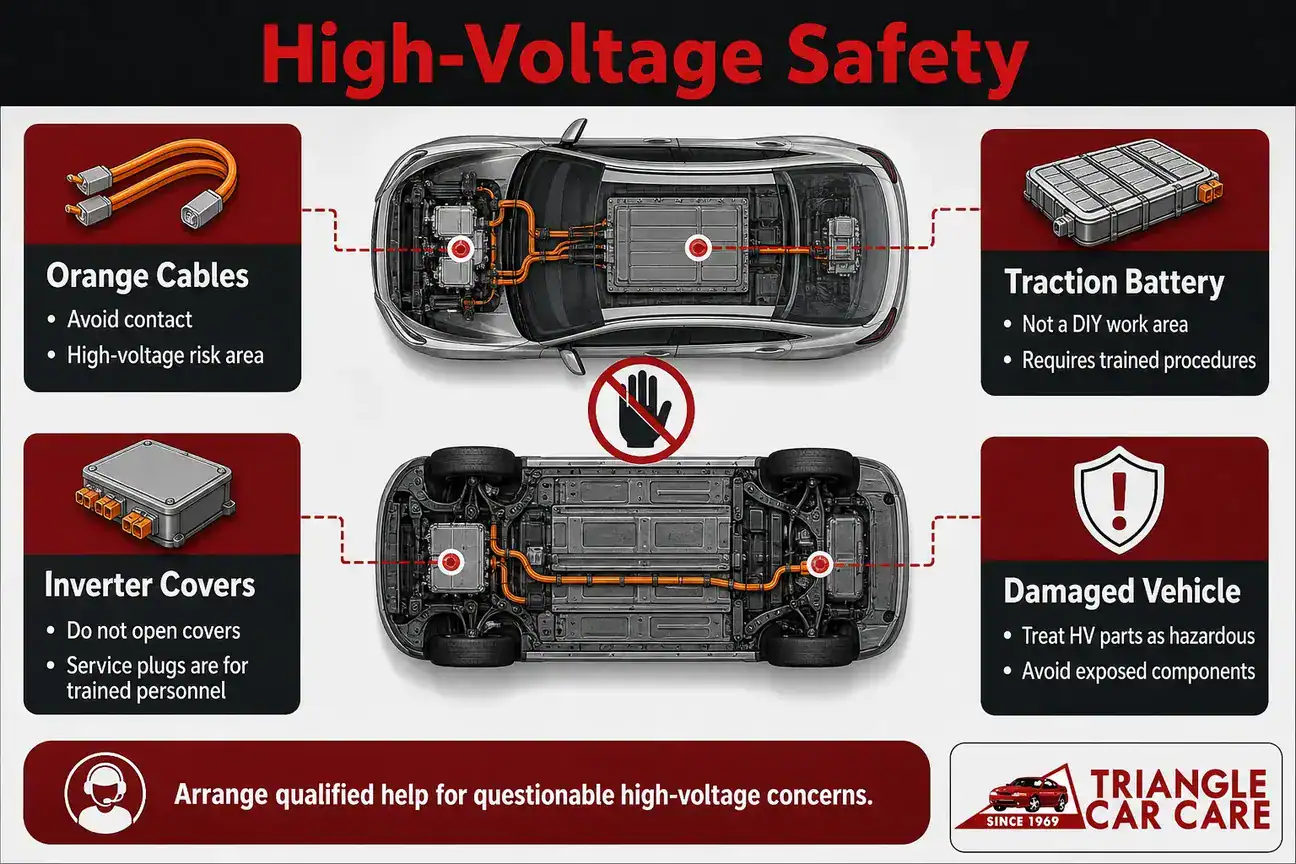
High voltage battery safety is not optional. The high-voltage system in a hybrid is not a DIY work area. The orange cables, traction battery, inverter, service plugs, and high-voltage covers are designed for trained personnel with vehicle-specific procedures and equipment.
The National Highway Traffic Safety Administration’s electric and hybrid vehicle safety information warns that electric-drive vehicles can present high-voltage risks, especially when components are damaged. For a damaged or questionable vehicle, treat high-voltage parts as hazardous and avoid contact with orange cables, exposed components, and battery areas identified as high-voltage risks; see NHTSA electric and hybrid vehicle safety guidance.
Do not touch, disconnect, cut, probe, or repair orange cables. Do not remove covers from a traction battery, inverter, converter, or high-voltage junction area. Do not attempt to diagnose the traction battery with a household meter. Do not assume a vehicle is de-energized because the dash is dark, the key is off, or the 12-volt battery appears dead.
Also be careful around damaged vehicles. Collision damage, flood exposure, fire exposure, underbody impact, melted wiring, leaking fluids, smoke, sparks, hissing, popping, crackling, chemical odor, heat, or unusual battery sounds are all reasons to move away from the vehicle and arrange qualified assistance. Triangle Car Care does not provide towing, roadside rescue, mobile repair, or emergency service.
If your owner’s manual provides a low-voltage jump-start or charging procedure, follow that manual exactly and only if the situation is safe. If you are unsure, do not guess. High voltage battery safety means staying away from traction-battery components and letting trained personnel handle high-voltage evaluation.
What you can safely check before asking for help
Safe checks should stay simple. You can read the warning message, check the owner’s manual, note whether the vehicle reaches READY or its equivalent, and look from a safe position for obvious visible damage. You can also note whether interior lights, locks, screens, and accessories seem weak, normal, or inconsistent.
Do not perform repair procedures in the driveway. Do not remove trim to access the traction battery. Do not work under a vehicle supported only by a jack. Do not open any high-voltage cover. Do not work near smoke, sparks, chemical odors, leaking fluids, or unusual battery sounds.
If the hood or cargo-area battery access is safe and your owner’s manual identifies the 12-volt battery or jump point, you may be able to observe whether a terminal looks loose, corroded, or damaged without touching high-voltage components. If anything looks overheated, melted, wet, or unsafe, stop there.
It helps to write down what happened before the symptom appeared. Did the vehicle sit for several days? Was it cold that morning? Was there a recent battery replacement? Were accessories installed? Did the warning appear after a short trip or while driving? These notes give a technician better evidence than “it would not start.”
When to stop driving a hybrid with electrical symptoms
Stop driving, get to a safe location, shut the vehicle off when appropriate, and arrange towing or qualified roadside help if there is smoke, fire, sparks, a strong chemical odor, hissing, popping, crackling, venting, visible battery damage, melted wiring, leaking fluid, collision damage, flood exposure, or an underbody impact concern.
You should also stop driving if a warning indicates a high-voltage, hybrid-system, braking, steering, or propulsion fault; if braking or steering feels reduced; if the vehicle repeatedly shuts down; or if it cannot reliably enter its required operating state. Do not assume the car is safe based only on a battery reading or the fact that it restarted once.
This is where high voltage battery safety and common sense meet. A dim screen after sitting overnight may end up being a low-voltage issue, but smoke, sparks, unusual battery sounds, or a high-voltage warning changes the risk. Do not put yourself near the vehicle to troubleshoot.
Once the vehicle is stable and no emergency condition is present, the next step is professional inspection. Triangle Car Care can discuss confirmed low-voltage battery service and general diagnostics, but high-voltage hybrid capability is not confirmed. Ask before scheduling if the concern appears to involve the traction battery or orange-cable system.
What professional inspection and testing may evaluate
A professional diagnostic approach starts with the symptom and the vehicle information. For a suspected hybrid 12 volt battery problem, inspection may include the battery case, terminals, cables, hold-down, nearby wiring, and visible corrosion or damage. A battery condition test is more useful than relying only on one resting-voltage reading.
Connection testing matters. A battery can test weak, but a poor terminal, damaged cable, or bad ground can create voltage drop that looks like a battery failure to the vehicle’s electronics. Testing may compare voltage at different points while the system is under the appropriate conditions for that vehicle.
Charging behavior is another piece of the puzzle. Many hybrids do not use a traditional alternator in the same way a conventional vehicle does. The low-voltage system may be maintained through hybrid-system electronics. Testing must be done according to the vehicle’s operating state and service information.
Electrical draw testing may be needed when the battery repeatedly goes low after sitting. The vehicle has to enter its normal sleep state before a technician can judge whether the draw is abnormal. Opening doors, waking modules, or checking too soon can mislead the test.
Modern hybrids also store useful information. A vehicle diagnostic service may review stored, pending, or history codes; freeze-frame data; communication faults; warning history; and module status. That information helps separate low-voltage clues from hybrid-system, brake-system, engine, charging, or emissions-related faults.
Triangle Car Care offers car battery testing and replacement and general diagnostic service for most makes and models, with ASE-certified personnel. Its high-voltage hybrid capability is not confirmed, so the shop should clarify whether it can evaluate the specific vehicle and concern before the appointment is confirmed.
Why replacement alone may not solve 12 volt battery symptoms
Replacing a weak 12-volt battery can be the correct repair when testing supports it. But replacement alone does not answer why the battery became discharged, whether the new battery is charging correctly, or whether another electrical fault created the same 12 volt battery symptoms.
For example, a vehicle may have a poor ground connection that prevents stable voltage. It may have a module staying awake after shutdown. It may have a charging-behavior issue. It may have an accessory drawing power. Or it may have a separate warning that happened to appear when the low-voltage battery was weak.
If a hybrid no start returns shortly after a battery replacement, the next step is not another guess. It is post-repair testing: confirm battery condition, confirm connections, verify charging behavior in the correct operating state, scan relevant modules, and compare stored information to the driver’s notes.
The same is true when a hybrid battery warning remains after the low-voltage battery is replaced. The warning may need a relearn or reset on some vehicles, but it may also represent an unresolved system fault. The answer depends on the specific vehicle and the evidence found during testing.
What to tell the shop before your appointment
Good notes help shorten the path from symptom to evidence. Before contacting a shop, write down the vehicle year, make, model, whether it is a conventional hybrid or plug-in hybrid, the exact warning wording, and the warning-light color. If you can safely take a photo of the dash message, that can help.
Also note whether the problem happens cold, hot, after sitting, after short trips, during stop-and-go driving, while using accessories, or after rain or a car wash. Describe whether the electronics dim, reset, flicker, or work normally. Tell the shop whether the vehicle reaches READY or its equivalent.
Mention recent work or events: battery replacement, jump-start, accessory installation, collision, curb strike, flood exposure, extended storage, or repeated short trips. If there was smoke, odor, leaking fluid, unusual battery noise, sparks, or visible damage, say that clearly and do not drive the vehicle in.
For non-emergency symptoms, you can request an appointment or call 919-787-0966. Provide the details above, and the shop will confirm the day and time. A request is not a confirmed appointment. You can also review Triangle Car Care’s common car care questions for general shop, maintenance, diagnosis, and safety information.
Raleigh driving conditions can affect how symptoms appear
Local driving patterns can shape the clues a driver notices. Short trips, stop-and-go traffic, hot and humid summers, occasional cold snaps, and heavy accessory use can all affect when electrical symptoms show up. That does not prove the cause of a warning, but it helps explain why the same vehicle may act differently from one week to the next.
For climate context, NOAA/National Weather Service Raleigh climate normals document the area’s seasonal weather patterns. Heat, humidity, and temperature swings can be hard on batteries and electrical connections, but vehicle-specific testing is still needed before naming a failed part.
Triangle Car Care is a single independent shop on Glenwood Avenue in northwest Raleigh, serving Raleigh since 1969. For hybrid owners in Wake County dealing with a no-start, dim electronics, or an electrical warning, the practical goal is clear communication: what happened, when it happened, what the vehicle displayed, and what testing found.
Warranty, records, and independent-shop service
Some drivers worry that using an independent shop for maintenance or battery service will automatically void a factory warranty. The Federal Trade Commission explains that warranty coverage cannot generally be denied simply because maintenance or repairs were performed by someone other than the dealer; drivers should keep records and understand their warranty terms. See the FTC guidance on auto warranties and auto service contracts.
That is consumer information, not legal advice. If your hybrid is under a factory warranty, keep maintenance records, note the exact symptom, and ask what warranty terms apply. If a high-voltage traction-battery concern is suspected, the vehicle manufacturer’s warranty terms and required diagnostic process may matter.
Triangle Car Care’s current warranty wording is a 24-month/24,000-mile warranty on most qualifying work. Ask which terms apply to your repair. Do not assume that every battery, diagnostic path, or high-voltage concern has the same coverage.
How to think about the next step
If the only clues are weak electronics, a slow startup sequence, or a one-time no-start after sitting, the low-voltage side is a reasonable place to begin. If there is a repeated hybrid battery warning, a shutdown, reduced propulsion, braking or steering concern, or any smoke, sparks, odor, leaking fluid, or unusual sound, treat the situation as a safety issue first.
The practical order is simple: stay safe, read the owner’s manual, avoid orange cables and high-voltage components, write down the exact symptoms, and arrange inspection when the vehicle can be handled safely. A hybrid no start or warning light may start with the 12-volt battery, but inspection and testing confirm the cause.
For confirmed low-voltage battery concerns and general electrical diagnostics, Triangle Car Care can discuss next steps. Because Triangle Car Care’s high-voltage hybrid capability is not confirmed, ask whether the shop can evaluate your specific make, model, warning, and concern before the appointment is set.
This article is general automotive information, not a diagnosis of your vehicle. Follow your owner’s manual, and have a qualified technician inspect the vehicle when a symptom could affect safe operation.
Frequently Asked Questions
Is a hybrid 12-volt battery the same as the hybrid battery?
No. The 12-volt battery supplies low-voltage electrical power and supports the startup sequence. The high-voltage traction battery supports the electric-drive system. They are separate systems, and a no-start does not identify which one is at fault.
Can a weak 12-volt battery prevent a hybrid from starting?
Yes, on some hybrids it can. A weak or discharged 12-volt battery can prevent the computers and control circuits from completing the startup sequence. The same symptom can have other causes, so battery and system testing are still needed.
Does a hybrid no-start always mean the traction battery is bad?
No. Possible explanations include the 12-volt battery, poor connections, charging behavior, electrical draw, control-module communication, authorization systems, or high-voltage faults. The symptom alone cannot identify a failed part.
What does a shop test for a hybrid 12-volt battery problem?
Testing may evaluate battery condition, terminal and ground connections, voltage drop, charging behavior, abnormal electrical draw, and stored vehicle information such as diagnostic codes and warning history. The exact tests depend on the vehicle and symptom.
Can I work on the orange cables or traction battery myself?
No. Orange cables and traction-battery components are part of the high-voltage system. Do not touch, disconnect, cut, probe, or remove covers from those areas. High-voltage inspection and repair should be handled only by appropriately trained personnel with the required vehicle-specific equipment.
When should I stop driving a hybrid with an electrical warning?
Stop driving and arrange qualified assistance if there is smoke, sparking, unusual battery noise, leaking fluid, strong chemical odor, collision or flood damage, a high-voltage warning, repeated shutdown, or loss of braking, steering, propulsion, or control.
Can Triangle Car Care diagnose or repair my hybrid’s high-voltage system?
Triangle Car Care’s confirmed services include car battery testing and replacement and general diagnostic service. Its high-voltage hybrid capability is not confirmed. Provide the year, make, model, warning message, and symptom when requesting an appointment so the shop can clarify whether it can evaluate the specific concern.
Sources


