


Car Vibrates at Highway Speed? What the Pattern Can Mean
Car Vibrates at Highway Speed? What the Pattern Can Mean
If your car vibrates at highway speed, the pattern matters, but it is not a diagnosis by itself. A shake that appears mainly while cruising can involve tires, wheels, alignment-related conditions, steering, suspension, drivetrain components or another issue that needs inspection and testing. Drivers may describe the same concern as steering wheel vibration, car vibration at speed, high speed vibration or that the vehicle shakes while driving. The useful details are when it starts, where you feel it, whether it changes with acceleration or braking, and whether it is getting worse.
Quick Answer
A highway-speed shake should be treated as a symptom, not a failed-part verdict. If the vibration is severe, rapidly worsening, paired with visible tire damage or making the vehicle hard to control, get to a safe place and arrange towing or roadside help rather than continuing to test it at speed. If the vibration is mild but new, make safe observations and schedule an inspection before it becomes a bigger handling or tire concern.
Why a car vibrates at highway speed: start with the pattern
The first question is not “which part failed?” The first question is “what pattern does the vehicle show?” A symptom is a clue, not a diagnosis. A repeatable shake at cruising speed can send inspection toward rotating tire-and-wheel assemblies, steering, suspension, alignment-related tire wear, wheel-end components or drivetrain parts, but inspection and testing confirm the cause.
That is why your description matters. A mild steering wheel vibration that appears only in a narrow speed range is different from a whole-body shake that gets worse under acceleration. A high speed vibration after a pothole impact is different from a shake that began after tire work. Those differences help a shop choose the next test instead of guessing.
As of November 1, 2026: Wake County inspection note
Vibration diagnosis is different from a North Carolina inspection, but some drivers notice the concern when an inspection is coming due. As of November 1, 2026, Wake County’s emissions requirement still applies for eligible vehicles, and annual safety inspections remain in North Carolina. North Carolina has enacted legislation intended to end the emissions program after final EPA approval and DMV implementation, but drivers should check current NC DEQ Inspection and Maintenance guidance and NCDMV requirements before assuming the rule has changed.
What does a highway-speed vibration feel like?
A speed-related vibration is usually a shaking, buzzing, pulsing or oscillating feeling that shows up while the vehicle is moving. It may begin at a repeatable speed, become more noticeable during steady cruising, fade when you slow down, or change when the road surface changes. Drivers may feel it through the steering wheel, seat, floor, pedals or the whole vehicle.
That pattern is different from a rough idle while stopped at a traffic light. It is also different from a shake that appears only while braking. Those symptoms can overlap in how they feel, but they send the inspection in different directions. If the steering wheel shakes only when you press the brake pedal, the brake system and related wheel-end parts become a separate diagnostic path.
The key point is simple: “the vehicle shakes at speed” describes what you feel, not what failed. A symptom is a clue, not a diagnosis. Road surface, tire condition, vehicle load, temperature, recent service and worn parts can all change how a vibration shows up. That is true whether the driver calls it car vibration at speed or a highway shimmy.
Steering wheel vibration, seat shake, and what location suggests
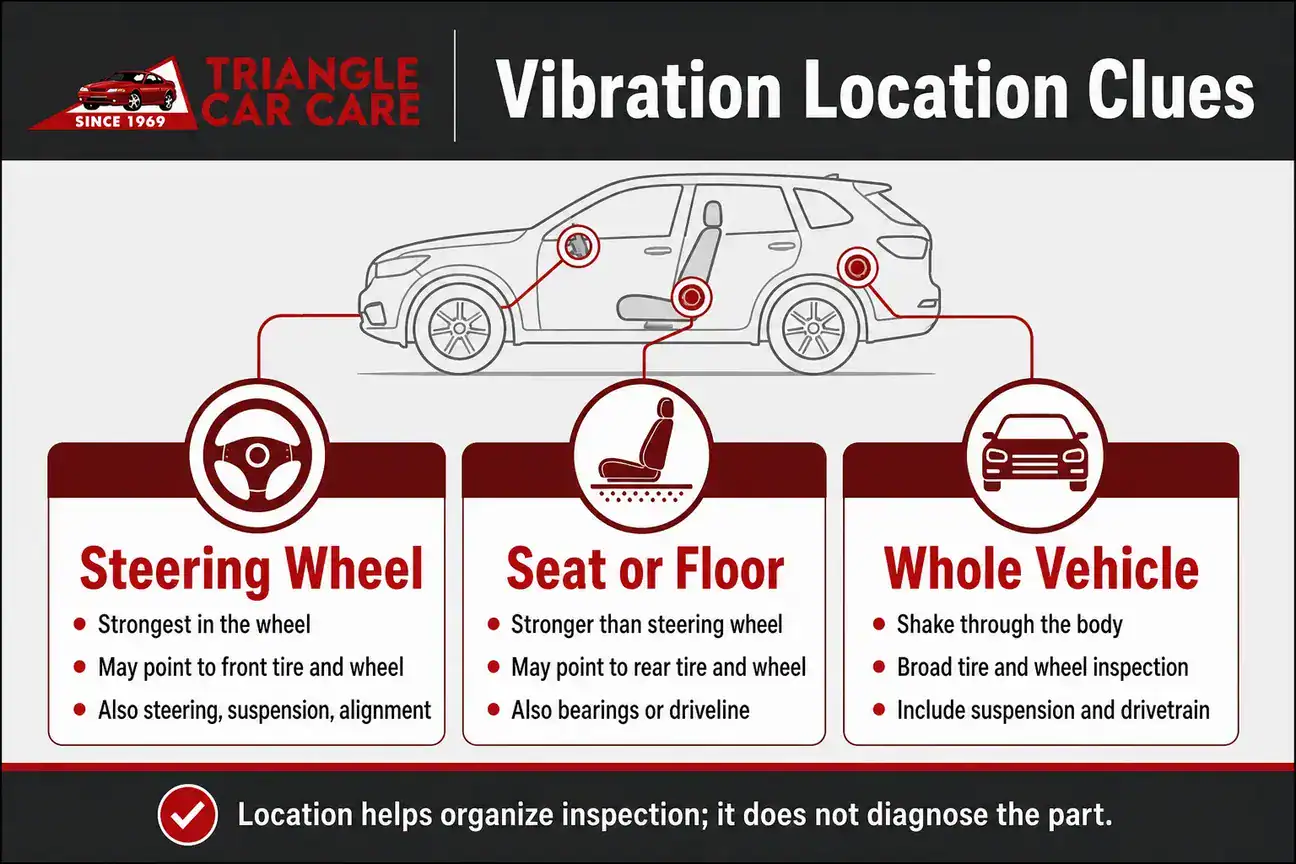
Steering wheel vibration is one of the most useful details to report because it tells the technician where the sensation is strongest. It does not prove the problem is in the front of the vehicle, but it can point the inspection toward the front tire-and-wheel assemblies, steering linkage, suspension, alignment-related conditions or wheel-end components.
If the seat or floor shakes more than the steering wheel, the inspection may also focus on rear tire-and-wheel assemblies, rear suspension, wheel bearings or driveline components. A whole-body shake may require a broader look at tires, wheels, suspension, steering and drivetrain. In other words, location helps organize the inspection, but it does not identify one part with certainty.
| What you notice | Areas a shop may inspect | What it does not prove |
|---|---|---|
| Steering wheel shakes at steady cruising speed | Front tire-and-wheel assemblies, steering, suspension and alignment-related conditions | A certain front-end part has failed |
| Seat or floor vibrates more than the wheel | Rear tire-and-wheel assemblies, suspension, wheel bearings or driveline components | A certain rear tire, wheel or driveshaft problem |
| The whole vehicle shakes | Tires, wheels, suspension, steering, drivetrain or other related systems | One specific failed part |
| Vibration gets stronger under acceleration | CV axles, driveshafts, mounts, transmission-related areas or other drivetrain components | A specific drivetrain component is bad |
| Vibration appears only during braking | Brake system and related wheel-end components | A highway-cruising vibration diagnosis |
Car vibration at speed: common causes to inspect
Car vibration at speed often leads with tires and wheels because they rotate faster as road speed increases. That does not mean the tire is automatically the cause. It means the tire-and-wheel assemblies are logical places to begin inspection, especially when the vibration appears in a specific speed range.
Tire pressure, uneven wear, internal tire damage, tread separation, wheel damage, wheel runout and imbalance can all create a speed-related shake. NHTSA tire safety guidance says poor tire maintenance can contribute to a flat tire, blowout or tread separation, and it recommends checking tire pressure, treadwear and tire damage regularly. That guidance supports safe checking; it does not tell you which part is causing your vehicle’s vibration.
NHTSA also explains that balancing helps wheels rotate properly and helps prevent shaking or vibrating. If a vibration began after tire installation or wheel work, tell the shop exactly when the work happened and whether the shake began immediately or gradually. A technician may inspect the tire-and-wheel assembly and determine whether a tire-and-wheel correction, another wheel-end concern, alignment-related work or a different repair path is appropriate.
Alignment, steering and suspension are also part of the picture. A pothole, curb strike, worn component or looseness can affect handling, tire wear and stability. Alignment-related conditions can contribute to uneven tire wear and pulling, but alignment alone should not be treated as the certain cause of every high-speed shake. If the vehicle also pulls, wanders, clunks or feels unstable, wheel alignment and steering and suspension inspection become important parts of the diagnostic conversation.
Drivetrain concerns can enter the picture when the vibration changes with load. If the shake is stronger while accelerating, fades when coasting, or changes on hills, the inspection may include CV axles, driveshafts, U-joints, differentials, transfer cases, mounts or related components. Triangle Car Care’s drivetrain repair page covers confirmed drivetrain service areas, but the symptom still needs testing before anyone can say what is involved.
Other systems can sometimes mimic a speed-related vibration. A wheel bearing concern, loose shield, underbody contact, engine or transmission mount issue, or engine operation problem may be considered when the pattern supports it. If a warning light is on, a scan can provide clues, but a code is a clue, not a diagnosis. The repair path should come after inspection and testing, not before.
High speed vibration patterns: 7 safe clues to write down
A good high speed vibration description helps the shop reproduce the concern and separate one pattern from another. Do not try to “test” the vehicle at higher and higher speeds. Instead, write down what you already noticed during normal driving and stop if the vehicle feels unstable.
1. The speed range where it starts
Note the approximate speed where the shake first appears and whether it fades above or below that speed. A vibration that appears in a narrow range may send the inspection toward rotating assemblies, but it still needs measurement and visual checks. If the vibration happens at many speeds and keeps getting worse, treat it more cautiously.
2. Whether it happens during steady cruising
A shake during steady cruising can point the inspection toward tires, wheels, steering, suspension or driveline conditions. The phrase car vibration at speed is especially useful when the engine is not struggling, the vehicle is not braking, and you are simply maintaining road speed. That pattern is different from a rough idle or low-speed stumble.
3. Whether acceleration makes it stronger
If the vibration becomes stronger only when you press the accelerator, the drivetrain may move higher on the inspection list. That can include CV axles, driveshafts, U-joints, mounts or other related parts, depending on the vehicle layout. It still does not prove a particular component has failed.
4. Whether coasting changes it
Letting off the accelerator during normal traffic conditions may make some vibrations change. If the shake fades while coasting but returns under load, mention that. If it stays the same whether you are cruising or coasting, tires, wheels, steering or suspension may remain part of the inspection.
5. Whether braking creates a different shake
A vibration that appears only when braking is a different symptom pattern from a highway cruising shake. If braking adds a separate pulsing or steering wheel vibration, tell the shop that it happens under braking. If you want more detail on that pattern, Triangle Car Care has a separate article about when the steering wheel shakes when braking.
6. Whether turning changes the sensation
If the vibration changes during a turn, the inspection may include wheel bearings, steering, suspension or tire loading conditions. Turning can shift vehicle weight and change the load on components. That detail helps, but it is not a safe roadside repair instruction and should not lead to crawling under the vehicle.
7. Whether it began after an impact or tire work
A pothole, curb strike or recent tire work can be important. Raleigh-area drivers often notice a new shake after an impact because tires, wheels, alignment angles and suspension parts can be affected by a hard hit. If the symptom began after service or an impact, say so when you request an appointment.
When a vehicle shakes while driving, when should you stop?
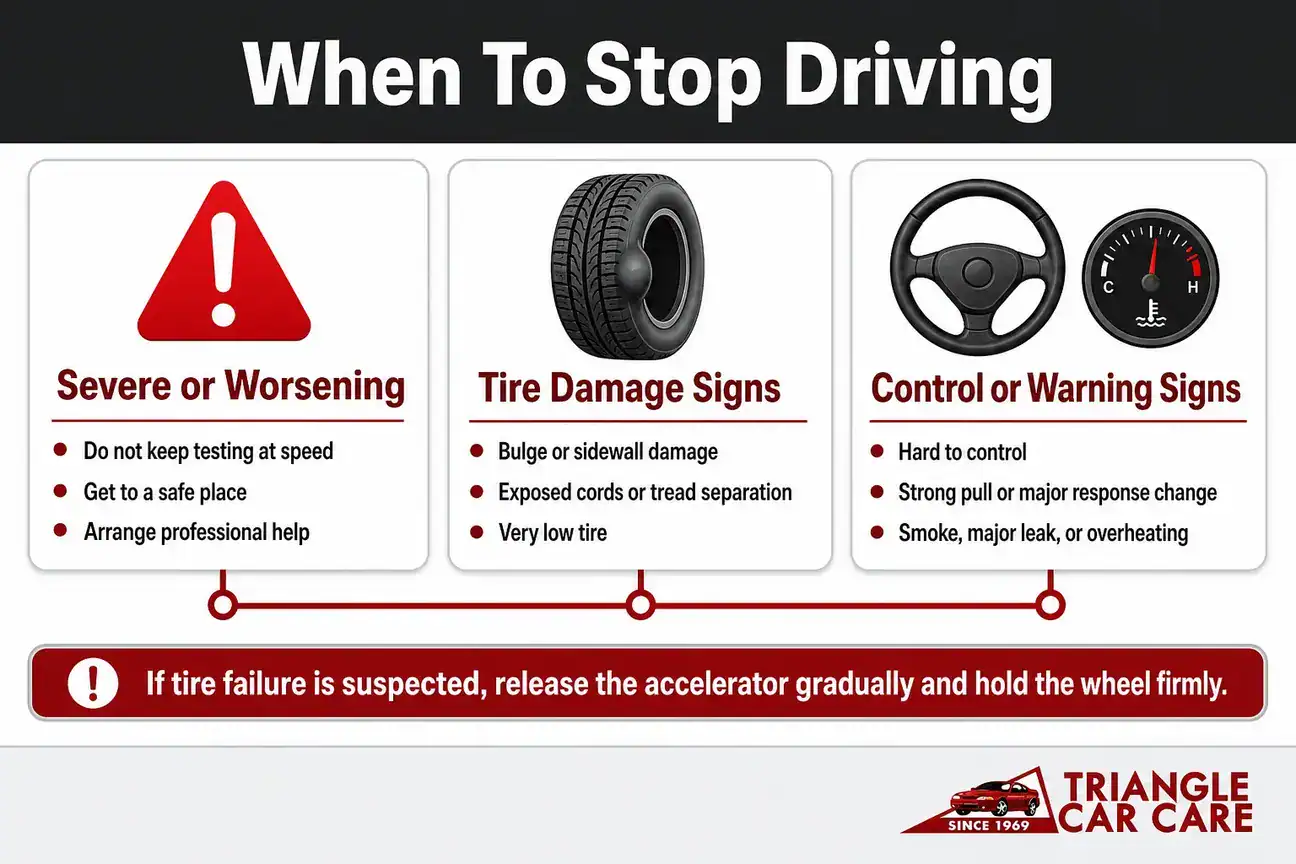
When a vehicle shakes while driving, the safest response depends on severity and control. Do not keep driving at highway speed just to see if it “works itself out.” Reduce risk first. If you suspect tire failure, NHTSA advises drivers not to abruptly brake or turn, to gradually release the accelerator, hold the steering wheel firmly and maintain the lane while moving to safety.
Arrange a safe stop and professional help instead of continuing to drive if the vibration is severe, rapidly worsening or paired with any of these signs:
- A tire bulge, sidewall damage, exposed cords, tread separation or a very low tire.
- Loss of steering control or a major change in how the vehicle responds.
- Strong pulling, wheel wobble or the feeling that something is loose.
- Heavy knocking, grinding or other severe mechanical noise.
- Smoke, a strong burning smell, a strong fuel odor or major fluid loss.
- Overheating, an oil-pressure warning, a flashing check engine light or another serious warning.
- A vibration that gets worse quickly over a short distance.
Get to a safe place, shut off the engine when appropriate, and arrange towing or roadside help. Triangle Car Care does not provide emergency, mobile, roadside or towing service, so the immediate safety step is to secure help first and plan diagnosis after the vehicle can be inspected.
What can you safely check before driving farther?
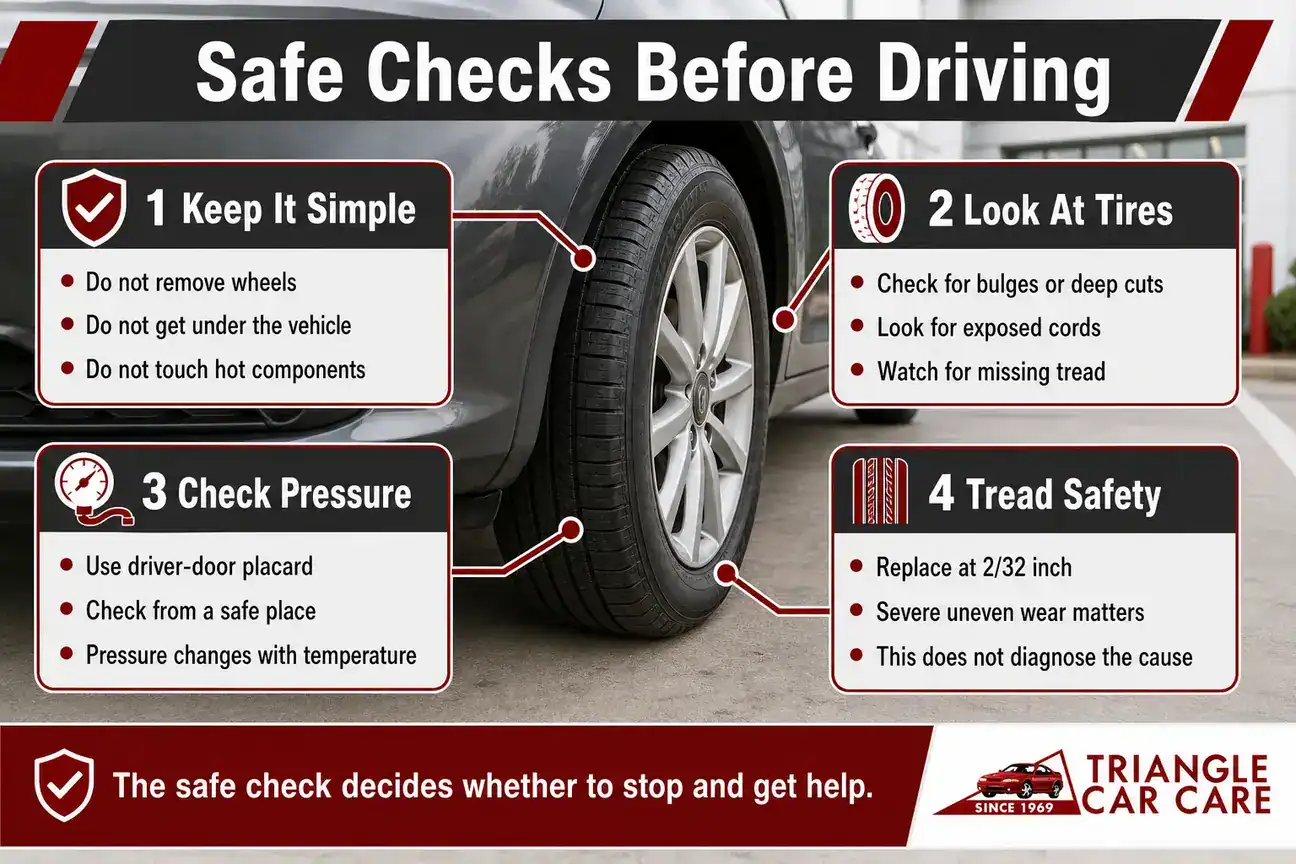
Keep roadside checks simple and safe. Do not remove wheels, get under the vehicle, touch hot components, open pressurized caps or attempt steering, suspension, brake, tire or drivetrain repairs. A safe check is meant to decide whether to stop and get help, not to prove the cause.
Start with visible tire condition if you can do so from a safe place. Look for a bulge, deep cut, exposed cords, missing tread, obvious tread separation or severe uneven wear. NHTSA says tires are not safe and should be replaced when tread is worn down to 2/32 of an inch; that threshold is tire-safety guidance, not a diagnosis of why your vehicle is vibrating.
Check tire pressure against the driver-door placard when the tires are cold. NHTSA defines cold tires as tires on a vehicle that has not been driven for at least three hours. Do not use the pressure molded into the tire sidewall as the vehicle’s recommended inflation pressure. If a tire is very low, visibly damaged or losing pressure, do not treat it as a normal drive-to-the-shop situation.
Look for warning lights and read the basic meaning in the owner’s manual. A flashing check engine light, overheating warning or oil-pressure warning changes the safety decision. Also look around the vehicle for obvious fluid loss without crawling underneath it.
If the checks do not show an immediate stop-driving sign but the vehicle shakes while driving, avoid further high-speed testing. Record the pattern and arrange inspection. If the concern feels like car vibration at speed only on certain roads, note that too, because road surface can change how a vibration is felt.
How vibration diagnosis works at a shop
A proper vibration diagnosis starts with the driver’s description. The speed range, steering wheel versus seat feel, acceleration changes, recent impacts, warning lights and tire history all help decide what to inspect first. The goal is not to guess quickly; it is to separate tire-and-wheel, steering, suspension and drivetrain causes with a logical process.
The inspection may begin with tire pressure, tread, sidewall condition, visible bulges, irregular wear and signs of impact damage. Wheels may be checked for visible bends, cracks or other damage. Tire-and-wheel assemblies may be evaluated for runout, imbalance or other conditions that can produce a speed-related shake. That does not mean every vibration receives the same correction.
Steering and suspension checks may include looking for looseness, wear, damage or mounting-point concerns. Alignment-related angles and tire-wear patterns may be considered when the vehicle pulls, wanders, has uneven tire wear or has a history of pothole or curb impact. For symptoms that fit this path, Triangle Car Care can connect the inspection to suspension and steering repair or an alignment check if those are appropriate.
When the shake changes with acceleration, coasting or load, drivetrain inspection may be part of the vibration diagnosis. Depending on the vehicle, that can involve CV axles, driveshafts, U-joints, differentials, transfer cases, mounts and related components. The technician’s job is to test the pattern, not to replace a part based only on the words “high speed vibration.”
If a warning light is present, scanning the appropriate systems can add useful clues. FTC auto repair guidance says drivers can notice vehicle trouble through visual checks, sounds, handling changes and odors, and its guidance says to get a diagnosis when symptoms indicate trouble. That matches the practical approach here: observations help, but inspection and testing confirm the repair path.
For a vibration concern that does not point clearly to one system, Triangle Car Care’s vehicle diagnostic service is the right starting point. From there, the inspection may lead toward tires and wheels, alignment, suspension, steering, drivetrain or another system based on what the vehicle actually shows.
Why a high speed vibration is not always “just balance”
Many drivers first think about tire balance when they feel steering wheel vibration or a shake at cruising speed. Tire-and-wheel balance can be part of the picture, especially after tire work, but it is not the only possibility. A bent wheel, tire damage, uneven wear, looseness in steering or suspension, alignment-related tire wear, wheel bearing concern or driveline issue can feel similar from the driver’s seat.
It is also possible for more than one condition to be present. A pothole impact might affect a wheel, tire and alignment-related angle at the same time. A worn suspension component may contribute to uneven tire wear, and the worn tire may then become the most noticeable part of the car vibration at speed. That is why diagnosis before assumptions matters.
Another reason not to guess is that vibration can travel through the vehicle. A rear tire concern can sometimes be felt through the body. A front-end issue can be felt through the steering wheel or pedals. A drivetrain vibration may show up through the floor. The driver’s description narrows the search, but it does not replace inspection.
A high speed vibration can also feel different from day to day. Tire pressure, temperature, road surface, vehicle load and whether the vehicle is accelerating or coasting can all change the sensation. Those changes are useful clues, but they still do not identify one failed part without testing.
What should you tell the shop?
The more clearly you describe the pattern, the easier it is to reproduce the concern when practical. You do not need technical terms. Plain details are usually more helpful than a part name you found online.
- The approximate speed where the vibration begins and whether it fades.
- Whether it happens during cruising, acceleration, coasting, turning or braking.
- Where you feel it most: steering wheel, seat, floor, pedals or the whole vehicle.
- Whether the vibration is new, intermittent, constant or getting worse.
- Any recent tire work, wheel work, pothole impact or curb strike.
- Any pulling, wandering, clunking, humming, grinding, burning smell or fluid leak.
- Any warning light, including whether it is steady or flashing.
- Whether the vehicle has been loaded differently than usual.
If the vehicle is not showing a stop-driving condition, you can request an appointment or call 919-787-0966. Describe whether it feels like steering wheel vibration, seat shake or whole-vehicle shake, and mention whether it changes with speed, braking or acceleration. The shop confirms the appointment time after receiving the request.
Raleigh driving conditions that can make vibration show up
Local driving conditions can make a vibration more noticeable without proving the cause. In Raleigh, potholes, curb strikes, stop-and-go traffic and seasonal temperature swings can all expose tire, wheel, alignment, steering or suspension concerns. A vehicle may feel normal at neighborhood speeds, then begin shaking once it reaches cruising speed.
Temperature changes can also affect tire pressure. That is one reason the door-placard pressure check matters, especially before longer highway driving. Follow your owner’s manual and your vehicle’s maintenance schedule rather than one universal mileage rule for every car, truck or SUV.
Triangle Car Care is an independent Raleigh auto repair shop on Glenwood Avenue, serving Raleigh since 1969. The shop works on most makes and models with ASE-certified personnel and clear communication focused on inspection and testing. Triangle Car Care provides a 24-month/24,000-mile warranty on most qualifying work; ask which terms apply to your repair.
Where North Carolina inspections fit in
A safety or emissions inspection is not the same as a full vibration diagnosis. A North Carolina safety inspection checks required safety items, and an emissions inspection applies to eligible vehicles in covered counties. A vibration complaint may need a separate road-test and diagnostic process even if inspection items are also being reviewed.
For inspection rules, NCDMV safety inspection information explains North Carolina’s annual safety inspection requirement, and NCDMV emissions inspection information explains emissions requirements and exemptions. If you are scheduling inspection and vibration evaluation together, say that clearly when you contact the shop so the concerns can be handled appropriately.
Final thought: use the pattern, but do not guess the part
When a car vibrates at highway speed, the best next step is to reduce risk, record the pattern and get the vehicle inspected. Steering wheel vibration, seat shake, acceleration changes and recent tire or wheel work all matter, but none of them names the failed part by themselves. A careful process is what separates tire-and-wheel concerns from alignment, suspension, steering, drivetrain or other causes.
If the symptom is severe, worsening or paired with tire damage, loss of control, smoke, major fluid loss, overheating or a serious warning light, get to a safe place and arrange towing or roadside help. If it is not an immediate stop-driving situation, avoid high-speed testing and schedule inspection so the vehicle can be checked under controlled conditions.
This article is general automotive information, not a diagnosis of your vehicle. Follow your owner’s manual, and have a qualified technician inspect the vehicle when a symptom could affect safe operation.
Frequently Asked Questions
Is a car vibration at highway speed always caused by tire balance?
No. Tire-and-wheel conditions are common possibilities, but alignment-related conditions, suspension, steering, drivetrain components and other issues can create a similar shake. Inspection and testing are needed before recommending a correction.
Why does the steering wheel shake but the seat does not?
That observation may lead a technician to inspect the front tire-and-wheel assemblies, steering and suspension first. It is useful information, but it does not identify the failed part by itself.
Why does the vibration happen only when accelerating?
A load-dependent vibration may lead to drivetrain and mount inspections, along with tire, wheel, steering and suspension checks. It is not enough to diagnose a CV axle, driveshaft or other component remotely.
Can I keep driving if the vibration is mild?
Do not treat continued driving as automatically safe. If the vibration is new, worsening or paired with tire damage, pulling, wobble, unusual noise, smoke, fluid loss or a warning light, stop in a safe place and arrange professional help. If there are no immediate danger signs, avoid high-speed testing and arrange an inspection promptly.
What should I do if the vibration started after tire service?
Tell the shop when the tire work occurred and whether the symptom began immediately afterward. The tire-and-wheel assembly may need inspection for mounting condition, balance-related concerns, wheel damage, tire damage or another issue.
Can wheel alignment cause highway-speed vibration?
Alignment-related conditions can contribute to uneven tire wear, pulling and handling concerns, but alignment is not automatically the cause of every vibration. A shop should inspect the tires, wheels, steering and suspension before recommending a correction.
Can a warning light and vibration be related?
They can be related, depending on the warning light and operating conditions. A code or warning light is a clue rather than a diagnosis, so record the light’s color, whether it is steady or flashing, and when the vibration happens.
Will a North Carolina inspection identify every vibration problem?
No. A safety or emissions inspection is not a complete diagnosis of every tire, wheel, suspension, steering or drivetrain concern. If you have a vibration complaint, ask for that symptom to be evaluated separately from the required inspection process.
Sources


