


Car Tire Keeps Losing Air but No Nail Is Visible
Tire losing air? 5 safe moves when no nail shows
If you have a tire losing air and you cannot see a nail, the leak still deserves attention. A visible puncture is only one possibility; air can also escape around the valve area, the tire bead, the wheel rim, a hard-to-see tread injury, or a sidewall or shoulder problem. A TPMS light is a warning clue, not a diagnosis, and NHTSA says the TPMS symbol means at least one tire is significantly underinflated. The next step is to check cold pressure against the driver-door placard or owner’s manual, note the pattern, and avoid assuming the cause until inspection and testing confirm it.
Quick Answer: A tire can lose air without an obvious nail because the leak may be in the tread, sidewall, valve stem, wheel rim, or bead-sealing area. A recurring pressure loss should be treated as a symptom that needs inspection, not as proof of one failed part. If the tire looks flat, pressure drops quickly, the vehicle vibrates, pulls, makes unusual noise, or becomes harder to steer, get to a safe place and arrange professional help.
5 safe moves when no nail is visible
When no object is sticking out of the tire, the goal is to gather useful information without turning a simple check into an unsafe roadside repair. These five moves help separate a routine pressure check from a situation that needs immediate attention.
Move 1: Check pressure cold when possible
NHTSA recommends checking all tires, including the spare, when they are cold, meaning the car has not been driven for at least three hours. A cold reading gives you a more useful baseline than a reading taken right after driving, when heat can raise pressure.
Move 2: Use the vehicle placard, not the tire sidewall
The correct target pressure comes from the driver-door label or owner’s manual, not the maximum printed on the tire. The number on the tire sidewall is not the vehicle manufacturer’s recommended pressure for normal driving.
Move 3: Write down the pattern
Note which tire has the pressure drop, how much it changes, and how often the warning returns. A written pattern can help separate one tire that keeps losing air from a temperature change that affects several tires at once.
Move 4: Look only for obvious damage
Check for visible objects, cuts, bulges, exposed cords, bent rim areas, or an uneven bead line, but do not remove embedded objects or attempt a repair. Your job is to observe safely, not to prove the leak source on the roadside.
Move 5: Change your plan if symptoms worsen
Rapid pressure loss, vibration, pulling, unusual noise, or steering difficulty calls for getting to a safe place and arranging professional help. Do not keep driving just because you cannot see a nail.
Why tire losing air belongs in the clue column
A tire with recurring pressure loss may look normal from the outside. The leak may be small, hidden on the inner tread, located at the bead where the tire seals to the wheel, or tied to the valve area. A pressure reading tells you the tire is low; it does not identify the leak location.
This is why Triangle Car Care approaches symptoms with diagnosis before assumptions. A pressure change, TPMS light, vibration, or pull gives the technician a starting point, but inspection and testing are what confirm the cause. That matters because two vehicles can show the same warning light for different reasons.
A small amount of normal air loss can happen over time. Cold weather can also lower pressure readings. Still, a repeated tire pressure drop in the same tire should not be dismissed as “just temperature,” especially if it returns after inflation or is paired with visible damage, noise, vibration, pulling, or steering changes.
Is it a slow tire leak or rapid deflation?
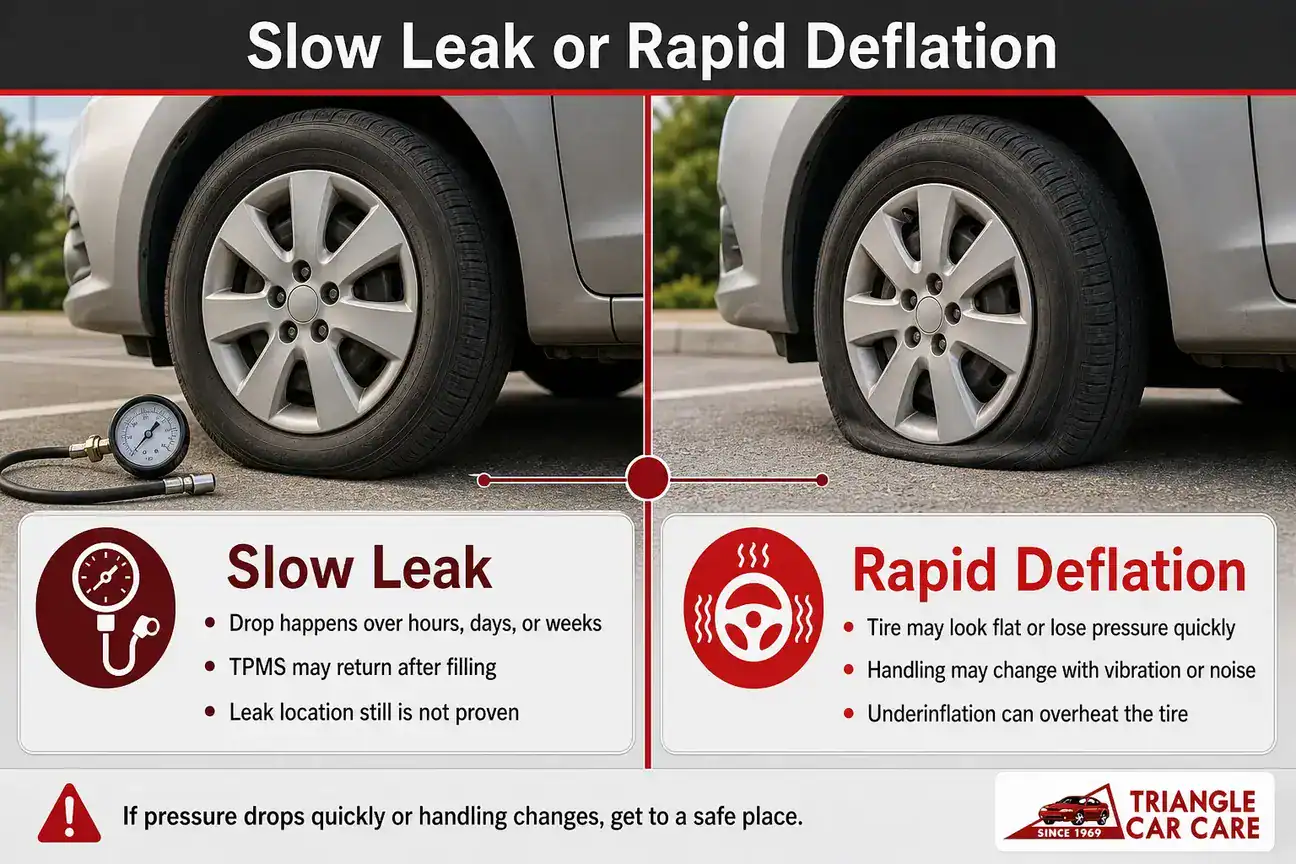
A slow tire leak usually shows up as a gradual tire pressure drop over hours, days, or weeks. You may fill the tire, drive normally for a while, and then see the TPMS light again. That pattern is useful, but it does not prove whether the issue is a hidden puncture, valve stem leak, tire bead leak, wheel-rim problem, or another cause.
Rapid deflation is different. A tire that looks flat, loses pressure quickly, changes the way the vehicle handles, or causes vibration or unusual noise should be treated more conservatively. Underinflation can generate heat and stress in a tire; NHTSA notes that driving on an underinflated tire can cause the tire to overheat and eventually lead to tire failure.
| Pattern | What you may notice | What it means |
|---|---|---|
| Slow tire leak | Pressure drops over days or weeks; TPMS returns repeatedly; the tire may not look flat | Inspection is needed; the source is not confirmed by the pattern alone |
| Rapid pressure loss | Tire looks low or flat; pressure falls quickly; noise, vibration, pulling, or handling changes appear | Get to a safe place and arrange professional help |
| Temperature-related change | Several tires read lower after a cold snap | Compare cold readings with the door placard, but do not ignore repeated loss from one tire |
Tire pressure drop: how to measure it correctly
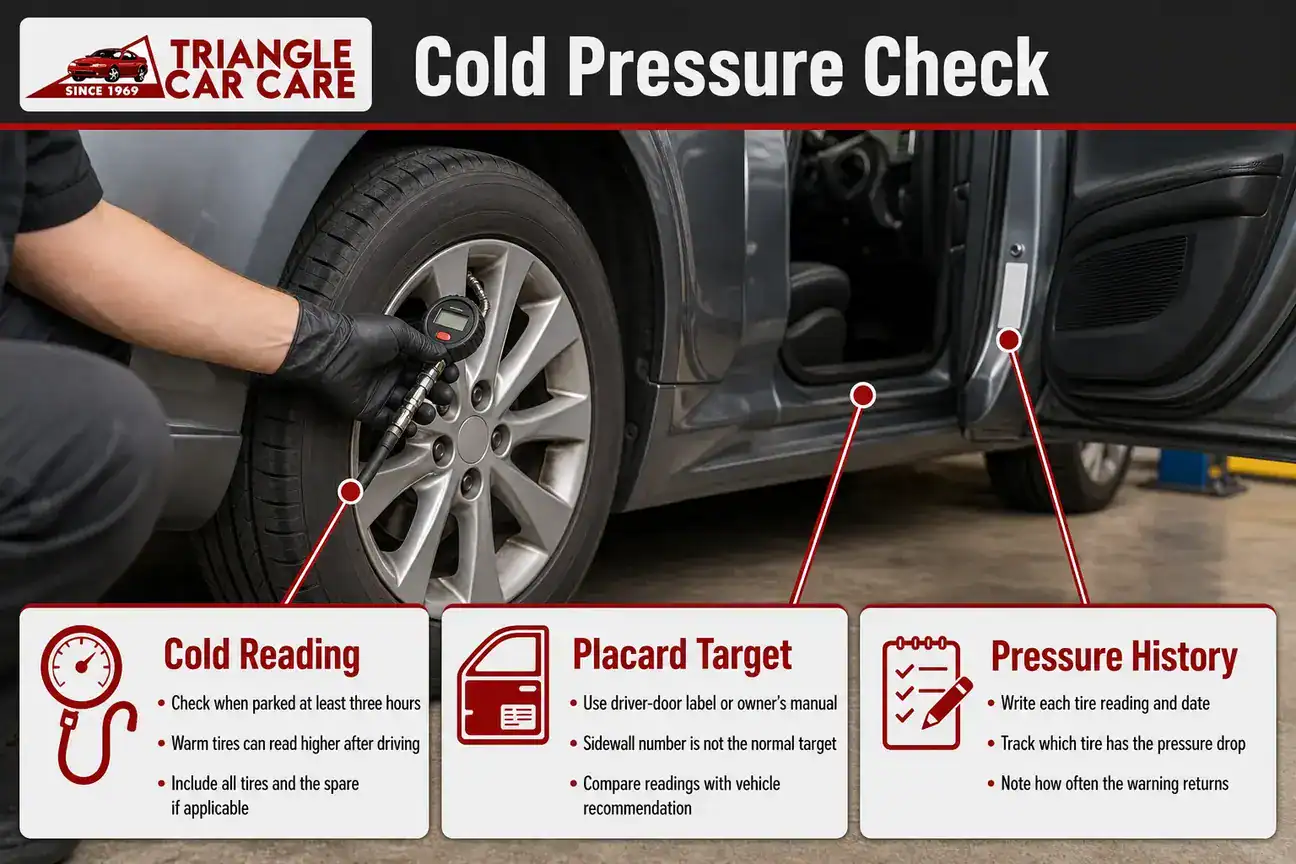
A useful pressure history starts with a cold reading. According to NHTSA tire safety guidance, drivers should check tire pressure at least once a month when tires are cold. Cold means the vehicle has not been driven for at least three hours. If you just drove several miles, the reading may be higher because the tire is warm.
Use the Tire and Loading Information label on the driver’s side door edge or door post, or the owner’s manual. NHTSA specifically says the correct pressure is the vehicle manufacturer’s recommendation, not what is listed on the tire itself. The number on the tire sidewall is not the target pressure for normal use.
Write down the reading for each tire and the date. If one tire consistently shows a tire pressure drop while the others stay close to the placard value, that pattern is helpful for inspection. If all four tires drop after a cold spell, temperature may be part of what you are seeing, but the pressures still need to be corrected to the vehicle’s recommendation.
A TPMS warning that returns after inflation is another important clue. The system can alert you to low pressure, but it does not tell you whether the cause is a slow tire leak, a valve stem leak, a tire bead leak, wheel damage, or a puncture you cannot see.
Where could the air be escaping?
The following areas are common inspection points when a driver reports repeated air loss with no obvious nail. They are possibilities, not a remote diagnosis. The exact cause depends on what inspection and testing find.
A tread puncture that is hard to see
A small screw, nail, glass shard, or metal fragment may be embedded in the tread without being obvious from a quick glance. It may be tucked into a groove, hidden on the inner shoulder, or positioned where it is difficult to see without safely lifting and rotating the tire. A slow tire leak from the tread can also act differently depending on the tire position and how the vehicle is parked.
Do not pull out an embedded object. Removing it can sometimes make air loss worse, and it still will not tell you whether the tire can be serviced. The safer observation is to note the tire position, pressure reading, and whether you saw anything unusual.
Sidewall, shoulder, or impact damage
The sidewall and shoulder of the tire can be damaged by potholes, curb contact, road debris, or a previous severe underinflation event. A cut, bulge, scrape, exposed cord, or unusual swelling is not something to ignore. Even if the air loss seems slow, sidewall damage can affect tire structure.
If the tire has a bulge, exposed cords, obvious sidewall damage, or a sudden change in handling, do not keep driving simply because the tire still holds some air. Get to a safe place and arrange professional help.
Valve stem leak: what the valve area may reveal
A valve stem leak is another possible source when the tire keeps needing air. Air may escape around the valve stem, valve core, or valve base. Sometimes the cap area looks normal, and the leak only shows up during testing.
A missing valve cap does not automatically prove a valve stem leak, and a cap alone does not seal every possible valve issue. Still, the valve area is worth noting if the cap is missing, damaged, loose, or surrounded by visible dirt or corrosion. Inspection can help determine whether the valve area is involved or whether the real source is elsewhere.
Valve stems can also be part of a TPMS sensor assembly on many vehicles. The TPMS light may be tied to low pressure, a sensor-related concern, or both. If the warning behavior is unusual, a broader vehicle diagnostic service may be needed to separate a tire-pressure problem from a sensor or system clue.
Wheel rim damage or corrosion
The wheel rim forms part of the sealing surface. A bent lip, corrosion, crack, or damaged finish may allow air to escape even when the tire tread looks clean. This can happen after a pothole, curb impact, or road-debris strike, but the impact history does not prove the rim is the cause.
Wheel damage can also create vibration or a steering change. If the vehicle has a new vibration, a pull, or uneven tire wear along with pressure loss, inspection may need to include the tire, wheel, alignment, and steering components rather than focusing only on the tread.
Tire bead leak: why the wheel seal matters
A tire bead leak occurs around the area where the tire bead seals against the wheel. Corrosion, debris, damage, or an imperfect seal can be possible contributors. A tire bead leak may be slow enough that the tire appears normal in the driveway but loses pressure after sitting overnight or over several days.
Because the bead area is partly hidden by the wheel and tire interface, confirmation usually requires professional inspection. A visible bubble test may reveal some leaks, but it does not replace a full evaluation when there is repeated underinflation, damage, or uncertainty about repairability.
A suspected tire bead leak should be treated as one possibility among several. A recurring tire pressure drop in the same tire could still come from the tread, valve stem, rim, or another condition that is not visible from the outside.
Temperature, normal air loss, and why patterns matter
NHTSA notes that a tire does not have to be punctured to lose air; all tires naturally lose some air over time. Temperature changes can also affect pressure readings. In practical terms, a cold morning may make several tires read lower than they did the day before.
The pattern matters. A similar pressure change across all four tires after a cold snap is different from one tire repeatedly dropping while the others stay close to the placard value. The first pattern may point you toward checking and correcting cold pressures. The second pattern deserves closer inspection for a slow tire leak or other specific source.
Related alignment, suspension, or steering findings
Alignment or suspension concerns do not automatically cause an air leak. However, they can show up alongside tire-pressure complaints. Uneven wear, a pull, steering-wheel off-center, vibration, or a history of hitting a pothole or curb can change what needs to be inspected.
If uneven wear or pulling is present, a wheel alignment evaluation may be part of the next step. If the vehicle also has clunks, steering looseness, vibration, or handling changes, a suspension and steering inspection may be appropriate. These checks do not replace tire inspection; they help look at the whole set of clues.
What should you do when the TPMS light comes on?
A TPMS warning means the vehicle has detected low pressure in at least one tire. It is not a leak-location tool. It cannot tell you, by itself, whether the problem is a valve stem leak, tire bead leak, hidden puncture, rim issue, or temperature-related pressure change.
NHTSA advises that when the low-pressure warning appears, drivers should inspect the tires and check tire pressure as soon as possible. When you can do it safely, check the pressure of all four tires and the spare if applicable. Compare the readings with the driver-door placard or owner’s manual.
If you add air and the warning turns off, that does not prove the leak is fixed. It only means the pressure may have returned above the system’s warning threshold. A slow tire leak can come back later, and a recurring warning should be taken seriously.
If the TPMS warning is flashing, behaving inconsistently, or paired with another warning light, treat that behavior as another clue. The owner’s manual can help explain the symbol for your vehicle, and inspection can determine whether the concern is low pressure, a sensor-related issue, or another system clue.
When should you stop driving and arrange help?
Do not keep driving just because no nail is visible. A tire can be underinflated, damaged, or losing air from a hidden area. If pressure is dropping quickly or the vehicle feels different, the safer response is to reduce risk rather than trying to “make it a little farther.”
Get to a safe place as soon as practical and arrange towing or roadside help from an appropriate provider if you notice any of the following:
- The tire looks flat or severely low.
- Pressure drops quickly after inflation.
- The vehicle vibrates, pulls, wanders, or becomes harder to steer.
- You hear thumping, flapping, grinding, or other unusual tire or wheel noise.
- You see a bulge, exposed cords, sidewall cut, rim damage, or smoke.
- The vehicle has handling or stopping changes.
- You suspect the tire was driven while severely underinflated.
Triangle Car Care does not provide emergency, mobile, roadside, or towing service. If moving the vehicle would create a safety concern, do not drive it to the shop. Get the vehicle and occupants out of harm’s way and arrange appropriate assistance.
What can you observe before an appointment?
Good notes can shorten the guessing game. You do not need to perform repairs or take anything apart. Just record what you can safely observe.
- The pressure reading for each tire when cold.
- The date, time, and outside conditions when you checked it.
- Which tire has the recurring tire pressure drop.
- How long it takes for the TPMS light to return after inflation.
- Whether the pressure loss happens after sitting, highway driving, stop-and-go driving, turning, braking, or cold weather.
- Any visible tread object, cut, bulge, exposed cord, rim damage, or uneven wear.
- Any recent pothole hit, curb contact, tire rotation, alignment, suspension work, or wheel work.
- Any vibration, pull, steering change, noise, or change in braking feel.
Photographs can help if they are taken safely while the vehicle is parked. A clear photo of the tire, wheel, valve area, tread wear, and dashboard warning can give the shop useful context. Do not stand in traffic, crawl under the vehicle, or work under a vehicle supported only by a jack.
How may professional inspection narrow down the cause?
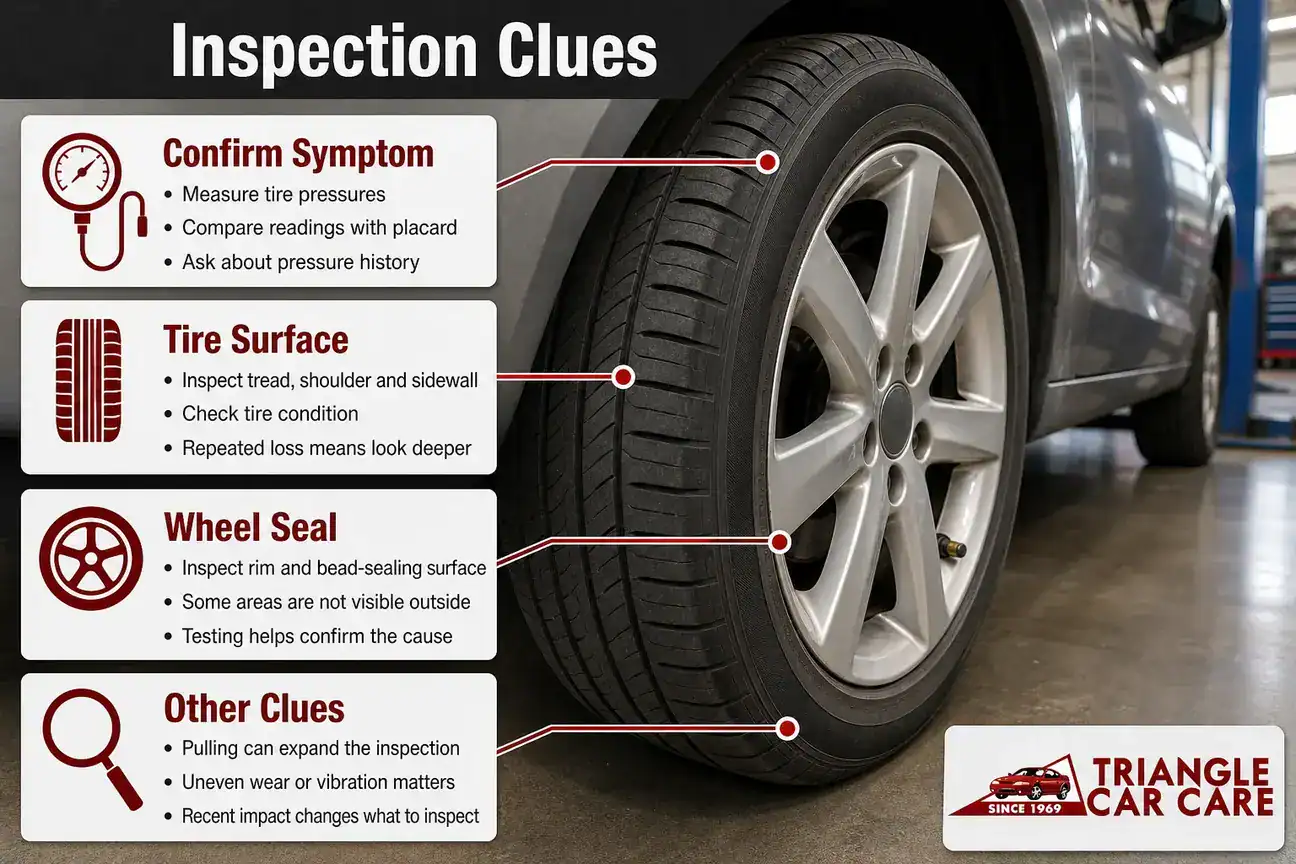
Professional inspection starts by confirming the symptom. That may include measuring tire pressures, comparing them with the placard, checking tire condition, and asking about the pressure history. The goal is not to guess the failed part; it is to follow the evidence.
A tire and wheel inspection may look at the tread, shoulder, sidewall, valve area, rim, and bead-sealing surface. Depending on the findings, a qualified tire professional may need to inspect areas that are not visible from the outside. The repeated pressure loss itself is the reason to look deeper.
If the driver reports pulling, uneven wear, vibration, or a recent impact, the inspection may expand. Alignment, suspension, steering, wheel condition, and tire wear can be related clues. A tire rotation history may also help identify whether the pressure loss followed a tire to a new position or stayed with one corner of the vehicle.
Rotation is maintenance and wear management, not a leak repair by itself. It can, however, help reveal uneven wear patterns, tire-position history, and whether a symptom changed after the tires were moved. Your vehicle’s maintenance schedule and owner’s manual remain the guide for routine service intervals.
If the TPMS light, dashboard messages, or other vehicle symptoms are part of the complaint, diagnostic testing may be appropriate. The important point is that a warning light or pressure reading is a clue. Inspection and testing confirm whether the issue is tire-related, wheel-related, sensor-related, alignment-related, or something else.
Raleigh driving conditions that can change what you notice
Raleigh drivers see a mix of stop-and-go traffic, hot humid summers, occasional cold snaps, potholes, and curb impacts. None of those conditions proves why a tire is losing pressure, but they can affect when the symptom appears and what else you notice. For example, a cold morning may reveal low pressure across multiple tires, while a pothole impact may be followed by vibration, rim damage, or a new pull.
The National Weather Service Raleigh climate normals are a useful reminder that local temperatures vary enough through the year to change cold-pressure readings. That is one reason cold checks and written pressure history are helpful. Still, a repeated pressure loss from one tire in Wake County traffic should not be waved off as weather without inspection.
Local driving conditions can also make small symptoms more noticeable. A tire that drops pressure slowly may feel normal on a short errand but show vibration at higher speeds. A wheel that was bent by an impact may not be obvious until the vehicle is driven under the right conditions. The safer approach is to document the pattern and have the tire and related systems inspected.
What happens next at Triangle Car Care?
Triangle Car Care is an independent auto repair shop on Glenwood Avenue, serving Raleigh since 1969. For a recurring low-pressure complaint, the most useful information you can bring is the pressure history, tire position, TPMS behavior, recent impacts, and any noise, vibration, pulling, or steering change.
Depending on the symptoms, the visit may involve confirmed services such as tire rotation, wheel alignment evaluation, suspension and steering inspection, or diagnostic service for TPMS and related vehicle clues. The shop’s role is to inspect, test, and communicate clearly before assumptions are made. This article does not promise tire sales, tire repair availability, a price, or a completion time.
If the vehicle can be moved without creating a safety concern, you can request an appointment or call 919-787-0966. Include the tire-pressure readings, how often the warning returns, which tire is affected, and whether you noticed any pull, vibration, noise, impact, or visible damage. The shop confirms the appointment time.
Triangle Car Care has ASE-certified personnel and offers a 24-month/24,000-mile warranty on most qualifying work; ask which terms apply to your repair. The right next step depends on what inspection and testing find, because the same warning can come from different causes on different vehicles.
A final word on repeated low pressure
A recurring tire losing air problem should be handled as a safety-related clue, not as a nuisance to keep refilling indefinitely. A slow tire leak may stay manageable for a while, but it can also become a faster pressure loss without much warning. A tire pressure drop after cold weather may be normal across multiple tires, but one tire that repeatedly falls low deserves closer attention.
Use the driver-door placard, record cold readings, watch for TPMS behavior, and pay attention to changes in handling. If symptoms point to rapid deflation or damage, stop in a safe place and arrange help. If the concern is recurring but not changing quickly, schedule inspection so the cause can be confirmed instead of guessed.
This article is general automotive information, not a diagnosis of your vehicle. Follow your owner’s manual, and have a qualified technician inspect the vehicle when a symptom could affect safe operation.
Frequently Asked Questions
Can a tire lose air without a nail or screw?
Yes. Possible sources include a difficult-to-see tread puncture, sidewall or shoulder damage, a valve-area leak, a wheel-rim sealing issue, or a bead leak. Temperature changes and normal air loss can also affect readings, but recurring loss still needs inspection.
Why does my TPMS light keep coming back after I add air?
Adding air may restore pressure temporarily without identifying the source of loss. The TPMS system warns that pressure is low; it does not prove whether the cause is in the tread, sidewall, valve, wheel, bead, or sensor system.
Is a slow tire leak safe to drive on?
Do not treat a recurring leak as proof the vehicle is safe to keep driving. Check the pressure, watch for changes, and arrange inspection. If pressure drops quickly, the tire looks damaged, or handling changes, get to a safe place and arrange professional help.
Should tire pressure be checked when the tires are warm or cold?
Check tire pressure when the tires are cold whenever possible. Use the pressure listed on the driver-door placard or in the owner’s manual, not the maximum pressure printed on the tire sidewall.
Could the wheel rim or tire bead be causing the leak?
They could be possible leak areas, especially after an impact or when corrosion or sealing damage is present. Confirmation requires inspection and may require evaluating areas that are not visible from outside the tire and wheel assembly.
Could alignment or suspension problems cause repeated low tire pressure?
Alignment or suspension concerns do not automatically prove an air leak, but they may contribute to uneven wear or handling symptoms that appear alongside pressure loss. Inspection may need to consider the tire, wheel, alignment, suspension, and steering together.
What should I tell the shop about a tire that keeps losing air?
Share the tire position, cold pressure readings and dates, TPMS behavior, recent pothole or curb impacts, visible damage, and any noise, vibration, pull, or steering change. Also mention recent tire rotation, alignment, suspension, or wheel work.
Sources


