


ABS and Brake Warning Lights On Together? What to Do
ABS brake light on with red brake light? 7 Safe Moves
Quick Answer: If you see the amber ABS light and the red brake warning light together, treat the ABS brake light on situation as a warning that needs prompt attention, not as proof of one failed part. For Raleigh drivers, the first safe checks are to make sure the parking brake is fully released and read the owner’s manual for your specific vehicle. If braking feels reduced, the pedal sinks, fluid is leaking, or the vehicle does not respond normally, get to a safe place and arrange towing or professional help rather than continuing to drive.
Those two lights can appear for several reasons, and the right next step depends on what the vehicle is doing. The important point is diagnosis before assumptions: a warning light is a clue, not a diagnosis. The vehicle needs inspection and testing to confirm whether the concern involves the parking brake circuit, brake fluid level, hydraulic braking, wheel-speed information, ABS control, wiring, or another vehicle-specific condition.
What the ABS warning light and red brake light can mean
The ABS warning light usually means the vehicle has detected a possible issue in the anti-lock braking system or a related monitoring circuit. The anti-lock system is designed to help control wheel lockup during certain braking conditions, but the light itself does not tell you which part, wire, sensor, hydraulic unit, or control input is involved.
The red brake light deserves even more caution because it may be tied to the parking brake, brake-fluid level, a brake-system warning circuit, or a manufacturer-specific condition. On some vehicles, the red brake light may appear when the parking brake is set. On others, it may also warn about a condition that can affect braking performance.
Warning-light colors, symbols, and wording vary by make, model, and model year. That is why the owner’s manual matters. A dashboard message such as “BRAKE,” “ABS,” “Service Brake System,” or a symbol in a circle should be interpreted using the manufacturer’s instructions for that vehicle, not a generic internet answer.
The driver-facing purpose of an ABS warning is also important. In a NHTSA interpretation discussing ABS malfunction indicators, the agency described ABS warning requirements as a way to inform the driver of a possible ABS malfunction and encourage repair of a faulty system. In practical repair terms, that means inspection and testing should come before replacing parts.
ABS brake light on together: why the combination matters
When the amber ABS warning and red brake warning appear at the same time, the combination deserves inspection because it may involve more than one system input. The lights could be related to a parking brake not fully released, brake-fluid level, a brake hydraulic concern, an ABS electrical concern, a wheel-speed signal issue, or a condition recorded by the vehicle’s diagnostic system.
It is tempting to search for one common failed part, but that can lead the wrong direction. A code, light, or symptom is only a clue. Replacing a wheel-speed sensor, ABS module, master cylinder, or other part without testing can miss the actual reason the warning appeared.
The other reason the combination matters is driver feel. If the vehicle still seems to stop normally, you still should not ignore the lights. If braking is changed in any way, the urgency goes up immediately. A brake warning plus a change in pedal feel or vehicle control is not something to “drive around and watch.”
What to do right now: 7 safe moves before assuming a repair
If the lights come on while you are driving, focus first on control and traffic around you. Do not deliberately make a hard stop to “test” the system. Instead, notice whether the vehicle responds normally to gentle, ordinary braking and whether the pedal feel has changed.
1. Reduce unnecessary driving
Continue only as needed to reach a safe location or decide the next step. If the lights came on during a short errand, that does not mean you should keep using the vehicle for the rest of the day. Warning lights are not a diagnosis, but they are a reason to pause and pay attention.
2. Release the parking brake fully
A partially applied parking brake can trigger or contribute to a brake warning on some vehicles. Make sure the parking brake is fully released according to the vehicle’s design. If the red brake light remains on after that, do not assume the parking brake was the only issue.
3. Check the owner’s manual
Look up the exact warning symbol, color, and message for your vehicle. The owner’s manual may distinguish between an amber ABS warning light, a red brake light, a parking-brake warning, and a brake-system message. Vehicle-specific wording matters more than a generic online explanation.
4. Notice pedal feel
Pay attention to whether the pedal feels firm, soft, unusually low, slow to return, or different from normal. A changed pedal feel can shift the situation from “prompt inspection” to “stop driving and arrange professional help.” Do not pump the brakes repeatedly as a test unless you are trying to maintain control in an immediate driving situation.
5. Look for visible fluid from a safe position
You can look near the wheels and beneath the parked vehicle from a safe position, but do not put any part of your body under a vehicle supported only by a jack. Wet areas near a wheel, a puddle, or a strong change in brake-fluid level should be treated seriously until inspected.
6. Do not clear codes or attempt brake repairs
Clearing a warning or guessing at a part can erase useful information and does not prove the system is working correctly. Avoid brake bleeding, hydraulic repairs, sensor replacement, or wiring repairs unless you have the correct training and equipment. Brake systems are safety systems.
7. Arrange inspection if the warnings remain
If the lights stay on or return after restart, the vehicle needs brake-system and ABS diagnosis before assumptions. If the warning remains after the parking brake is released, arrange inspection and testing. The lights may not tell you whether the cause is simple or serious, but they are telling you the vehicle has a condition that should be checked.
When a sinking brake pedal changes the answer
A sinking brake pedal means the pedal continues moving downward while you are holding steady pressure, feels unusually low, or does not build normal resistance. That symptom should be treated conservatively because it may point to a brake-system condition that needs prompt attention.
If you notice a sinking brake pedal, reduced braking, a need for much more pedal force, visible fluid loss, pulling, skidding, unusual pedal pulsing, or any feeling that the vehicle may not stop normally, get to a safe place if possible. Once there, shut the vehicle off when appropriate and arrange towing or professional help. Do not keep driving to see if it improves.
Brake fluid loss is another stop-driving concern. A low brake-fluid level can be a result of normal wear in some cases, but it can also be related to a leak or other condition that inspection must confirm. Adding fluid without finding out why it is low does not diagnose the problem.
If you are unsure whether the vehicle can stop normally, treat that uncertainty as a safety concern. The goal is not to prove the vehicle can make one more trip. The goal is to avoid putting yourself or others in a situation where braking response is unpredictable.
Red brake light after the parking brake is released
If the red brake light stays on after you confirm the parking brake is fully released, do not dismiss it as a nuisance light. The owner’s manual may give vehicle-specific instructions, but in practical terms the vehicle should be inspected before unnecessary driving continues.
The red brake light may be connected to a simple parking-brake switch condition, but it may also be tied to brake-fluid level, hydraulic pressure, an electronic brake control input, or a manufacturer-specific warning strategy. Without testing, you cannot tell which one applies.
Pay close attention to whether the red brake light appeared by itself first, came on together with the ABS warning, or came on after a restart. Also note whether any message appeared in the instrument cluster. Those details help a technician confirm the warning pattern instead of starting with guesses.
ABS warning light without obvious braking symptoms
An ABS warning light does not automatically mean the service brakes have completely failed. Some vehicles may retain conventional braking while the anti-lock function is disabled or limited, but that is not a universal rule for every vehicle or condition. The owner’s manual and inspection matter.
If the ABS warning light remains on and the red brake light is also present, the combination deserves more urgency than an isolated amber light with no symptoms. The system may have stored diagnostic information that helps identify whether the issue is current, intermittent, electrical, hydraulic, or related to vehicle-speed information.
Do not try to test ABS operation at road speed. That kind of testing can be unsafe outside controlled conditions and still may not reveal the root cause. A proper ABS diagnosis uses vehicle-specific information, inspection, and diagnostic data rather than a driver trying to make the wheels lock up.
Also remember that “no obvious symptom” is not the same as “no problem.” Modern brake and stability-related systems use sensor information and control modules that can detect concerns before a driver feels a dramatic change. That is useful information, but it still needs to be interpreted carefully.
What could cause both warning lights to appear?
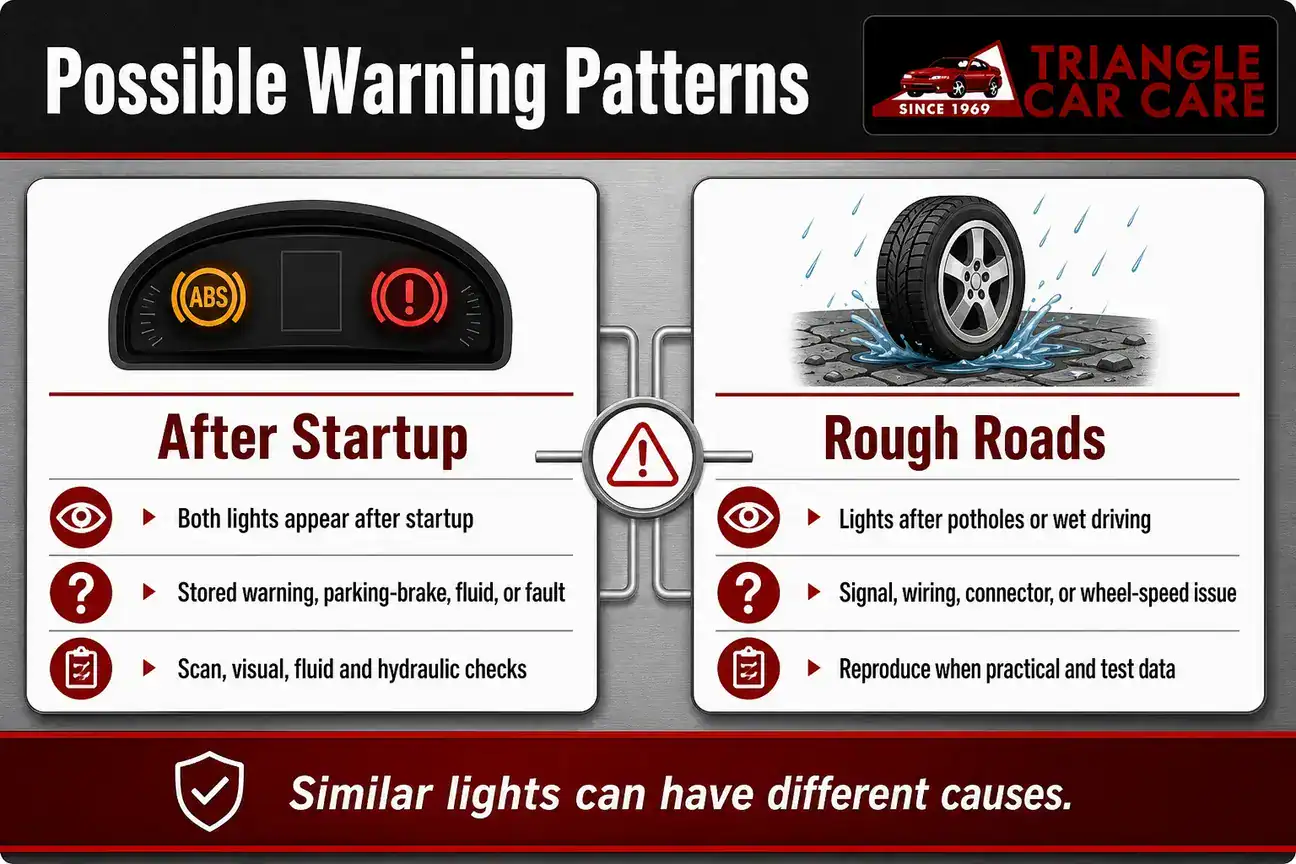
The list below shows possibilities, not confirmed diagnoses. Two vehicles can show similar lights for different reasons. The right answer comes from inspection and testing, not from assuming the most common part has failed.
| What the driver notices | What it may indicate | What confirms it |
|---|---|---|
| Both lights appear after startup | A stored warning condition, parking-brake issue, fluid-related condition, or ABS/brake-system fault | Warning-system scan, visual inspection, fluid and hydraulic checks, and vehicle-specific testing |
| Lights appear after rough roads, potholes, or wet driving | An intermittent signal, wiring, connector, or wheel-speed information issue is possible | Reproducing the condition when practical and checking related sensors, wiring, connectors, and stored data |
| Red light remains after the parking brake is released | A brake-system warning condition remains possible | Owner’s manual review, brake-fluid inspection, and brake-system testing |
| Pedal feels soft, low, or continues to sink | A hydraulic or mechanical brake concern is possible | Professional brake inspection and pressure or system testing as appropriate for the vehicle |
| Braking feels normal but lights remain on | An ABS or brake-system warning may still be present | ABS-capable diagnostic scan, visual inspection, and vehicle-specific checks |
Recent brake work, battery replacement, wheel service, collision repair, or a hard curb impact can also be useful context. None of those events proves the cause, but they can help a technician decide where to start the inspection.
Why ABS diagnosis matters before replacing parts
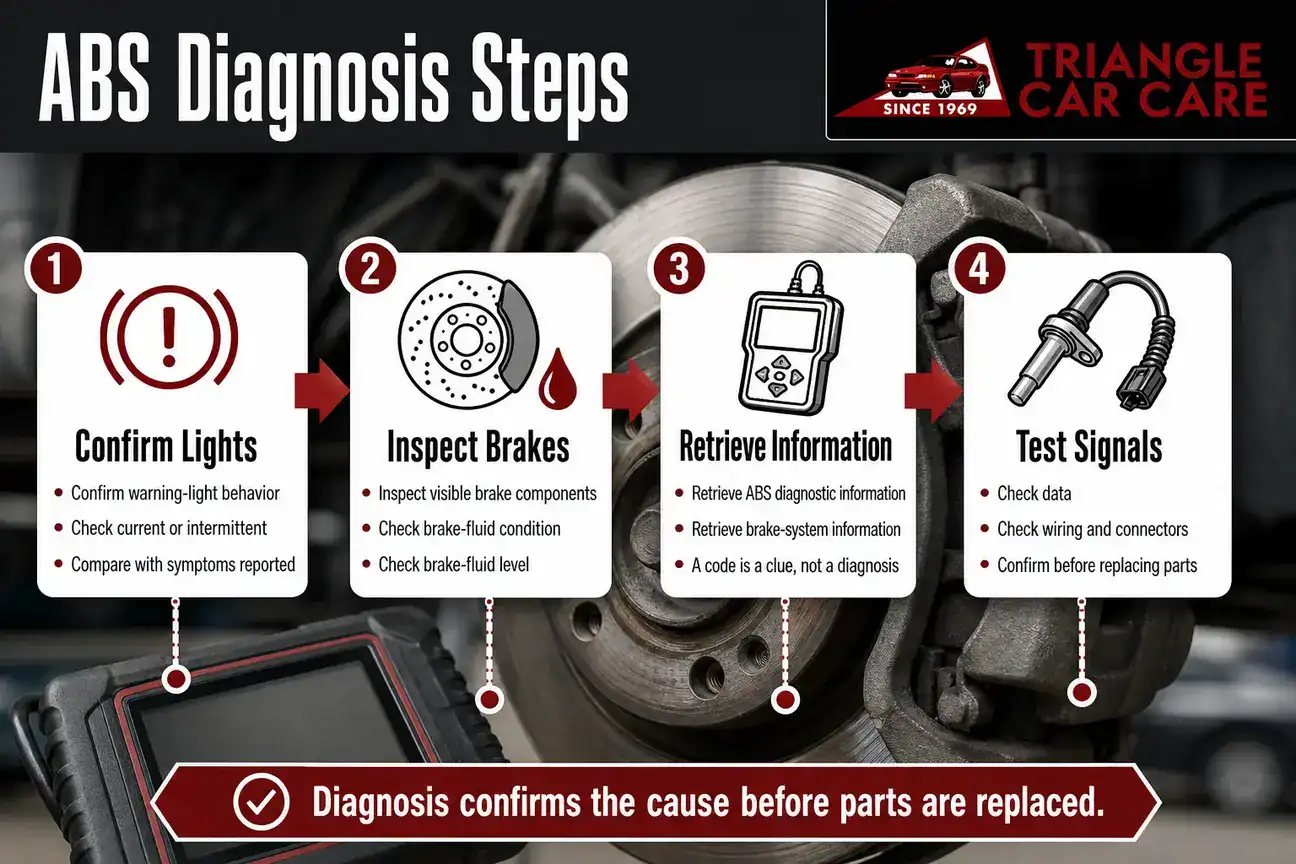
ABS diagnosis is the process of confirming what the vehicle is reporting and comparing that information with what the technician can inspect and test. It is different from reading one code and ordering a part. A code can point toward a circuit or system, but a code is a clue, not a diagnosis.
A shop may confirm the warning-light behavior, check whether the lights are current or intermittent, inspect visible brake components, evaluate brake-fluid condition and level, and retrieve ABS or brake-system diagnostic information. The exact path depends on the vehicle and the symptoms you report.
For example, a wheel-speed signal concern may require checking data, wiring, connectors, and related components. A brake-fluid or hydraulic concern may require a different set of brake-system checks. A parking-brake warning may involve still another path. The goal is to narrow the concern with evidence.
ABS diagnosis may also include checking whether the vehicle’s warning strategy is behaving as designed. Some systems turn on more than one light when a shared input, power supply, ground, communication line, or hydraulic-related signal is outside the expected range. That is why the pattern of lights matters, but the pattern still has to be tested.
Triangle Car Care provides brake repair and vehicle diagnostic service for most makes and models at its Glenwood Avenue shop. The practical value is clear communication: what was found, what still needs testing if needed, and what repair options make sense for the vehicle.
What to tell the shop before the inspection
The more clearly you describe the warning, the easier it is to reproduce and confirm. You do not need technical language. Plain details about what happened before, during, and after the lights appeared are often more useful than a guess about a part.
- Vehicle year, make, model, and current symptoms.
- Whether the ABS warning light and red brake light came on together or at different times.
- Whether the lights remain on after restarting.
- Whether the parking brake was engaged or recently used.
- Whether the pedal feels firm, soft, low, or like a sinking brake pedal.
- Whether braking requires more pedal force than usual.
- Any pull, vibration, grinding, scraping, pulsation, skid feeling, or unusual vehicle control.
- Any visible fluid near a wheel or beneath the vehicle.
- Recent brake work, wheel service, battery work, pothole impact, curb strike, or wet-road event.
- Whether the warning appeared during startup, braking, turning, wet weather, or rough-road driving.
If the vehicle can be inspected without unsafe driving, you can request an appointment and include those details in the form. You can also call 919-787-0966. Triangle Car Care confirms the appointment time; an online request is not a confirmed appointment until the shop follows up.
Brake warning lights and NC inspection context
A warning-light diagnosis and a state inspection are related to vehicle safety, but they are not the same thing. Diagnosis is meant to find the reason your warning lights are on. A state inspection evaluates the vehicle against current inspection requirements.
The NCDMV vehicle safety inspection page explains that a licensed mechanic examines safety items during the annual inspection. That page should not be stretched into a universal statement about every ABS or brake light; the vehicle still has to be evaluated under the current inspection rules and its actual condition.
As of October 29, 2026, Wake County’s emissions requirement still applies. North Carolina has enacted legislation to end the emissions inspection program in the remaining counties once EPA approval and DMV implementation are complete, but the program has not already ended. Annual safety inspections remain, and drivers should check current NCDMV emissions inspection guidance and the NC DEQ Inspection and Maintenance program page for their vehicle.
Triangle Car Care performs NC car inspection services, but a warning-light concern should be handled as a diagnostic and safety issue first. If the red brake light is on or pedal feel is abnormal, do not treat an inspection appointment as a substitute for deciding whether the vehicle should be driven.
Could a recall or vehicle-specific issue be involved?
Some warning-light concerns can be affected by vehicle-specific information, including manufacturer communications or recalls. A recall is not the same as a technical service bulletin, and a recall check should be done by VIN rather than by general model reputation.
NHTSA provides a VIN-based recalls lookup that lets drivers check open safety recalls. A recall result does not diagnose your current brake warning by itself, but it can be useful information to share when a shop is evaluating the vehicle.
If your owner’s manual gives a specific instruction for the ABS warning light, red brake light, or a combined brake-system message, follow that instruction. Manufacturer wording is written for your vehicle’s warning strategy. Generic advice should never override a vehicle-specific safety instruction.
Cost and timing factors without guessing
There is no responsible way to quote a repair from the warning lights alone. The cost and timing depend on what inspection finds, the vehicle design, parts availability, whether the concern is intermittent, whether hydraulic work is needed, whether wiring or corrosion is involved, and whether related systems need additional testing.
A simple warning caused by a parking-brake status issue is very different from a hydraulic, electrical, or control-system concern. A vehicle that arrives with reduced braking or a sinking brake pedal also needs a different safety approach than one that has normal pedal feel but stored ABS information.
Good communication matters here. Before approving repairs, ask what testing was performed, what the evidence showed, which repair is being recommended, and whether the 24-month/24,000-mile warranty on most qualifying work applies. Coverage varies by service and repair, so ask which terms apply to your specific work.
Triangle Car Care has ASE-certified personnel and is serving Raleigh since 1969. If you need to discuss a vehicle that has both brake warnings illuminated, you can contact Triangle Car Care with the warning-light details, pedal feel, and whether the vehicle has any braking symptoms.
What not to do when both brake warnings are on
A few choices can make diagnosis harder or create unnecessary risk. Avoid clearing codes before inspection, because stored information can help identify whether a condition is current or intermittent. Avoid assuming a scan-tool code proves a failed part. Avoid replacing parts based only on a forum thread or a common failure list.
Do not bleed brakes, open hydraulic components, work under the vehicle without proper support, or attempt brake-system repair if you do not have the right equipment and training. Brake systems are safety systems, and a small mistake can create a serious problem.
Also avoid topping off brake fluid as a way to “fix” the red brake light without inspection. If the fluid is low, the reason matters. It may be related to wear, a leak, or another condition that needs to be confirmed before the vehicle is put back into regular use.
Simple decision guide for both warning lights
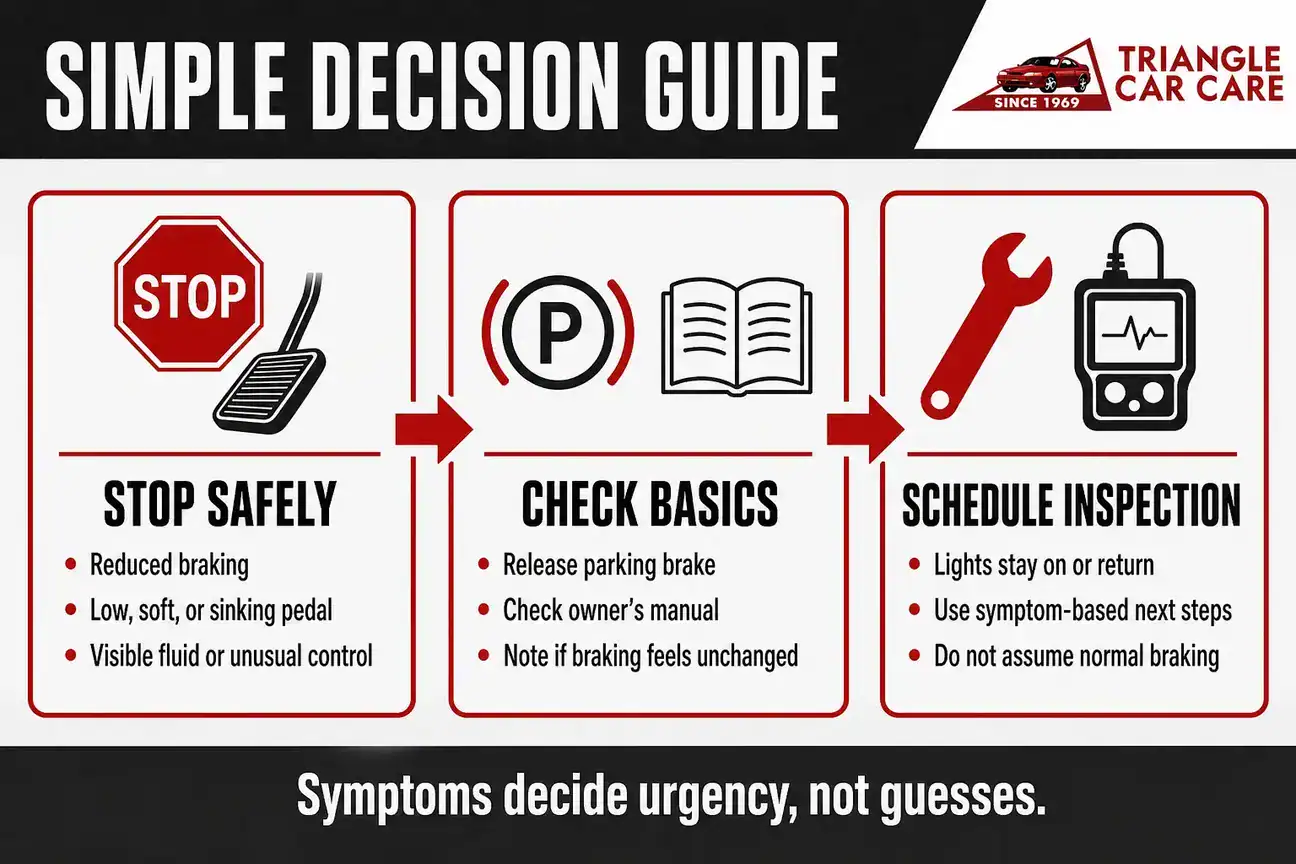
If both brake-related warning lights are on, use a symptom-based decision rather than a guess-based one. The lights tell you that attention is needed; the way the vehicle responds tells you whether the next step is urgent stop-driving action or prompt inspection.
- Stop safely and arrange professional help if braking is reduced, the pedal is low or soft, there is a sinking brake pedal, fluid is visible, the vehicle pulls or skids unexpectedly, or control feels unusual.
- Do not assume normal braking just because the vehicle still moves or the lights come and go.
- Release the parking brake and check the owner’s manual if the vehicle is parked or braking feels unchanged.
- Schedule inspection and testing if the ABS warning light and red brake light remain on or return after restarting.
- Share the details about when the lights appeared, what changed, and whether the vehicle had recent brake, wheel, battery, or rough-road events.
The safest answer is not to panic and not to ignore it. The ABS brake light on combination calls for a calm check of the parking brake and owner’s manual, careful attention to pedal feel, and professional ABS diagnosis when the lights remain. If anything about stopping feels different, get to a safe place and arrange towing or professional help rather than trying to finish the trip.
This article is general automotive information, not a diagnosis of your vehicle. Follow your owner’s manual, and have a qualified technician inspect the vehicle when a symptom could affect safe operation.
Frequently Asked Questions
Can I drive with the ABS and brake warning lights on together?
Do not treat the combination as a simple yes-or-no situation. If braking is reduced, the pedal is soft or low, fluid is leaking, or control feels unusual, get to a safe place and arrange professional help. If those symptoms are not present, the lights still call for prompt inspection and testing.
What if the parking brake is released but the red brake light stays on?
Check your owner’s manual and arrange an inspection. A red brake light that remains on after the parking brake is released should not be dismissed, because the meaning can vary by vehicle and may involve the brake warning system.
Does the ABS light mean the brakes have failed?
Not necessarily. The ABS light indicates a possible anti-lock braking system warning or malfunction, but it does not diagnose the exact cause. Braking behavior, vehicle-specific information, and testing determine what is actually happening.
What does a sinking brake pedal mean?
A sinking brake pedal means the pedal continues downward or feels unusually low under steady pressure. Treat that as a stop-driving concern: get to a safe location if possible and arrange towing or professional help instead of continuing to test the vehicle.
Can low brake fluid cause both lights to appear?
Low brake fluid is one possible explanation, but it is not a confirmed diagnosis from the lights alone. A low level or visible fluid loss should be inspected because adding fluid does not identify or correct the underlying reason.
What will a shop check during ABS diagnosis?
An ABS diagnosis may include confirming the warning-light behavior, reviewing stored diagnostic information, inspecting visible brake components and wiring, checking brake-fluid condition and level, and performing vehicle-specific tests. The exact process depends on the vehicle and symptoms.
Will these warning lights affect an NC safety inspection?
They may need evaluation during the inspection process, but no one should promise a pass or fail without seeing the vehicle and applying current state requirements. A brake warning concern should be diagnosed for safety, not only considered as an inspection item.
Sources


