


Car Battery Testing & Replacement in Raleigh, NC
If your vehicle is slow to crank, needs repeated jump-starts, has electrical symptoms, or will not start, the battery is one possible cause—but it is not the only one.
Triangle Car Care provides car battery testing and replacement for most makes and models from its Raleigh location on Glenwood Avenue. The goal is to determine whether the battery is weak, discharged, improperly connected, or whether another starting or charging-system concern may be involved.
A dead battery does not automatically mean the battery itself has failed. Testing before replacement helps avoid guessing at the repair.
Signs Your Car Battery May Need Testing
These symptoms can point toward a battery problem, but they can also overlap with charging, starting, wiring, connection, or electrical issues. They should be treated as clues rather than automatic proof that the battery needs replacement.
Slow Engine Cranking
If the engine turns more slowly than usual during startup, a weak or undercharged battery is one possibility. Connections, starter operation, temperature, and engine condition can also influence cranking speed.
No-Start or Clicking
Clicking or a no-crank condition may involve battery voltage, battery connections, the starter circuit, starter motor, or another electrical problem.
Repeated Jump-Starts
A vehicle that repeatedly needs a jump may have a battery that is not holding charge, but it may also have a charging-system problem or an electrical draw while parked.
Electrical Behavior Changes
Unusual electrical behavior around startup can sometimes accompany low system voltage. Because modern vehicles rely heavily on electronics, the cause should be verified rather than assumed.
Corrosion or Connection Problems
Corrosion, looseness, damaged cables, or poor terminal connections can affect current flow and may create symptoms that resemble a weak battery.
Battery Age or History
Battery age can be useful context, especially when combined with starting symptoms or a failed test, but age alone does not prove that replacement is required.
Battery, Charging System or Starting System?
These systems work together on many conventional vehicles, which is why similar symptoms can have different causes.
Battery
Stores electrical energy and supplies high current during engine cranking on conventional starting systems. A weak, discharged, damaged, or poorly connected battery can cause starting problems.
Charging System
Replenishes the low-voltage battery and supports electrical loads while the vehicle operates. Conventional vehicles commonly use an alternator; many electrified vehicles use different charging architecture.
Starting System
Uses battery power to crank the engine on many gasoline-powered vehicles. A starter, control circuit, relay, connection, or other issue can create a no-start symptom even when the battery itself is serviceable.
A Battery-Shaped Warning Light Does Not Automatically Mean “Replace the Battery”
On many vehicles, the battery-shaped dashboard warning is a charging-system warning. It can indicate that the low-voltage battery is not being charged properly rather than proving that the battery itself has failed.
Manufacturer guidance varies by vehicle. Some manufacturers instruct drivers to stop safely and arrange prompt inspection when a charging-system warning remains on while driving. Follow the owner's manual for your specific vehicle.
For a detailed explanation, read our Battery Light On While Driving guide .
How a Battery Concern May Be Evaluated
The exact process depends on the vehicle, battery design, and symptoms. Not every vehicle requires the same tests or procedures.
Confirm the Concern
Note whether the problem involves slow cranking, no start, repeated discharge, a warning light, or another electrical symptom.
Inspect Battery & Connections
Battery condition, terminals, cables, connections, and visible damage may provide important diagnostic clues.
Test as Appropriate
Battery testing and relevant starting or charging-system checks can help determine whether the battery is weak, discharged, or whether another condition needs attention.
Replace if Needed
When replacement is appropriate, the replacement battery must match the vehicle's required specifications and installation needs.
Car Battery Warning Signs, Testing & Replacement
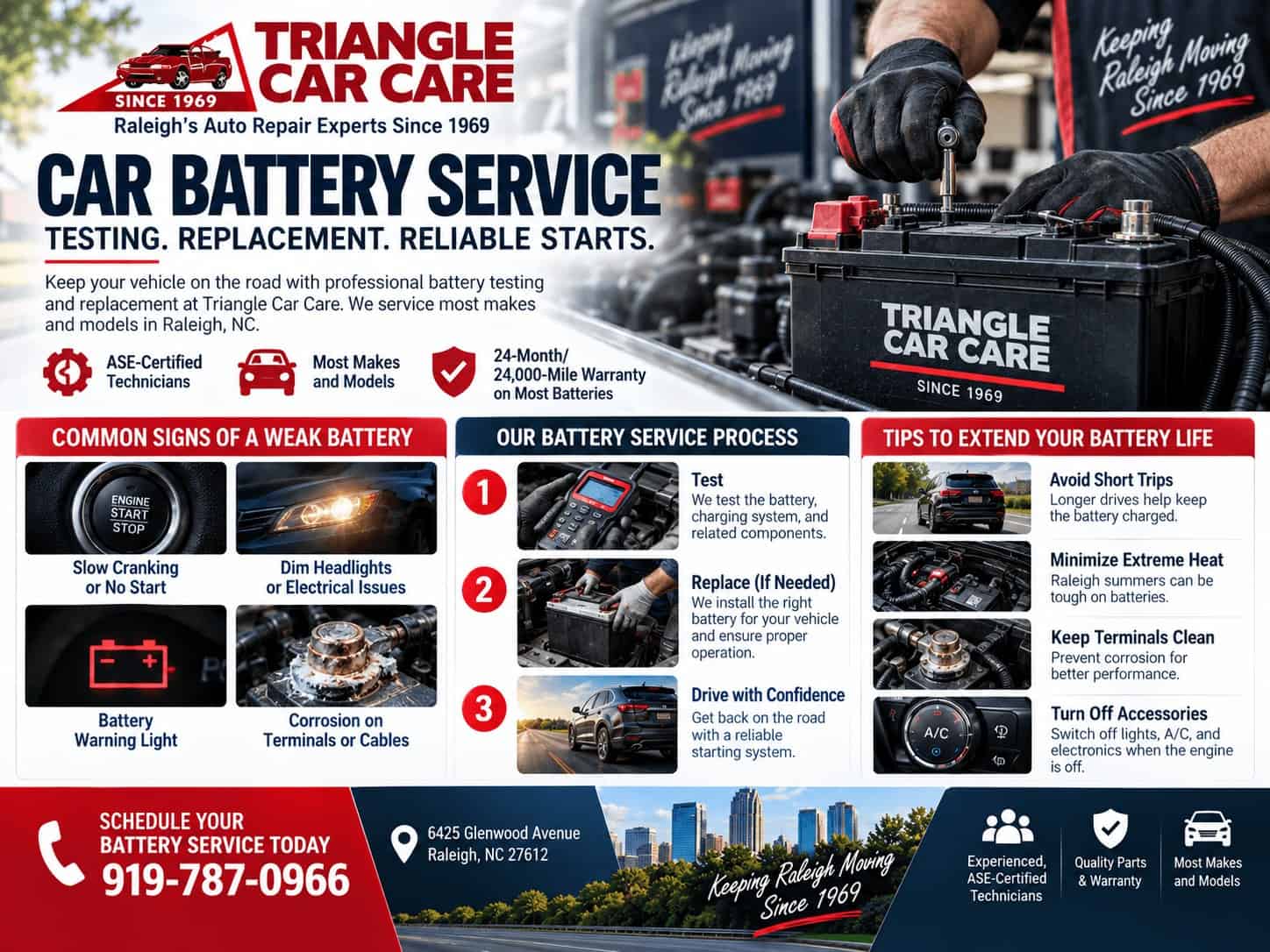
This visual guide summarizes common battery-related symptoms, the testing process, battery-care considerations, and when replacement may be appropriate.
Starting Trouble Is a Clue
Slow cranking, repeated discharge, and electrical changes can help guide testing but do not identify the failed component by themselves.
Look Beyond Battery Voltage Alone
The overall symptom pattern, battery condition, connections, and related starting or charging behavior may all matter when determining the cause.
The Battery Must Match the Vehicle
Battery size, capacity, terminal arrangement, battery technology, and manufacturer procedures can vary by vehicle.
Choosing a Replacement Battery Is More Than Finding One That Fits
Battery specifications are vehicle-specific. The correct replacement depends on the manufacturer's requirements and the electrical demands of the vehicle.
The battery must fit the tray, hold-down system, and available space correctly.
Positive and negative terminal position and connection type must match the vehicle's design.
Required starting capacity and other electrical specifications should follow manufacturer information for the vehicle.
Some vehicles specify technologies such as AGM batteries or other designs that should not be substituted without checking the vehicle's requirements.
Some Vehicles Need More Than a Simple Battery Swap
Modern vehicles may monitor battery condition, charging strategy, electrical load, or battery state through control modules and sensors.
Depending on the vehicle, replacement may involve manufacturer- specific procedures after the battery is disconnected or replaced. Some vehicles may require battery registration, adaptation, or resetting certain stored functions.
Those requirements vary by year, make, model, battery technology, and vehicle configuration. They should be checked for the specific vehicle rather than assumed.
A Good Battery Still Needs Good Electrical Connections
Battery terminals and cables carry substantial current during engine starting. Corrosion, looseness, damage, or poor contact can interfere with current flow and create symptoms that resemble a weak battery.
Honda owner guidance for some vehicles specifically recommends checking 12-volt battery terminals for corrosion and following the correct procedures for the battery type installed in the vehicle.
Heat, Short Trips & Vehicle Use Can Affect Battery Condition
Battery life is influenced by more than calendar age. Temperature, driving patterns, vehicle electrical demand, state of charge, and the amount of time a vehicle sits can all influence battery condition.
Battery manufacturers note that high under-hood temperatures can accelerate internal corrosion. Raleigh's warm summers make battery condition worth considering when starting performance begins to change—but heat alone does not prove that a battery has failed.
A Successful Jump-Start Does Not Tell You Why the Battery Went Dead
If the vehicle starts after a jump, that confirms the vehicle had insufficient low-voltage power to start normally. It does not identify why the battery was discharged.
Possible explanations can include a weakened battery, a charging problem, a light or accessory left on, extended parking, poor connections, or an electrical draw while the vehicle is off.
If the problem repeats, testing is more useful than continuing to rely on jump-starts.
A 12-Volt Battery Is Not the Same as a High-Voltage Traction Battery
Electrified vehicles can contain more than one battery system, and those systems have very different functions and safety requirements.
Low-Voltage / 12-Volt Battery
NHTSA explains that hybrid and electric vehicles commonly still use a low-voltage battery for functions such as lighting, instrumentation, and vehicle electronics.
The design varies by vehicle, and some electrified vehicles use a DC-to-DC converter instead of a conventional alternator to replenish the low-voltage battery.
High-Voltage Traction Battery
The high-voltage traction battery powers the electric drive system and requires specialized training, equipment, and safety procedures. It is not the same service as ordinary 12-volt car battery replacement.
If you have a hybrid or electric vehicle, contact Triangle Car Care before scheduling so the service scope for your specific vehicle can be confirmed.
What Different Battery-Related Symptoms Can Mean
These examples show why battery symptoms should guide testing rather than be treated as a diagnosis.
| What You Notice | Possible Areas to Check | General Next Step |
|---|---|---|
| Slow cranking | Battery state, terminals, cables, starter operation, temperature, or another starting-system condition. | Test before replacing the battery. |
| Vehicle needs repeated jump-starts | Battery condition, charging performance, parked electrical draw, or connection issues. | Battery and related system evaluation is appropriate. |
| Battery-shaped warning light while driving | Charging-system operation and low-voltage electrical supply. | Follow the owner's manual and arrange prompt inspection. |
| Corrosion around a battery terminal | Terminal condition, cable condition, connection integrity, and battery condition. | Inspect before assuming the battery itself has failed. |
| Battery goes dead after vehicle sits | Battery condition, state of charge, length of storage, normal vehicle loads, or an abnormal electrical draw. | Diagnosis may be needed if the problem repeats. |
Why Car Battery Replacement Cost Varies
Battery pricing and installation requirements vary by vehicle. A generic national average should not be treated as a Triangle Car Care quote.
Size, capacity, battery technology, and electrical requirements can vary considerably between vehicles.
Some batteries are easily accessible while others may be located under trim, seats, or other components.
Certain vehicles may require manufacturer-specific initialization, registration, or reset procedures after replacement.
If the battery went dead because of another electrical or charging concern, additional testing may be necessary before the problem is resolved.
Battery Service From an Established Raleigh Auto Repair Shop
Triangle Car Care has served the Raleigh area since 1969 from one location at 6425 Glenwood Avenue, Raleigh, NC 27612. The shop provides maintenance, diagnosis, and repair services for most makes and models.
For a battery concern, the goal is to understand whether the battery itself needs replacement or whether another starting, charging, or electrical condition may be responsible.
Related Battery, Electrical & Vehicle Services
When a starting or electrical problem is not caused by the battery itself, the next step depends on what testing finds.
Car Battery Service Raleigh NC FAQs
Common questions about battery testing, replacement, warning signs, charging systems, and modern vehicle battery service.
What are common signs that my car battery may be weak?
Possible signs include slow cranking, repeated jump-starts, a no-start condition, unusual electrical behavior around startup, or visible corrosion at the battery connections. These symptoms can also have other causes, so testing is more reliable than assuming the battery needs replacement.
Does a dead battery always need to be replaced?
No. A battery can become discharged because a light or accessory was left on, the vehicle sat for an extended period, the charging system is not replenishing the battery properly, or another electrical condition is present. Battery condition and the reason for the discharge should be evaluated before replacement is assumed.
Does the battery warning light mean my battery is bad?
Not necessarily. On many vehicles, the battery-shaped dashboard warning is a charging-system warning. It may indicate that the low-voltage battery is not being charged properly rather than proving the battery itself has failed. Follow the vehicle owner's manual and arrange prompt inspection if the warning stays on while driving.
Why does my car need a jump-start repeatedly?
Repeated discharge can result from a weak battery, insufficient charging, a poor electrical connection, an electrical load while the vehicle is parked, or other conditions. A successful jump-start does not identify the cause, so recurring problems should be tested.
Can corroded battery terminals cause starting problems?
Yes. Corrosion or poor contact at the battery terminals can affect electrical current flow and may contribute to slow cranking, intermittent starting, or other low-voltage symptoms. The battery, cables, and connections should be considered together rather than assuming the battery itself is defective.
How long does a car battery last in Raleigh?
There is no universal battery lifespan. Battery technology, temperature, vehicle electrical demand, driving habits, state of charge, installation quality, and how long the vehicle sits can all affect service life. Raleigh's warm weather can contribute to battery deterioration, but age or climate alone does not prove a battery needs replacement.
Does hot weather damage car batteries?
High temperatures can accelerate chemical activity and internal corrosion in conventional automotive batteries, which can shorten useful life. Heat is therefore one factor to consider in Raleigh, but battery condition should still be determined by the vehicle's symptoms and appropriate testing.
Does my car require a specific type of replacement battery?
Yes. Replacement requirements can include physical size, terminal configuration, starting capacity, battery technology, mounting, and other manufacturer specifications. Vehicles equipped with AGM or other specialized batteries should receive a compatible replacement that meets the vehicle's requirements.
Does a new battery need to be programmed or registered?
Some vehicles require manufacturer-specific battery registration, adaptation, initialization, or reset procedures after replacement, while others do not. Requirements vary by make, model, year, battery type, and vehicle configuration, so the correct procedure should be confirmed for the specific vehicle.
Is an electric vehicle's 12-volt battery the same as its main battery?
No. Hybrid and electric vehicles may use a low-voltage battery for electronics and vehicle controls while also having a separate high-voltage traction battery for propulsion. High-voltage battery systems require specialized training and equipment and should not be treated as ordinary 12-volt battery service.
How much does car battery replacement cost in Raleigh?
Cost depends on the vehicle, battery specification, battery technology, location in the vehicle, installation requirements, and whether additional diagnosis is needed. A generic national average is not a Triangle Car Care quote. The correct battery and service scope need to be identified for the specific vehicle.
Does Triangle Car Care replace batteries on most makes and models?
Triangle Car Care provides car battery testing and replacement as part of its automotive service offerings for most makes and models from its Raleigh location at 6425 Glenwood Avenue. Vehicle-specific battery requirements and the appropriate service scope depend on the vehicle and diagnostic findings.
Battery Trouble? Test the Cause Before Replacing Parts
Contact Triangle Car Care for car battery testing and replacement in Raleigh. If your vehicle is slow to start, repeatedly needs a jump, or has another battery-related symptom, proper testing can help determine the appropriate next step.
Sources & Further Reading
- National Highway Traffic Safety Administration — Electric and Hybrid Vehicles: Battery, Charging & Safety
- Honda Owners Manual — 12-Volt Battery Guidance
- Honda Owners Manual — 12-Volt Battery Charging System Indicator
- Interstate Batteries — How Temperature Affects Automotive Batteries
- Triangle Car Care — Battery Light On While Driving
- Triangle Car Care — About Us
- Triangle Car Care — Warranty Information


