


Flashing Check Engine Light: What Raleigh Drivers Should Do Next
Flashing Check Engine Light: 7 Safe Next Moves for Raleigh Drivers
A flashing check engine light is a serious warning, especially if the vehicle is shaking, hesitating, losing power, smoking, smelling like fuel or showing another warning light. It often points to an active engine-management problem, such as a misfire, but it does not prove which part failed. Treat the light as a clue that needs inspection and testing, not as a reason to guess at spark plugs, coils, sensors or any other single part. If the light is flashing, reduce unnecessary driving, move to a safe place when practical, shut the engine off when appropriate and arrange professional help or towing rather than continuing as if nothing happened.
Quick Answer: A flashing warning light is more urgent than a steady warning light, but neither one is a complete diagnosis. A code can point toward a system, circuit, cylinder or operating condition, yet the cause still has to be confirmed. If the light is flashing now, focus first on reducing risk and preserving useful information for diagnosis.
As of November 5, 2026: NC inspection context
A blinking engine warning can matter if your vehicle is due for inspection because OBD emissions checks look at vehicle readiness and emissions-related fault information. As of November 5, 2026, Wake County’s emissions requirement still applies; North Carolina has enacted legislation intended to end the emissions program in all 19 counties, but the change remains subject to final EPA approval and DMV implementation. Annual safety inspections remain. Check current NCDMV safety inspection requirements, NCDMV emissions inspection requirements and the NC DEQ Inspection/Maintenance Program page before assuming which rules apply to your vehicle.
What does a flashing check engine light mean?
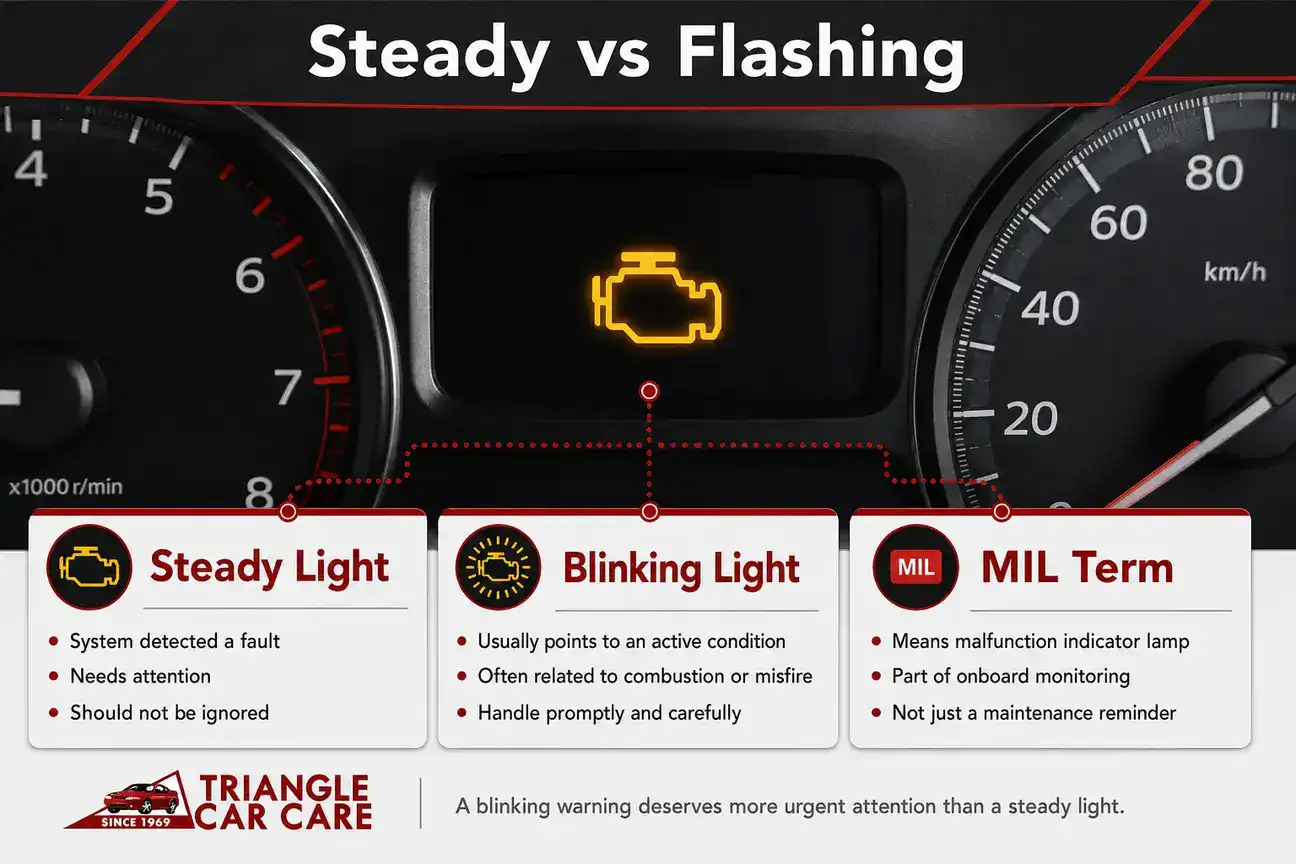
The check engine light, also called the malfunction indicator lamp, is part of the vehicle’s onboard monitoring system. A steady light means the system has detected a fault that needs attention. A blinking light usually points to a more active condition, often related to combustion, misfire or another engine-management issue that may be happening right now.
That is why the MIL terminology matters. “MIL” is the technical abbreviation for malfunction indicator lamp. In plain English, the vehicle is not simply reminding you about maintenance; it is warning you that the control system has detected a condition that should be handled promptly and carefully.
A steady light should not be ignored, but a blinking light deserves a different response. Do not treat it as just another dashboard message. Do not assume the vehicle can keep being driven because it still starts, idles or moves under its own power. A symptom is a clue, not a diagnosis, and the blinking pattern is one of the most important clues to report.
The light behavior alone does not identify a failed component. A flashing engine light could be related to ignition, fuel, air, wiring, sensor feedback, mechanical condition, software strategy or another engine-management concern. Two vehicles can show similar light behavior for different reasons. That is why guessing based on the light alone can waste money and leave the real issue untouched.
7 safe next moves when the warning starts blinking
When the light begins blinking, the goal is not to solve the problem from the driver’s seat. The goal is to reduce risk, protect useful diagnostic information and avoid making the symptom worse. These seven next moves fit most everyday situations, but always follow your owner’s manual and use judgment based on traffic, weather and the way the vehicle is behaving.
1. Ease out of heavy engine demand
If practical, reduce hard acceleration, high-speed operation, steep climbing or heavy engine load. Do not make sudden moves that create a traffic hazard. The point is to avoid asking more from an engine that may already be struggling.
2. Move to a safe place when practical
Choose a location where you can stop without putting yourself or others in danger. Use your judgment based on traffic, visibility and the way the vehicle feels. If the vehicle is hard to control, smoking, losing power or running very roughly, safety comes before convenience.
3. Shut the engine off when appropriate
If the engine is shaking badly, smoking, overheating, smelling like fuel or losing power, turning it off after you are stopped may reduce additional risk. Do not open a hot cooling system, work around a running engine or attempt a repair at the roadside.
4. Do not clear the code
Clearing codes or disconnecting the battery can remove information that may help diagnosis, and it does not repair the cause. Stored and pending codes, freeze-frame information and the timing of the warning may all help a technician understand what the vehicle detected.
5. Check only simple, safe items
Look at the owner’s manual warning-light description. Vehicle makers publish model-specific owner information; for example, Toyota provides official manuals through its Toyota Owners manuals and warranties page. If the vehicle is stopped and conditions are safe, note obvious smoke, odor or fluid loss from a distance. Do not attempt ignition, fuel, emissions or high-voltage work.
6. Record what happened
Note whether the light flashed continuously or briefly, what the vehicle was doing and whether any other symptoms appeared. Useful details include engine temperature, speed, acceleration, traffic conditions, weather, recent fueling and any other dashboard lights.
7. Arrange professional help
If continued operation seems questionable, arrange towing or roadside help. Triangle Car Care does not claim towing, mobile repair or emergency roadside service. If the vehicle is no longer in an urgent roadside situation, you can request an appointment and describe the warning-light behavior, driving conditions and symptoms. The shop confirms the appointment time.
When should you stop driving?
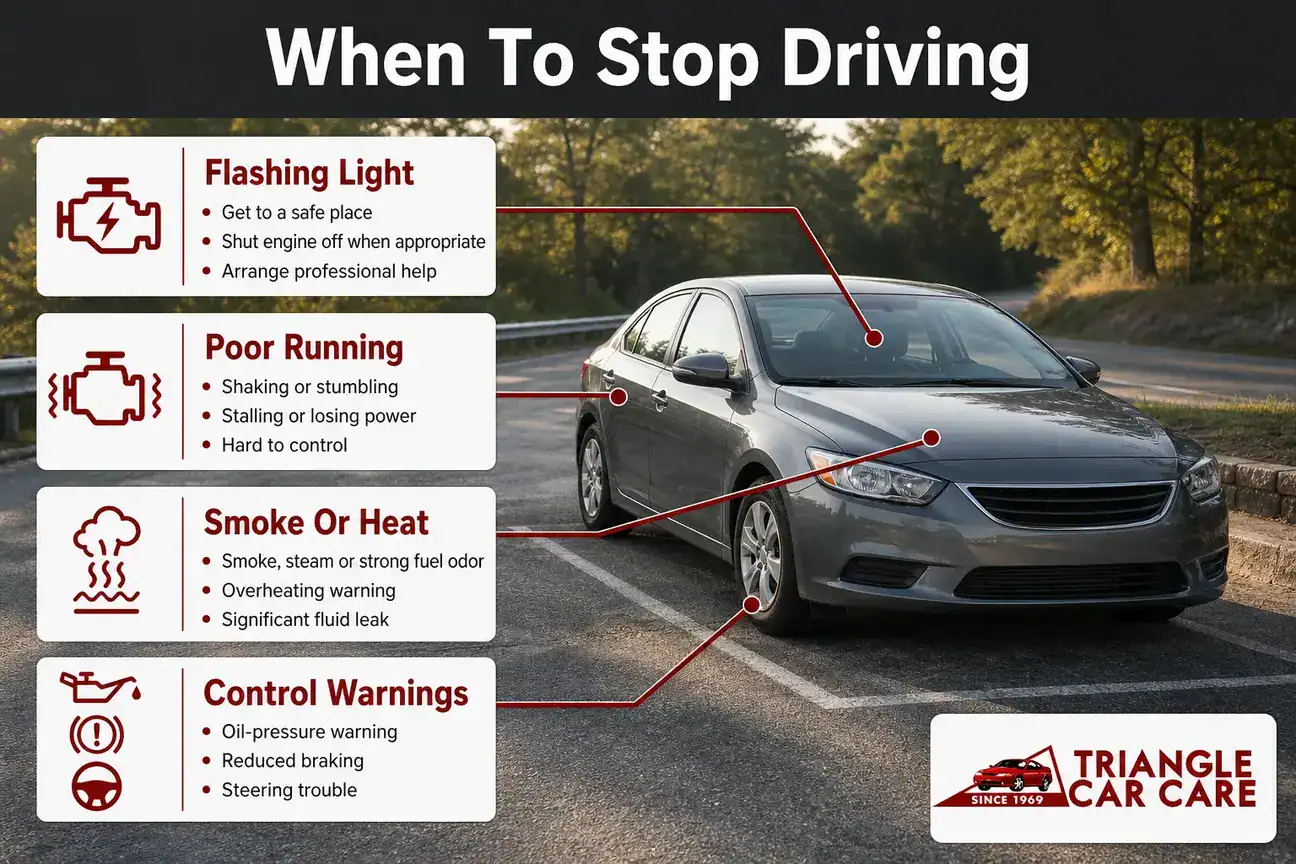
Stop-driving guidance should be conservative with a blinking warning light. Get to a safe place, shut off the engine when appropriate and arrange towing or professional help if the light is flashing, especially when the vehicle is shaking, stumbling, stalling or losing power.
You should also stop when there is smoke, steam, a strong fuel odor, a significant fluid leak, overheating, an oil-pressure warning, reduced braking, steering trouble or any condition that makes the vehicle hard to control. These symptoms can involve more than one system, and trying to “make it a few more miles” can add risk.
A check engine light flashing and then turning steady does not prove the problem went away. It may mean the condition changed, the system stopped seeing the same fault at that moment or the event became intermittent. Treat that history as useful information, not as a repair.
A blinking engine warning during a short trip to work, after fueling, during a cold start or while accelerating onto a highway should all be taken seriously. The exact timing helps diagnosis, but no timing pattern by itself proves the failed part.
Flashing engine light clues to notice before diagnosis
Drivers often remember the warning light but forget the conditions around it. Those conditions can matter as much as the code. Before arranging diagnosis, write down what you noticed while it is still fresh.
| What to note | Why it helps |
|---|---|
| Whether the light flashed continuously or came and went | Helps describe whether the event seemed steady or intermittent |
| Cold start, idle, acceleration, hill, highway speed or stop-and-go driving | Gives the technician operating conditions to consider |
| Shaking, hesitation, stalling or loss of power | Helps characterize how the engine behaved |
| Smoke, odor, steam or fluid loss | May point to an added safety concern |
| Other warning lights | Helps show whether multiple systems were involved |
| Recent fuel, maintenance or repair | Gives useful history without assuming cause |
| Whether an inspection is coming due | Helps plan diagnosis around OBD readiness and inspection needs |
If the flashing engine light appeared only once, do not leave that out. If it appears only after the engine warms up, only in wet weather or only under acceleration, say that too. Intermittent symptoms can be harder to reproduce, so details from the driver can save time and help avoid assumptions.
Why check engine light flashing codes do not prove the part
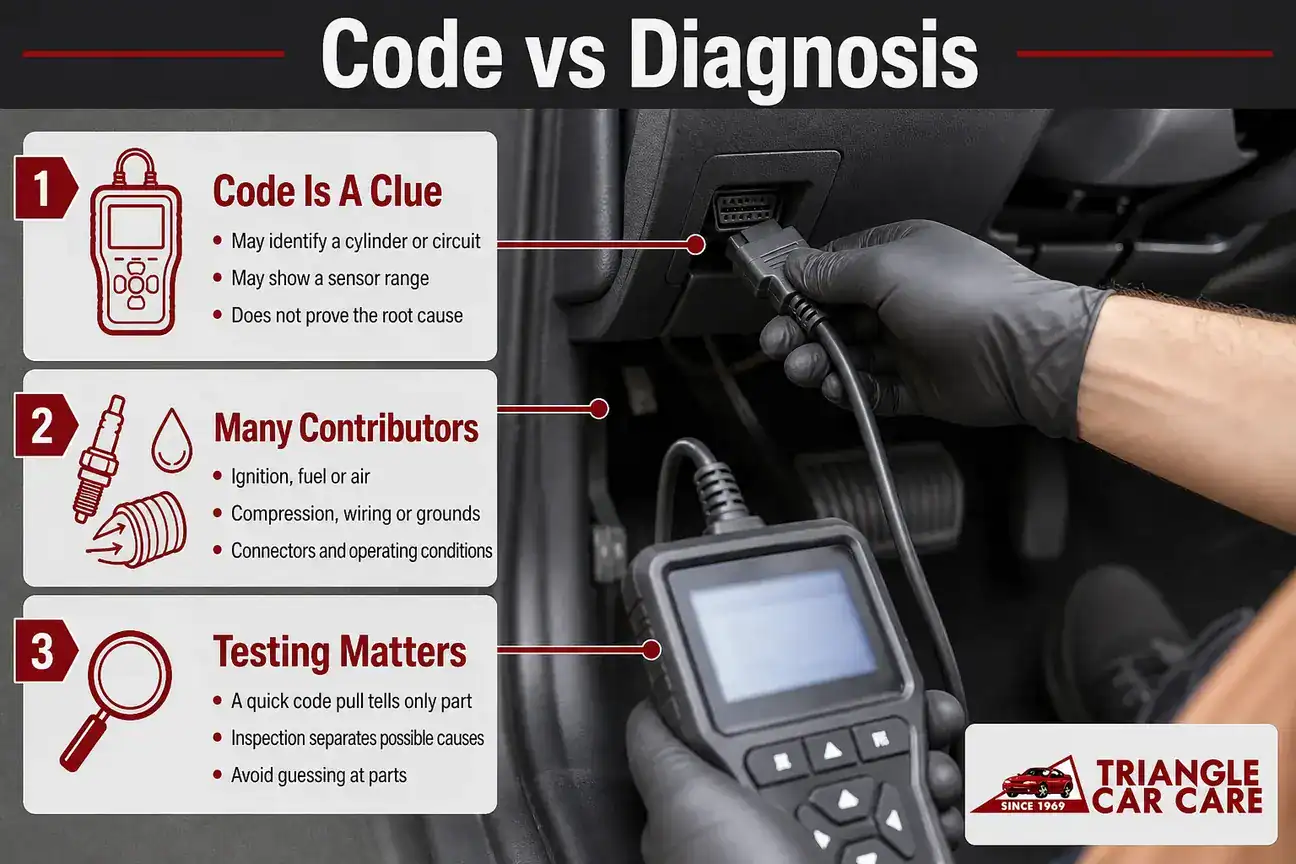
A diagnostic trouble code is a clue, not a diagnosis. A code may identify a cylinder, a circuit, an emissions-related monitor, a sensor range or a condition the control module detected. It does not automatically prove that the named sensor, plug, coil, injector or other part is the root cause.
That is the main reason check engine light flashing searches can be misleading. A code reader may show a misfire code, but a misfire can have different possible contributors. Ignition, fuel, air, compression, wiring, grounds, connectors, control strategy and operating conditions can overlap. Replacing the first part named by an internet search may not address the actual cause.
The same is true when the blinking stops before the vehicle reaches a shop. Stored information may still help, but clearing codes can remove useful data. If the light changes from blinking to steady, tell the shop exactly what happened rather than trying to reset it.
Professional diagnosis may include retrieving current, pending and stored codes, reviewing freeze-frame data, inspecting wiring and connectors, checking related symptoms and testing likely system areas. The process depends on the vehicle, the code set, available data and the symptoms reported. Good diagnosis before assumptions means verifying the cause before recommending a repair.
For general consumer guidance on repair conversations, the FTC Auto Repair Basics page advises consumers to communicate clearly with a repair shop and understand what work is being authorized. That guidance fits warning-light situations because the best starting point is a clear description of the symptom, not a request to replace a guessed part.
Flashing MIL meaning in plain English
The flashing MIL meaning can be summed up this way: the vehicle’s control system is warning you about an active fault condition that deserves prompt attention. It is not a maintenance reminder, and it is not a reliable part label. The light is asking for diagnosis.
Some drivers use the phrase flashing MIL meaning because their owner’s manual or scan tool uses “MIL” instead of “check engine light.” Others see “malfunction indicator lamp” in inspection paperwork. The wording changes, but the practical approach is the same: reduce unnecessary driving, record what happened and have the vehicle evaluated before assuming the cause.
The MIL warning also depends on context. A vehicle that runs smoothly with a brief blinking event gives a different set of clues than one that shakes hard, loses power or smells like fuel. The warning light behavior matters, but symptoms around it matter too.
Do not use the MIL wording as a reason to ignore the problem. If the light is blinking and the engine feels rough, the concern may be active at that moment. If the blinking stops, the event still belongs in the diagnostic history.
Possible causes are categories, not a remote diagnosis
A blinking engine light can have several possible cause categories. The list below is not a diagnosis of your vehicle. It is a way to understand why inspection and testing matter before a part is named.
- Ignition or combustion concerns: Spark delivery, combustion quality or cylinder-to-cylinder behavior may need evaluation.
- Fuel-delivery or fuel-quality concerns: The vehicle may be reacting to fuel supply, pressure, injector control or fuel quality conditions.
- Air-intake or vacuum-related concerns: Unmetered air, airflow measurement or vacuum-related issues can affect engine operation.
- Wiring, connector or ground faults: Electrical problems can imitate component failures or create intermittent symptoms.
- Sensor or control-system issues: Sensor signals and control-module decisions may need to be compared with actual operating conditions.
- Mechanical engine conditions: Compression, valve, timing or internal mechanical concerns may have to be ruled in or out with testing.
- Vehicle-specific software or calibration conditions: Some symptoms require vehicle-specific information before conclusions can be drawn.
- Other emissions or engine-management faults: Related systems can set warning lights without pointing to one obvious failed part.
Notice that each item is a category. A rough idle with a blinking warning might lead one vehicle toward ignition testing and another toward air, fuel, wiring or mechanical testing. A flashing engine light after recent service might make recent work part of the history, but it still does not prove the cause.
DIY checks should stay simple and safe. Check the owner’s manual. Note whether the fuel cap was left loose if that applies to your vehicle, but do not assume that explains a blinking warning. Look for obvious smoke, odor or fluid loss from a safe position. Do not work on fuel, ignition, emissions, airbag, steering, suspension or high-voltage hybrid and EV systems yourself.
How inspection and testing may narrow the cause
At Triangle Car Care, the matching service for this topic is check engine light diagnosis. A blinking light needs more than a quick code pull because the code tells only part of the story. Diagnosis may involve confirming the customer’s concern, retrieving available data and separating possible causes through inspection and testing.
A broader vehicle diagnostic service may be appropriate when the warning light comes with other symptoms, such as a vibration, noise, leak, power loss, hard starting or another dashboard warning. The diagnostic path depends on what the vehicle is doing and what data is available.
The process may include checking current, pending and stored codes; reviewing freeze-frame information; inspecting related wiring, connectors, hoses and visible components; reproducing the condition when practical; and performing vehicle-specific tests. If the evidence points toward an engine mechanical or drivability concern, engine diagnosis and repair recommendations should still be based on confirmed findings, not assumptions.
Sometimes diagnosis is straightforward. Other times the vehicle has to be tested under the conditions that triggered the fault. A symptom that appears cold but not warm, under load but not at idle, or during stop-and-go operation but not steady cruising can lead the testing in different directions. That is why your notes are useful.
Raleigh driving conditions can add useful context
Local conditions do not diagnose the vehicle, but they can help describe when symptoms appear. Stop-and-go traffic, hot and humid summers, pollen seasons and occasional cold snaps can change operating conditions. A check engine light flashing in heavy traffic may be reported differently from a warning that appears during a cold start or highway acceleration.
Triangle Car Care has one shop on Glenwood Avenue in northwest Raleigh and is serving Raleigh since 1969. If your vehicle is already stopped because the light is blinking or the engine is running poorly, arrange the appropriate help first rather than trying to drive it in. If the urgent situation has passed and the vehicle can be handled through a normal appointment process, provide the details when you contact the shop.
How a blinking light can affect inspection planning
If your inspection is coming due, do not clear the code to make the light disappear. Clearing codes can reset readiness information and does not repair the underlying issue. The result may be more delay, less diagnostic information and the same root problem still present.
For eligible gasoline vehicles in counties that require emissions inspection, the OBD portion looks at readiness and emissions-related fault information. Triangle Car Care performs NC safety and emissions inspection, but diagnosis and repair decisions still depend on the vehicle’s actual condition and current requirements.
A flashing MIL meaning question often comes up when a driver worries about passing inspection. The better question is whether the vehicle has an active fault that needs diagnosis before inspection. If the light is blinking, handle the symptom first. Inspection status can be discussed after the warning-light concern is documented and tested.
What to tell the shop before your appointment
Clear communication helps the technician start in the right direction. When you request service, include the vehicle year, make and model; when the warning began; whether the light blinked continuously or only under certain conditions; and whether the engine shook, hesitated, stalled or lost power.
Also mention recent fuel, maintenance, repair work, jump-starts, battery replacement or any change that happened shortly before the warning. If there was smoke, steam, odor, a fluid leak or another dashboard light, include that. If the check engine light flashing stopped, say when it stopped and whether the light stayed on steady afterward.
You can request an appointment online or call 919-787-0966. Describe the symptom, when it happens and any warning lights. Appointment requests are confirmed by the shop; a request is not a confirmed appointment time.
Cost, timing and warranty factors after diagnosis
Repair recommendations depend on the confirmed cause, the vehicle’s condition, parts availability, related damage, access to the affected system and whether additional symptoms are present. No article can quote an accurate price or completion time from the warning light alone, and a code by itself is not enough to authorize a repair confidently.
Some symptoms are straightforward to test. Others require reproducing the condition, checking related systems and separating multiple possible causes. That is one reason a written description of when the light blinked, how the engine felt and what else happened can be valuable before any repair recommendation is made.
Triangle Car Care has ASE-certified personnel and a 24-month/24,000-mile warranty on most qualifying work. Ask which warranty terms apply to your specific repair. The right repair path comes from diagnosis before assumptions, not from replacing parts based only on a warning light or code.
Bottom line for a blinking warning light
A flashing check engine light deserves prompt, careful attention. Move to a safe place when practical, avoid unnecessary driving, preserve diagnostic information and arrange professional help rather than clearing codes or guessing at parts.
A flashing engine light, check engine light flashing message or flashing MIL meaning search all lead to the same practical answer: the light is a serious clue, but inspection and testing are what confirm the cause. This article is general automotive information, not a diagnosis of your vehicle. Follow your owner’s manual, and have a qualified technician inspect the vehicle when a symptom could affect safe operation.
Frequently Asked Questions
Is a flashing check engine light more serious than a steady light?
Yes, flashing behavior is a serious clue and is often associated with an active engine-management condition such as a misfire. A steady light still needs attention, but a blinking light should prompt you to reduce unnecessary driving, move to a safe place when practical and arrange professional help.
Can I drive with a flashing check engine light?
Do not assume continued driving is okay. If the light is flashing, especially with shaking, power loss, smoke, fuel odor, overheating or another warning light, get to a safe place, shut the engine off when appropriate and arrange towing or professional help.
What can cause a flashing engine light?
Possible categories include ignition, fuel, air, wiring, grounds, sensors, control-system issues, software conditions and mechanical engine concerns. These are only possibilities. Inspection and testing are needed to distinguish among them.
Does a P0300 or cylinder-misfire code prove a spark plug or coil failed?
No. A code identifies a detected condition or system area; it does not automatically prove a specific part failed. Testing may need to evaluate wiring, grounds, fuel quality, operating conditions and mechanical causes before a repair is recommended.
What information should I give the repair shop?
Report when the light started, whether it flashed continuously or came and went, what the vehicle was doing, whether the engine shook or lost power, and any recent fuel, maintenance or repair work. Mention smoke, odor, leaks or other warning lights.
What if the check engine light stops flashing?
The change does not prove the underlying issue is resolved. Tell the shop what happened and when. Stored codes or freeze-frame information may still help diagnosis when available, so avoid clearing codes before the vehicle is checked.
Can a flashing warning light affect a Wake County inspection?
It can affect inspection planning because OBD emissions checks involve readiness and emissions-related fault information. As of November 5, 2026, Wake County’s emissions requirement still applies while the statewide program change awaits final approval and implementation. Check current NCDMV and NC DEQ guidance.
Should I clear the code before my appointment?
No. Clearing codes or disconnecting the battery can remove information that may help diagnosis and does not repair the cause. Let the shop document the warning light behavior and available data.
Sources


