


Drivetrain Repair in Raleigh, NC
Your vehicle's drivetrain transfers power toward the wheels so the vehicle can move. The exact components involved depend on whether the vehicle is front-wheel drive, rear-wheel drive, all-wheel drive, or four-wheel drive.
Drivetrain-related concerns can involve CV axles and joints, half-shafts, driveshafts, universal joints, differentials, transfer-case or power-transfer components, seals, mounts, bearings, fluids, and related hardware depending on the vehicle.
Triangle Car Care evaluates drivetrain concerns for most makes and models from its Raleigh location on Glenwood Avenue. The appropriate repair depends on the vehicle design and what inspection and testing actually find.
Drivetrain Layout Depends on How the Vehicle Sends Power to the Wheels
“Drivetrain” and “driveline” are sometimes used slightly differently. For this page, we are focusing mainly on the components that transmit power from the transmission or transaxle toward the driven wheels.
Front-Wheel Drive
Many front-wheel-drive vehicles use a transaxle with half-shafts or CV axles that carry power to the front wheels. Exact layouts vary by vehicle.
Rear-Wheel Drive
Many rear-wheel-drive vehicles use a driveshaft to transfer power toward a rear differential and axle assemblies. Component design varies considerably.
All-Wheel Drive
AWD systems may use transfer units, couplings, center differentials, rear drive modules, multiple shafts, or electronic controls depending on the vehicle.
Four-Wheel Drive
Many 4WD systems use a transfer case to distribute power toward front and rear axles. Shift strategy, operating modes, and service requirements are vehicle-specific.
Symptoms That May Deserve Drivetrain Inspection
These symptoms may involve drivetrain components, but they can also overlap with tires, wheels, suspension, engine mounts, brakes, transmission operation, and other systems.
Clicking During Turns
Repetitive clicking during certain turns can be associated with a CV joint or axle concern, but the sound should be located and the components inspected before a repair is assumed.
Clunking on Acceleration or Deceleration
Driveline lash, joints, mounts, shafts, differentials, transmission behavior, or other mechanical movement can produce a clunk when torque direction changes.
Vibration Under Load
Vibration during acceleration can involve shafts, joints, axles, mounts, wheels, tires, or other rotating components. Speed and load patterns help narrow the inspection.
Whining or Humming
Gear, bearing, tire, wheel-bearing, or other rotating-component noises can change with vehicle speed or load. Sound alone does not identify the source.
Drivetrain Fluid Leaks
Differentials, transfer assemblies, seals, and related housings may contain lubricant or fluid. Identifying the source and fluid type matters before deciding what service is needed.
AWD or 4WD Operation Changes
Difficulty engaging a mode, warning messages, binding, unusual steering behavior, or new driveline noise may require inspection of the particular AWD or 4WD system.
Some Drivetrain Symptoms Should Not Be Driven Through
A mild noise and a severe mechanical failure are not the same situation. Use conservative judgment when a drivetrain symptom changes suddenly or affects the way the vehicle moves.
- Severe or violent vibration: continuing to drive may increase the risk of additional damage if a rotating driveline component is failing.
- Grinding, binding, or loud mechanical impact: stop when safely possible if the vehicle no longer moves or operates normally.
- Sudden loss of propulsion: move to a safe location if possible and arrange assistance.
- Major fluid loss: a drivetrain housing or seal leak can leave a component without adequate lubrication.
- Visible axle, shaft, or wheel-area damage: do not assume the vehicle is safe to continue driving without inspection.
How a Drivetrain Concern May Be Evaluated
The diagnostic process changes with the vehicle and symptom. Not every drivetrain complaint requires the same tests or disassembly.
Confirm the Symptom
Determine when the click, clunk, vibration, leak, warning, or other concern occurs and whether it changes with speed, load, steering, or acceleration.
Inspect the Driveline
Check relevant shafts, joints, boots, seals, mounts, bearings, housings, fasteners, fluid condition, and other accessible components.
Test & Isolate
Depending on the concern, evaluation may include checking play, runout, movement, fluid condition, operating behavior, electronic information, or related systems.
Recommend the Next Step
Once the findings support a cause, the appropriate repair or service options can be explained before work proceeds.
Components That May Be Involved in a Drivetrain Concern
The presence of a component below depends on the vehicle's drivetrain design. The list is not a promise that every repair or internal rebuild is available for every vehicle.
CV Axles & Half-Shafts
Half-shafts transfer torque while allowing suspension and steering movement on many front-wheel-drive and AWD layouts. Boots, joints, splines, seals, and shaft condition may all matter.
Constant-Velocity Joints
CV joints allow a driven shaft to transmit torque through changing angles. Torn boots, lubricant loss, wear, or damage can affect operation.
Driveshafts
Many RWD, AWD, and 4WD vehicles use one or more propeller shafts to transfer torque between major drivetrain assemblies.
Universal Joints
U-joints are used on many driveshaft designs to accommodate angle changes. Wear or looseness may contribute to clunking, vibration, or driveline movement.
Differential Assemblies
Differentials allow driven wheels to rotate at different speeds while distributing torque. Designs include open, limited-slip, locking, and electronically controlled systems.
Transfer & AWD Components
Transfer cases, power-transfer units, couplings, center differentials, rear drive modules, actuators, sensors, and controls vary substantially by vehicle.
Seals & Boots
Boots help retain joint lubricant and exclude contamination, while drivetrain seals help retain fluid within housings and around rotating shafts.
Bearings & Supports
Some driveline assemblies rely on carrier bearings, support bearings, axle bearings, or internal bearings that can influence noise and vibration.
Mounts & Related Hardware
Mounts, bushings, brackets, flanges, yokes, fasteners, and related hardware can influence driveline alignment, movement, and vibration.
Drivetrain Components, Symptoms & Diagnosis
This visual guide summarizes common drivetrain components and the symptoms that can lead to further inspection.
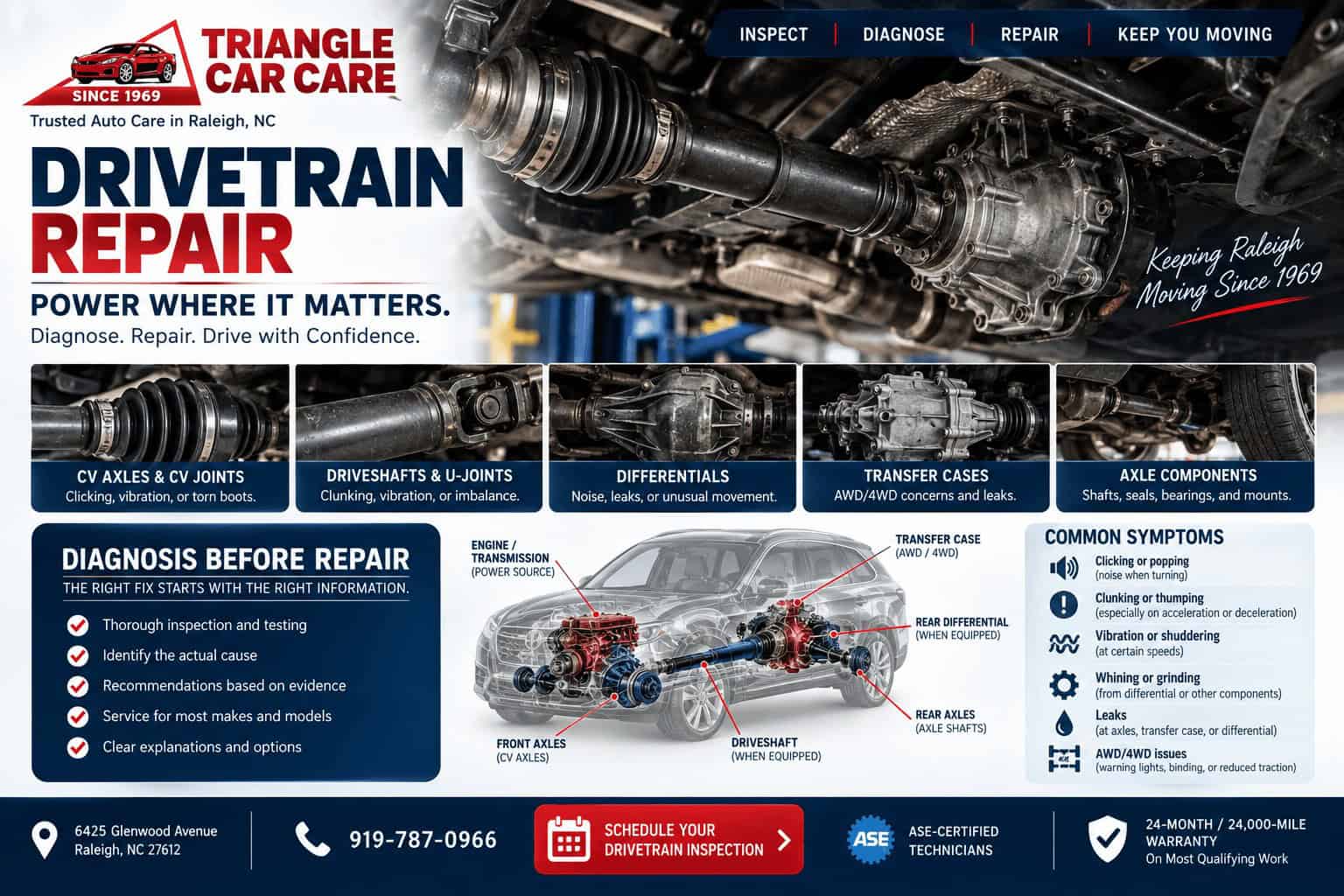
When Does the Noise Happen?
Turning, accelerating, decelerating, coasting, and steady-speed driving can produce different clues about where a driveline symptom originates.
Look Beyond the Obvious Part
A damaged boot, loose joint, leaking seal, worn mount, tire issue, or another component can produce overlapping symptoms.
Let the Findings Guide the Repair
Diagnosis should establish the source before a CV axle, driveshaft, differential-related component, or other driveline part is replaced.
Clicking During a Turn Can Be a Clue—Not a Final Diagnosis
CV joints are designed to transmit torque through changing angles. Depending on the vehicle, an outer CV joint may operate through steering movement while inner joints also accommodate suspension or driveline movement.
A repetitive click during a turn can be associated with CV-joint wear, especially when other evidence supports it. However, clicking can also come from other rotating or suspension-related components. Inspection should confirm the source.
Vibration Can Come From More Than a Driveshaft
Driveshaft systems may include slip joints, yokes, universal joints, flexible couplings, center supports, dampers, flanges, and other components depending on the design.
Driveline vibration can be influenced by joint wear, shaft damage, runout, support bearing condition, mounting, alignment, operating angle, or other factors. Tires, wheels, suspension, hubs, and engine or transmission mounts can create similar symptoms.
Because vibration can travel through the body of the vehicle, feeling the vibration in the seat or floor does not automatically identify the failed component.
Differential, Transfer and AWD Systems Are Vehicle-Specific
A differential allows driven wheels to rotate at different speeds, which is necessary when a vehicle turns. Modern vehicles may use open, limited-slip, locking, electronically controlled, or integrated differential designs.
AWD and 4WD systems vary even more. Depending on the vehicle, power may be distributed through a transfer case, power-transfer unit, center differential, clutch pack, coupling, rear drive module, or a combination of mechanical and electronically controlled components.
That variation is why drivetrain diagnosis and maintenance should follow information for the specific year, make, model, drivetrain, and configuration.
What Different Drivetrain Symptoms Can Suggest
These examples show useful diagnostic patterns, not remote diagnoses.
| What You Notice | Possible Areas to Inspect | Why Diagnosis Matters |
|---|---|---|
| Repeated clicking while turning | CV joints, axle assemblies, wheel or suspension components, or another rotating source. | Clicking can support a CV-joint suspicion, but inspection should confirm the source. |
| Clunk when accelerating or changing direction | U-joints, CV joints, mounts, differential movement, driveline lash, transmission behavior, or related hardware. | Several drivetrain and mounting components can produce a similar torque-change clunk. |
| Vibration that increases with road speed | Driveshaft, shaft supports, axles, wheels, tires, hubs, bearings, or suspension. | Road-speed vibration is not automatically a driveshaft balance problem. |
| Whine or hum that changes with acceleration | Differential gears or bearings, wheel bearings, tires, transmission, or other rotating components. | Load-sensitive changes can provide diagnostic clues but do not identify the part by themselves. |
| Fluid under a differential or transfer assembly | Housing seals, shaft seals, covers, vents, plugs, or nearby components. | Identify the fluid and exact source before deciding on service. |
| Severe vibration, grinding, binding or loss of propulsion | Potential major drivetrain or related mechanical problem. | Stop when safely possible and arrange inspection rather than continuing to drive. |
Differential and Transfer-Case Maintenance Is Not Universal
Fluid specifications, capacities, inspection procedures, and maintenance intervals vary by vehicle and drivetrain configuration. Some systems are serviced differently under severe-use conditions, towing, off-road operation, water exposure, or other operating conditions.
Use the owner's manual and current manufacturer service information for the specific vehicle. A generic mileage interval should not be applied to every differential, transfer case, power-transfer unit, or AWD system.
The fluid itself also matters. Different systems can require different lubricants, additives, or procedures. Using the wrong specification can create problems rather than prevent them.
Drivetrain Repair, Transmission Repair or Suspension Service?
These systems interact closely and can create overlapping symptoms. The most specific service page should own each commercial intent.
Drivetrain Repair
Start here when the concern appears related to CV axles, CV joints, half-shafts, driveshafts, U-joints, differential-related operation, transfer components, AWD or 4WD driveline behavior.
Transmission Repair
If the primary concern involves gear engagement, shifting, transmission fluid, slipping, transmission-specific operation, or another transmission issue, visit our Transmission Repair page .
Suspension & Steering
If the primary concern involves steering looseness, handling, suspension noise, vehicle stability, ball joints, control arms, shocks, struts, or tie rods, visit our Suspension and Steering Systems page .
Vibration and Noise Can Cross Several Vehicle Systems
A vehicle may feel as though it has a drivetrain problem when the actual cause is a wheel or tire, suspension component, wheel bearing, engine mount, brake component, transmission condition, or another system.
If the main symptom is broad and you do not know which system is responsible, our Diagnostic Service page is the better starting point.
Keeping these intents separate helps each Triangle Car Care service page answer one primary customer need instead of competing with other pages on the site.
Why Drivetrain Repair Cost Varies
“Drivetrain repair” covers many different components and vehicle layouts. A generic national average is not a Triangle Car Care quote.
FWD, RWD, AWD, and 4WD layouts use different components and can require very different access and procedures.
A CV boot, axle assembly, driveshaft joint, seal, bearing, or differential-related concern can involve very different scopes of work.
A torn boot caught early may present a different situation from a joint or component that has operated after lubricant loss or mechanical damage.
Parts availability, fluid specifications, fasteners, access, electronic controls, and manufacturer procedures can affect the repair plan.
Local Driving Can Help Reveal Drivetrain Symptoms
Raleigh drivers encounter stop-and-go traffic, highway commuting, turning through parking lots, road repairs, uneven pavement, rain, and changing driving loads. Those conditions do not prove why a drivetrain problem developed, but they can help reveal when a symptom occurs.
Tell the shop whether a noise or vibration appears only during acceleration, on tight turns, at highway speed, after the vehicle warms up, while backing up, or when changing from acceleration to deceleration.
Drivetrain Service From an Established Raleigh Auto Repair Shop
Triangle Car Care has served the Raleigh area since 1969 and operates one location at 6425 Glenwood Avenue, Raleigh, NC 27612. The shop services and repairs most makes and models.
Triangle Car Care's published warranty information specifically lists qualifying wheel bearing, CV axle and joint, half-shaft, and driveshaft repair categories. Warranty coverage depends on the particular repair and applicable terms.
Related Automotive Services in Raleigh
Drivetrain symptoms can overlap with several systems. These pages keep each service intent separate while helping drivers reach the right starting point.
Drivetrain Repair Raleigh NC FAQs
Common questions about drivetrain noises, CV joints, driveshafts, differentials, AWD and 4WD systems, maintenance, and repair planning.
What is included in a vehicle's drivetrain?
The exact drivetrain depends on the vehicle. Components may include CV axles, half-shafts, CV joints, driveshafts, universal joints, differentials, axle shafts, transfer cases, power-transfer units, couplings, seals, bearings, mounts, and related hardware. Front-wheel drive, rear-wheel drive, AWD, and 4WD vehicles use different layouts.
Is drivetrain repair the same as transmission repair?
No. The transmission or transaxle is closely connected to the drivetrain, but transmission-specific problems such as shifting, engagement, internal transmission operation, and transmission-fluid concerns have their own service intent. Triangle Car Care maintains a separate Transmission Repair page for those concerns.
Does clicking while turning mean my CV joint is bad?
Clicking during a turn can be associated with CV-joint wear, particularly when other inspection findings support it, but the sound alone does not prove the joint has failed. Other rotating, wheel, or suspension-related components can produce similar noises, so the source should be confirmed before replacement.
What causes drivetrain vibration during acceleration?
Possible causes can include CV axles, driveshafts, universal joints, support bearings, mounts, or other driveline components. Tires, wheels, hubs, suspension components, and engine or transmission mounts can also produce overlapping vibration. The speed, load, and conditions under which the vibration appears help guide diagnosis.
Can a torn CV boot damage a CV joint?
A CV boot helps retain lubricant and protect the joint from dirt and moisture. When a boot tears, lubricant can escape and contaminants can enter, which can contribute to joint wear. The condition of the boot and joint should be inspected to determine the appropriate service.
What causes a clunk when I accelerate or let off the gas?
A torque-change clunk can involve drivetrain lash, CV joints, U-joints, mounts, driveshaft components, differential movement, transmission behavior, or related hardware. Several components can create similar symptoms, so the noise should be reproduced and located before a repair is recommended.
How often should differential or transfer-case fluid be changed?
There is no universal interval for every vehicle. Fluid specifications and maintenance schedules vary by manufacturer, model year, drivetrain, operating conditions, and component design. Follow the owner's manual and current manufacturer information for the specific vehicle rather than using one generic mileage interval.
Is AWD the same as 4WD?
No. AWD and 4WD systems both can send torque to more than two wheels, but their mechanical layouts, operating strategies, driver controls, electronic systems, transfer components, and maintenance requirements can differ significantly. The correct service information should be based on the vehicle's specific system.
Can different tire sizes affect an AWD vehicle?
Some AWD and 4WD systems can be sensitive to differences in tire circumference or final-drive ratio. Tire replacement requirements vary by manufacturer and vehicle, so the owner's manual or manufacturer guidance should be followed instead of applying one universal AWD tire rule.
Can I keep driving with a drivetrain noise?
That depends on the cause and severity, which cannot be determined from the sound alone. Severe vibration, grinding, binding, sudden loss of propulsion, major fluid loss, or visible axle or shaft damage are reasons to stop when safely possible and arrange inspection rather than continuing to drive.
How much does drivetrain repair cost in Raleigh?
Drivetrain repair cost depends on the vehicle layout, confirmed component, parts required, labor access, fluid and service requirements, and whether related damage is present. A generic national average is not a Triangle Car Care quote. Diagnosis is needed before an appropriate repair scope can be established.
Does Triangle Car Care provide drivetrain service for most makes and models?
Triangle Car Care provides automotive drivetrain diagnosis and repair services for most makes and models from its Raleigh location at 6425 Glenwood Avenue. The specific service available depends on the vehicle's drivetrain design, diagnostic findings, parts requirements, and scope of repair.
Clicking, Clunking or Vibration? Start With the Cause.
Contact Triangle Car Care for drivetrain diagnosis and repair in Raleigh. Whether the concern involves a CV axle, driveshaft, differential-related symptom, AWD or 4WD operation, or an unexplained driveline noise, the appropriate repair begins with identifying the source.
Sources & Further Reading
- National Institute for Automotive Service Excellence — Automobile & Light Truck Test Series, including Manual Drive Train & Axles
- Toyota Owners — Vehicle-Specific Manuals & Maintenance Information
- Triangle Car Care — About Us
- Triangle Car Care — Warranty Information
- Triangle Car Care — Transmission Repair
- Triangle Car Care — Suspension and Steering Systems


