


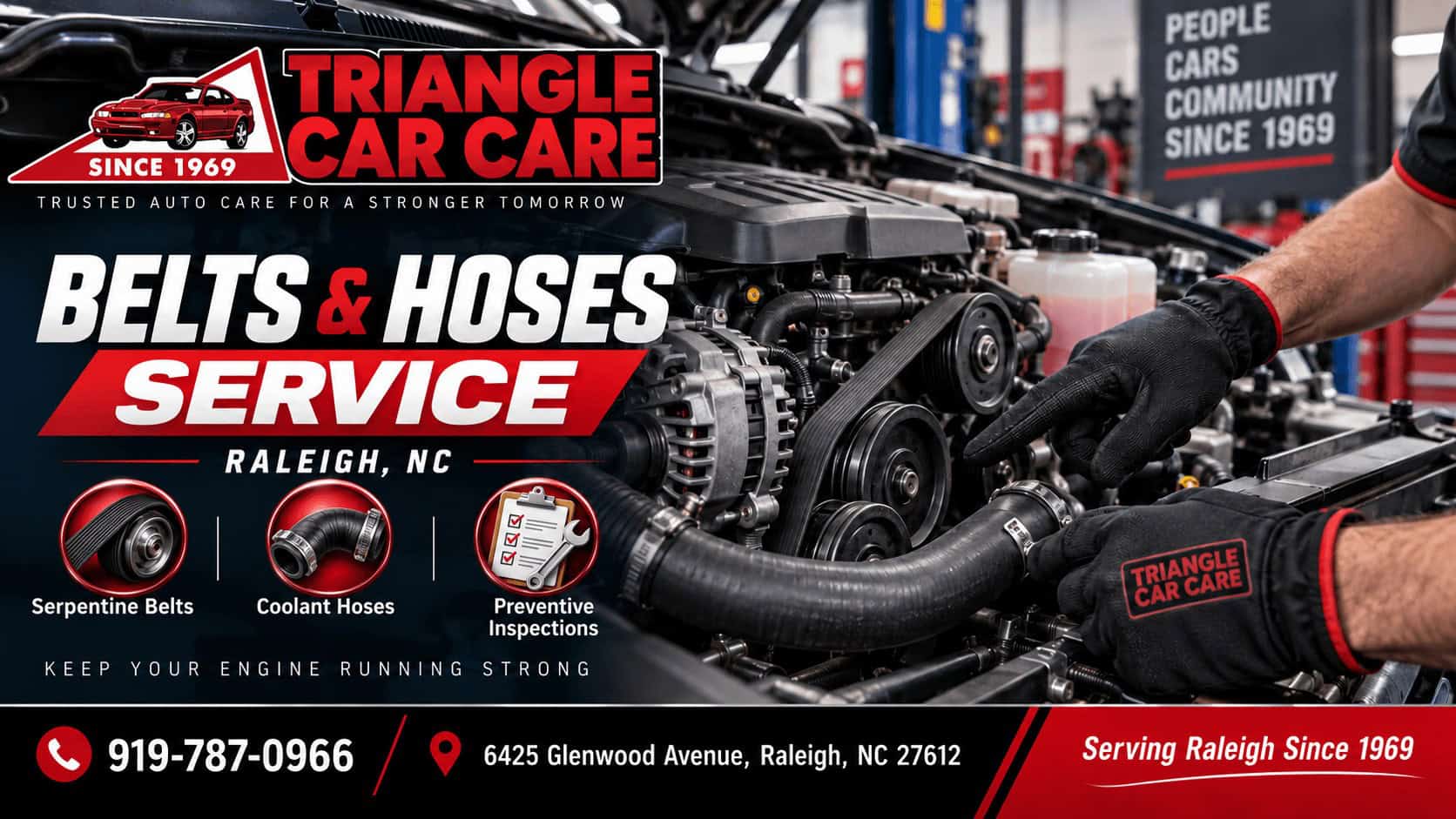
BELTS & HOSES IN RALEIGH, NC • SERPENTINE BELT & COOLANT HOSE INSPECTION • MOST MAKES & MODELS
Engine Accessory & Cooling-System Maintenance
Belts & Hoses Service in Raleigh, NC
Engine belts and coolant hoses perform different jobs, but both can be important to reliable vehicle operation. Accessory-drive belts may transfer engine power to components such as the alternator, air-conditioning compressor, water pump, or other accessories depending on vehicle design. Coolant hoses route engine coolant between components in the cooling system.
When Should Belts and Hoses Be Checked?
There is no single replacement interval that applies to every belt or hose on every vehicle. Inspection and replacement requirements vary by year, engine, belt design, hose construction, operating conditions, and manufacturer maintenance guidance. Visible cracking, fraying, glazing, abnormal belt noise, coolant leakage, hose bulging, soft spots, or overheating are reasons to have the system evaluated rather than waiting for a generic mileage number.
Serving Raleigh Since 1969
Automotive maintenance and repair from Triangle Car Care's Glenwood Avenue location.
ASE-Certified Personnel
Belt and hose concerns considered in the context of the complete vehicle system.
Most Makes & Models
Service for many cars, trucks, SUVs, and other passenger vehicles.
919-787-0966
Call or request an appointment online for belts and hoses service in Raleigh.
Accessory Drive System
What Does a Serpentine Belt Do?
Many modern gasoline and diesel vehicles use a multi-ribbed serpentine belt to transfer engine rotation to one or more accessories. Depending on the exact vehicle, those accessories may include the alternator, air-conditioning compressor, mechanically driven water pump, hydraulic power-steering pump, or other belt-driven components.
Not every vehicle uses the same arrangement. Some modern vehicles use electric power steering, electric cooling fans, electrically driven water pumps, electrically driven air-conditioning compressors, multiple accessory belts, or other designs.
That is why a belt should be evaluated according to the exact engine and accessory-drive system rather than assuming every serpentine belt powers the same components.
More Than Just the Belt
The Accessory Belt Works as Part of a System
A belt does not operate by itself. Pulleys, tensioners, accessories, bearings, and belt routing all influence how the drive system operates.
Serpentine Belt
Transfers rotation from the engine crankshaft to applicable accessories.
Belt Tensioner
Helps maintain appropriate belt tension where the vehicle uses an automatic or adjustable tensioning system.
Idler & Accessory Pulleys
Guide the belt and support the required routing around belt-driven components.
Driven Accessories
Which accessories are belt-driven depends on the vehicle and engine design.
What Do Radiator and Heater Hoses Do?
Cooling-system hoses carry coolant between components such as the engine, radiator, heater core, coolant reservoir, thermostat housing, water pump, and other cooling-system passages depending on vehicle design.
These hoses operate in an environment that can include heat, pressure, vibration, coolant exposure, engine movement, and changing temperatures. Their construction varies considerably between vehicles, and modern molded hose assemblies may incorporate branches, connectors, plastic fittings, valves, quick-connects, sensors, or other components.
A visible coolant leak near a hose does not automatically prove that the hose itself is the source. Coolant can travel from another fitting, housing, radiator, reservoir, water pump, or nearby component before becoming visible.

Triangle Car Care belts and hoses guide for Raleigh drivers covering belt wear, coolant hose condition, warning signs, and preventive inspection.
Accessory Drive Warning Signs
Signs a Serpentine Belt or Belt Drive May Need Attention
Belt symptoms should be treated as clues rather than a diagnosis. A worn belt can create problems, but abnormal belt behavior can also be caused by a tensioner, pulley, bearing, accessory, contamination, misalignment, or another issue within the drive system.
Cracking or Fraying
Visible damage, missing belt material, frayed edges, or deterioration should be evaluated in the context of the belt type and manufacturer guidance.
Glazing or Unusual Wear
A shiny, polished, unevenly worn, or contaminated belt surface may indicate belt wear or another condition affecting the drive system.
Squealing or Chirping
Belt-area noise can involve belt condition, tension, pulley alignment, bearings, contamination, or driven accessories. Noise alone does not identify the failed part.
Belt Wandering or Misalignment
A belt that does not track normally on its pulleys may indicate tensioner, pulley, mounting, bearing, alignment, or component concerns.
Signs a Coolant Hose May Need Attention
NHTSA recommends looking for visible bulges, blisters, cracks, or cuts in belts and hoses and checking that hose connections are secure. Hose manufacturers also identify soft areas, cracking near fittings, and bulging as signs that deserve attention.
| What You May Notice | Why It Deserves Attention |
|---|---|
| Coolant residue or wetness | May indicate coolant escaping from a hose, fitting, clamp, connection, or nearby cooling-system component. |
| Bulging or swelling | Can indicate deterioration or damage within the hose structure. |
| Cracking or abrasion | External deterioration or rubbing against another component can weaken the hose. |
| Unusually soft areas | May indicate deterioration within the hose depending on its design and construction. |
| Coolant odor | A sweet or unusual coolant odor may accompany a leak, but the leak source still needs to be identified. |
What May Be Checked During Belts and Hoses Service?
What needs to be inspected depends on the vehicle and the concern. A belt or hose problem is often best evaluated as part of the larger system rather than looking at one rubber component in isolation.
Belt Condition
Visible wear, cracking, fraying, glazing, contamination, damaged ribs, and abnormal tracking may be considered.
Tensioner & Pulleys
The condition of applicable tensioners, pulleys, bearings, and belt routing may affect belt operation.
Coolant Hoses
Radiator, heater, bypass, reservoir, and other accessible coolant hoses may be considered depending on vehicle design.
Connections & Clamps
Hose ends, clamps, quick-connect fittings, and adjacent connections may be checked for visible leakage or deterioration.
Coolant Residue
Dried residue, wetness, staining, or odor can provide clues about a cooling-system leak.
Related Component Condition
A belt or hose concern may require evaluating nearby components before recommending a repair.
Important Difference
Serpentine Belt vs. Timing Belt
A serpentine or accessory-drive belt is different from a timing belt. Accessory belts generally drive external engine accessories. A timing belt, when used, synchronizes internal engine operation between the crankshaft and camshaft or camshafts.
Many modern engines use timing chains instead of timing belts, and timing-belt replacement requirements vary significantly by manufacturer, engine, model year, and operating conditions.
Do not apply a generic timing-belt interval to every vehicle. Check the maintenance information for the exact year, make, model, and engine.
What Happens if a Serpentine Belt Breaks?
The result depends on what the belt drives on that vehicle. A broken belt can stop one or more accessories from operating. Depending on the design, that could affect charging-system operation, air conditioning, hydraulic power steering, or coolant circulation if the water pump is mechanically driven by that belt.
Because accessory layouts differ, the safest approach is to identify which systems are affected rather than assuming every broken belt produces the same symptoms.
Can a Bad Belt or Hose Cause Engine Overheating?
It can on some vehicles, but neither condition should be assumed without diagnosis.
A leaking coolant hose can reduce coolant level and cooling-system pressure. A failed accessory belt can affect coolant circulation when the vehicle uses a belt-driven water pump. However, overheating can also involve the thermostat, radiator, cooling fans, water pump, coolant level, airflow, pressure-control components, internal engine conditions, sensors, electrical controls, or other problems.
An overheating vehicle should be diagnosed based on the complete cooling system rather than replacing a belt or hose simply because overheating is present.
Important Safety Guidance
When Should You Stop Driving?
Stop driving when continuing could cause engine damage or create an unsafe condition. Examples include an overheating warning, temperature gauge entering the hot range, steam from under the hood, major coolant loss, a large active fluid leak, smoke, or sudden loss of a critical belt-driven function such as steering assist on a vehicle that uses a belt-driven hydraulic pump.
Move to a safe location when possible, shut the engine off when directed by the vehicle manufacturer or when overheating is occurring, and arrange inspection or towing as appropriate.
Never remove a radiator or pressurized cooling-system cap from a hot engine. Hot coolant and steam can cause serious burns.
How Often Should Belts and Hoses Be Replaced?
Replacement schedules vary. Some vehicles provide maintenance intervals for particular belts, while other components are primarily replaced according to condition, inspection findings, repair procedures, or manufacturer recommendations.
Belt construction has also changed over time. A modern EPDM serpentine belt may not develop the same obvious cracking pattern associated with older belt materials, which is another reason visual appearance alone may not tell the whole story.
Use the maintenance schedule and service information for the exact vehicle rather than applying a universal replacement mileage to every belt and hose.
Belts and Hoses in Raleigh Driving Conditions
Raleigh vehicles can experience summer heat, stop-and-go traffic, highway commuting, repeated short trips, and seasonal temperature changes. Heat is one factor that can contribute to rubber-component deterioration over time, but Raleigh conditions do not create one universal local replacement interval.
Vehicle age, mileage, component material, under-hood temperature, contamination, previous repairs, maintenance history, and manufacturer requirements all matter. Inspection should be based on the individual vehicle.
Why Choose Triangle Car Care for Belts & Hoses in Raleigh?
Serving Raleigh Since 1969
Triangle Car Care provides automotive maintenance, diagnosis, and repair from its Raleigh location on Glenwood Avenue.
System-Based Diagnosis
Belt noise, coolant leaks, overheating, and accessory-drive symptoms can have several causes, so repair recommendations should follow inspection.
Most Makes & Models
Triangle Car Care services most makes and models while considering vehicle-specific belt, hose, and maintenance requirements.
Triangle Car Care offers a 24-month/24,000-mile warranty on most qualifying work. Warranty applicability depends on the particular service or repair.
Schedule Belts & Hoses Service in Raleigh, NC
Hearing unusual belt noise, noticing coolant leakage, or concerned about the condition of a serpentine belt or coolant hose? Triangle Car Care can inspect the concern and determine the appropriate next step for your vehicle.
Triangle Car Care
6425 Glenwood Avenue, Raleigh, NC 27612
Belts & Hoses FAQ
Frequently Asked Questions About Belts and Hoses
How often should a serpentine belt be replaced?
There is no single serpentine-belt replacement interval for every vehicle. Belt design, engine configuration, operating conditions, mileage, age, component condition, and manufacturer recommendations all matter. Follow the maintenance information for your exact vehicle and have visible wear, abnormal noise, or accessory-drive problems inspected.
What are signs of a worn serpentine belt?
Possible signs include cracking, fraying, missing material, damaged ribs, glazing, unusual wear, or abnormal belt-area noise. These signs do not always mean the belt itself is the only problem because pulleys, tensioners, bearings, contamination, or driven accessories can also affect belt operation.
Why is my serpentine belt squealing?
Belt-area squealing can have several possible causes, including belt condition, incorrect tension, contamination, pulley alignment, tensioner problems, bearing problems, or a driven accessory. The sound alone does not identify which component needs repair.
What happens if the serpentine belt breaks?
The effect depends on which accessories the belt drives. Depending on the vehicle, a broken belt may affect charging, air conditioning, hydraulic steering assist, coolant circulation, or other functions. Vehicle design varies, so the affected systems should be identified for the specific engine.
What are signs of a bad coolant hose?
Visible coolant leakage, dried residue, bulging, swelling, cracking, abrasion, damaged fittings, or unusually soft areas can justify inspection. Coolant near a hose does not automatically prove the hose is leaking because nearby cooling-system components can produce similar evidence.
Can a coolant hose cause overheating?
A leaking or failed coolant hose can contribute to overheating if coolant is lost or the cooling system cannot maintain proper operation. However, overheating can also involve the thermostat, radiator, water pump, fans, coolant level, airflow, pressure control, sensors, electrical controls, or other conditions.
Is a serpentine belt the same as a timing belt?
No. A serpentine or accessory belt generally drives external engine accessories. A timing belt, when equipped, synchronizes internal engine operation between the crankshaft and camshaft or camshafts. Some engines use timing chains instead, and maintenance requirements vary by engine.
Should the belt tensioner be checked with the belt?
The tensioner is part of the accessory-drive system on vehicles that use one, so its condition can be relevant when diagnosing belt wear or noise. Pulleys, bearings, accessory alignment, and other related components may also need to be considered.
Can Raleigh heat affect belts and hoses?
Heat is one factor that can contribute to rubber-component deterioration over time, but there is no special Raleigh replacement interval that applies to every vehicle. Vehicle design, age, mileage, materials, under-hood conditions, maintenance history, and manufacturer guidance remain important.
Where can I get belts and hoses service in Raleigh, NC?
Triangle Car Care provides belts and hoses service and related automotive repair at 6425 Glenwood Avenue in Raleigh, North Carolina. Call 919-787-0966 or request an appointment online.


