


Ford Repair Raleigh NC: Warning Signs, Costs, Timelines, and What Triangle Drivers Should Know
Ford repair Raleigh NC drivers can trust starts with accurate diagnosis, honest communication, and a shop that understands how local driving affects Ford cars, trucks, SUVs, hybrids, vans, and high-mileage daily drivers. Ford vehicles are built for work, commuting, family driving, towing, and everyday use, but even a dependable F-150, Explorer, Escape, Fusion, Mustang, Transit, Super Duty, Edge, Expedition, Ranger, Taurus, Focus, or hybrid model needs the right maintenance and repair at the right time.
For busy drivers in Raleigh, Cary, Durham, Garner, Knightdale, Wake Forest, Chapel Hill, Apex, Morrisville, and the greater Triangle area, Ford problems rarely appear at a convenient time. A check engine light may come on before work. A truck may start clunking when shifting into gear. An SUV may develop a coolant smell in summer traffic. A commuter car may start shaking at idle. A van may lose power during a workday route.
Triangle Car Care has been family-owned and Raleigh-trusted since 1969. The shop provides honest, no-upsell auto repair for foreign and domestic vehicles, including Ford repair, diagnostic service, engine repair, drivetrain repair, belts and hoses, exhaust system repair, Honda repair, Toyota repair, Chevrolet repair, Lexus repair, brake service, cooling system service, oil and fluid changes, and general Raleigh auto repair.
If your Ford has a warning light, brake noise, oil leak, coolant leak, rough idle, drivetrain vibration, engine noise, starting problem, overheating concern, or maintenance need, call (919) 787-0966 or request an appointment with Triangle Car Care.
Why Ford Repair Raleigh NC Service Matters
Ford repair Raleigh NC service matters because local driving conditions can put real stress on trucks, SUVs, commuter cars, hybrids, and work vehicles. Stop-and-go traffic, summer heat, humidity, towing, short trips, high-mileage commuting, heavy air conditioning use, and long drives across the Triangle can wear down brakes, fluids, belts, hoses, cooling systems, suspension parts, drivetrain components, batteries, and engine systems.
Ford repair may help with:
- Check engine lights
- Rough idle
- Poor acceleration
- Brake noise
- Steering vibration
- Overheating
- Coolant leaks
- Oil leaks
- Battery or charging problems
- Starter issues
- Engine misfires
- Transmission-related symptoms
- Drivetrain vibration
- CV axle or U-joint concerns
- Exhaust noise
- Suspension clunks
- Air conditioning problems
- Dashboard warning lights
- Poor fuel economy
- Maintenance reminders
- Used-vehicle inspection concerns
- Fleet or work vehicle reliability
- Preventive maintenance
A small symptom can become a bigger repair when ignored. A minor coolant leak can turn into overheating. A brake squeal can become grinding. A rough idle can point to an ignition, fuel, air, sensor, or mechanical issue. A drivetrain vibration can stress nearby components.
Triangle Car Care focuses on diagnosing the real problem first so drivers can make informed decisions before approving work.
Why Choose Triangle Car Care for Ford Repair in Raleigh?
Triangle Car Care has served Raleigh and Triangle area drivers since 1969. That history matters when you want a repair shop that is experienced, honest, practical, and easy to talk to. The team works on foreign and domestic vehicles, including Ford models used for commuting, family driving, work, towing, and long-distance travel.
Drivers choose Triangle Car Care for:
- Family-owned Raleigh auto repair since 1969
- Ford repair for cars, trucks, SUVs, hybrids, and vans
- Diagnostic service before replacing parts
- No-upsell communication
- Practical repair recommendations
- Clear estimates before work
- Experience with foreign and domestic vehicles
- Modern diagnostic tools
- Help prioritizing urgent vs. future service
- Convenient Raleigh location on Glenwood Avenue
- Long-time Triangle service history
- Peace of mind for busy drivers
Triangle Car Care is a strong alternative to dealership service for many Ford owners who want clear answers, practical recommendations, and a local repair relationship.
What Ford Models Does Triangle Car Care Service?
Triangle Car Care services many Ford vehicles commonly driven in Raleigh and across the Triangle area.
Ford models may include:
- Ford F-150
- Ford Super Duty
- Ford Ranger
- Ford Maverick
- Ford Explorer
- Ford Expedition
- Ford Escape
- Ford Edge
- Ford Bronco
- Ford Bronco Sport
- Ford Mustang
- Ford Fusion
- Ford Focus
- Ford Taurus
- Ford Transit
- Ford Transit Connect
- Ford C-MAX Hybrid
- Ford Fusion Hybrid
- Ford Escape Hybrid
- Older Ford sedans and coupes
- High-mileage Ford daily drivers
- Ford family vehicles
- Ford work vehicles
- Ford trucks used for towing or hauling
Whether your Ford is newer, older, high-mileage, used for work, or used as a daily commuter, a proper inspection can help determine what it needs now and what can wait.
Common Ford Warning Signs You Should Not Ignore
Many Ford repair problems begin with small warning signs. A dashboard light, new noise, leak, vibration, or performance change can point to a developing issue.
Common Ford warning signs include:
- Check engine light
- Flashing check engine light
- Rough idle
- Engine misfire
- Hard starting
- Battery warning light
- Clicking when starting
- Poor acceleration
- Loss of power
- Brake squeal
- Brake grinding
- Steering wheel vibration
- Vehicle pulling to one side
- Clunking over bumps
- Clicking while turning
- Drivetrain vibration
- Transmission hesitation
- Coolant smell
- Oil smell
- Fluid spots under the vehicle
- Overheating
- Exhaust noise
- Air conditioning blowing warm
- Dashboard warning lights
- Reduced fuel economy
- Maintenance light overdue
A flashing check engine light, overheating, brake grinding, loss of power, severe vibration, or strong burning smell should be treated as urgent. When a vehicle feels unsafe, stop driving and call the shop for guidance.
Ford Diagnostic Service: Why Guessing Gets Expensive
Ford diagnostic service helps identify the real cause of a problem before parts are replaced. A scan tool code is only a starting point. The same warning light can be caused by a sensor issue, wiring concern, ignition problem, air leak, fuel issue, emissions issue, drivetrain problem, or mechanical fault.
A diagnostic visit may include:
- Driver symptom review
The team asks what you noticed, when it started, whether warning lights appeared, and whether the Ford feels safe to drive.
Scan tool check
Diagnostic codes, warning lights, and available data may be reviewed when needed.
Visual inspection
The technician checks for leaks, worn parts, loose connections, damaged belts, damaged hoses, smoke, fluid concerns, and obvious safety issues.
Test drive when safe
A test drive may help reproduce vibration, hesitation, braking concerns, drivetrain noise, or rough running.
System-specific testing
The technician may test ignition, charging, cooling, fuel, intake, braking, steering, drivetrain, exhaust, or related systems based on symptoms.
Repair explanation
Triangle Car Care explains what was found in plain language and separates urgent repairs from maintenance items.
Written estimate before work
Drivers receive a clear estimate before approving Ford repairs.
The goal is to diagnose first and repair second.
Ford Repair vs. Ford Maintenance
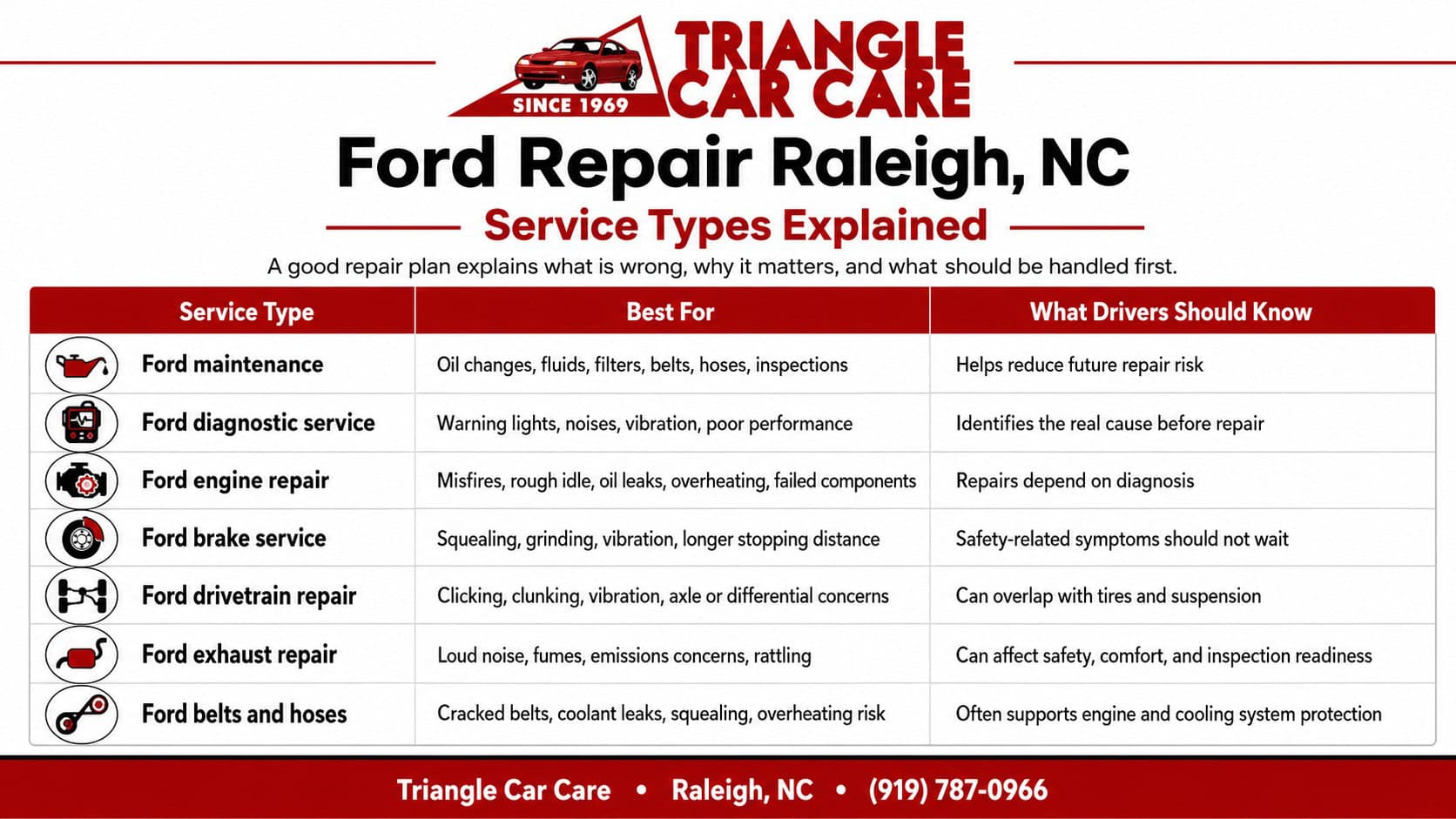
Ford repair and Ford maintenance are related, but they are not the same. Maintenance helps prevent future problems. Repair addresses a problem that already exists.
Ford Engine Repair and Check Engine Lights
Ford engine concerns can show up as warning lights, rough idle, poor acceleration, stalling, oil leaks, smoke, overheating, or unusual noise. Not every check engine light means a major repair, but it should not be ignored.
Ford engine repair may be needed when:
- Check engine light appears
- Check engine light flashes
- Engine shakes at idle
- Vehicle hesitates
- Engine misfires
- Fuel economy drops
- Oil leaks appear
- Coolant leaks appear
- Engine runs hot
- Burning smell appears
- Engine ticks, knocks, or rattles
- Vehicle stalls
- Starting becomes difficult
- Smoke appears from exhaust or engine area
- Warning lights appear together
A flashing check engine light is more urgent than a steady light. It may indicate a misfire that can damage emissions components or affect safe driving. Drivers should call for guidance before continuing to drive.
Ford Brake Repair in Raleigh
Brakes are one of the most important safety systems on any Ford. Trucks, SUVs, family vehicles, and commuter cars all rely on strong braking performance in Raleigh traffic.
Ford brake repair may be needed when:
- Brakes squeal
- Brakes grind
- The brake pedal feels soft
- The steering wheel shakes while braking
- The vehicle pulls while braking
- Stopping distance feels longer
- Brake warning lights appear
- Rotors feel warped
- Brake fluid is low
- Pads are worn unevenly
- A burning smell appears after braking
- The vehicle vibrates at highway speed
A brake inspection may include checking pads, rotors, calipers, brake fluid, hoses, lines, warning lights, and overall stopping performance. Brake repair pricing depends on the Ford model, parts needed, rotor condition, labor, and whether other components are worn.
Ford Drivetrain, Axle, and Differential Concerns
Ford drivetrain symptoms can show up as clicking, clunking, vibration, shuddering, grinding, whining, or fluid leaks. Trucks, SUVs, all-wheel-drive vehicles, and four-wheel-drive vehicles may have additional drivetrain components that need inspection.
Ford drivetrain service may be needed when:
- The vehicle clicks while turning
- The vehicle clunks when shifting into gear
- Vibration occurs during acceleration
- A humming or whining noise changes with speed
- A fluid leak appears under the vehicle
- Four-wheel-drive concerns appear
- All-wheel-drive warning lights appear
- The vehicle shudders under load
- There is poor acceleration
- A wheel-area noise appears
- A truck has been used for towing
- Service history is unknown
A drivetrain inspection helps determine whether the issue is related to CV axles, U-joints, driveshafts, differential, transfer case, mounts, wheel bearings, tires, suspension, or another system.
Ford Belts, Hoses, and Cooling System Problems
North Carolina heat can expose weak belts, hoses, and cooling system parts quickly. A Ford that overheats should not be ignored because overheating can lead to serious engine damage.
Cooling system warning signs include:
- Temperature gauge rising
- Steam from under the hood
- Sweet coolant smell
- Coolant spots under the vehicle
- Low coolant warning
- Repeated coolant top-offs
- Heater performance changes
- Radiator fan concern
- Water pump noise
- Hose swelling or soft spots
- Belt squeal
- Burning rubber smell
- Engine runs hot in traffic
Cooling system repair may include inspection of the radiator, water pump, thermostat, hoses, cooling fans, coolant condition, pressure cap, and possible leaks. The repair should focus on why the Ford overheated, not just adding coolant.
Ford Exhaust System Repair
The exhaust system helps move exhaust gases away from passengers, control noise, and support emissions-related performance. Exhaust issues can create loud sounds, odors, reduced performance, or inspection-related concerns.
Ford exhaust repair may be needed when:
- The vehicle sounds louder than usual
- Rattling appears under the vehicle
- Exhaust odor enters the cabin
- Check engine light appears
- Fuel economy drops
- Acceleration feels weak
- Rust or damage appears under the vehicle
- The vehicle fails inspection
- A catalytic converter code appears
- A muffler or pipe is damaged
Exhaust repair can involve pipes, mufflers, hangers, gaskets, oxygen sensors, catalytic converters, or other components. A proper inspection helps identify the actual failed part.
Ford Electrical, Battery, Alternator, and Starter Problems
Electrical problems can make a Ford unreliable quickly. A weak battery may look like a starter issue. A failing alternator may look like a battery problem. Corroded cables or wiring concerns can create confusing symptoms.
Electrical service may be needed when:
- The vehicle clicks but will not start
- Lights dim
- Battery warning light appears
- Battery keeps dying
- Starter sounds weak
- Accessories work intermittently
- Vehicle stalls
- Dashboard lights flicker
- Alternator is not charging
- Vehicle starts only after a jump
- Warning lights appear together
Triangle Car Care can test the battery, alternator, starter, cables, and charging system to identify the real cause before replacing parts.
Ford Suspension, Steering, and Ride Concerns
A Ford that clunks, pulls, bounces, vibrates, or feels unstable may need suspension or steering inspection. These symptoms can overlap with drivetrain, tire, brake, and wheel bearing concerns.
Suspension or steering service may be needed when:
- The vehicle pulls to one side
- Steering wheel vibrates
- Clunking occurs over bumps
- Tires wear unevenly
- Vehicle feels loose on the highway
- Steering feels heavy
- A humming or growling noise appears
- The ride feels bouncy
- The vehicle feels unstable during turns
- Noise appears after hitting a pothole
Because symptoms overlap, a proper inspection helps identify whether the issue is suspension, steering, tires, brakes, drivetrain, or wheel bearings.
Ford Repair Cost in Raleigh NC
Ford repair cost in Raleigh NC depends on the model, mileage, symptoms, diagnostic time, parts, labor access, fluid needs, and whether the issue involves maintenance or a larger repair.
| Ford Service | Common Reason | Cost Factors |
|---|---|---|
| Diagnostic service | Warning light, noise, leak, performance issue | Testing time, symptom complexity, scan data |
| Brake repair | Squeal, grinding, vibration, worn pads | Pads, rotors, calipers, fluid, labor |
| Engine repair | Rough idle, misfire, oil leak, overheating | Parts, testing, labor access, severity |
| Drivetrain repair | Clicking, clunking, vibration, leaks | Axles, joints, differential, transfer case, access |
| Belts and hoses | Squealing, cracks, coolant leaks | Belt type, hose location, tensioner condition |
| Exhaust repair | Loud noise, odor, emissions concern | Muffler, pipes, sensors, catalytic converter |
| Electrical repair | No-start, battery light, dim lights | Battery, starter, alternator, wiring |
| Preventive maintenance | Mileage-based service | Fluids, filters, inspections, spark plugs |
A simple maintenance service may cost less than a repair involving deep access, hard-to-find electrical issues, overheating damage, drivetrain components, or multiple failed parts. Triangle Car Care provides clear estimates before approved work begins.
How Long Does Ford Repair Take?
Ford repair timelines depend on the symptom, diagnosis, parts availability, vehicle design, labor access, and whether the issue affects multiple systems.
| Repair Type | Typical Scope | Timeline Factors |
|---|---|---|
| Diagnostic service | Warning light, noise, leak, test drive | Symptom complexity and shop schedule |
| Brake service | Pads, rotors, fluid, caliper check | Parts and rotor condition |
| Engine diagnosis | Misfire, rough idle, overheating, leak | Testing time and system complexity |
| Drivetrain repair | Axles, U-joints, differential, mounts | Vehicle layout and parts availability |
| Belt or hose replacement | Replace worn or leaking components | Access and related parts |
| Exhaust repair | Noise, odor, emissions-related parts | Rust, parts, and underbody access |
| Starting system diagnosis | Battery, starter, alternator, cables | Testing time and failure location |
| Preventive maintenance | Fluids, filters, inspection | Service package and vehicle condition |
Some Ford repairs can be completed quickly, while deeper diagnostics or larger repairs may take longer. The shop can explain the expected timeline after inspection.
Is It Safe to Drive With Ford Warning Lights?
Some warning lights allow limited driving to a repair appointment. Others are urgent. When in doubt, call the shop before continuing to drive.
Use caution if you notice:
- Flashing check engine light
- Overheating
- Steam from under the hood
- Low oil pressure warning
- Brake warning light
- Severe knocking
- Heavy smoke
- Strong burning smell
- Loss of power
- Severe vibration
- Steering concerns
- Coolant pouring out
- Oil leak worsening quickly
- Vehicle stalling
- Warning lights appearing together
If the vehicle feels unsafe, do not continue driving. Pull over safely and call Triangle Car Care for guidance.
Dealer vs. Independent Ford Repair in Raleigh
Many Ford owners wonder whether they need a dealership for repair. Dealerships may be useful for recalls, warranty claims, factory campaigns, software updates, and covered repairs. But many Ford diagnostics, brakes, belts, hoses, cooling system repairs, engine concerns, drivetrain inspections, exhaust issues, oil leaks, starting problems, and preventive maintenance services can be handled by an experienced independent Raleigh auto repair shop.
| Repair Option | Best For | What Drivers Should Know |
|---|---|---|
| Ford dealership | Warranty work, recalls, factory campaigns | May be needed for covered repairs |
| Independent repair shop | Diagnostics, maintenance, brakes, engine, drivetrain, exhaust | Often more personal and practical |
| Diagnostic service | Warning lights, noises, leaks, poor performance | Helps avoid replacing the wrong part |
| Preventive maintenance | Fluids, filters, belts, hoses, brakes, inspections | Helps reduce breakdown risk |
| Emergency repair | Overheating, severe braking issue, no-start | May require towing if unsafe to drive |
Triangle Car Care gives Raleigh drivers a family-owned, no-upsell option for Ford diagnosis and repair without dealership pressure.
Ford Maintenance Tips for Triangle Drivers
Preventive maintenance can reduce breakdown risk and help spot Ford problems early.
Helpful Ford maintenance habits include:
- Follow the owner’s manual maintenance schedule
- Do not ignore warning lights
- Change oil at proper intervals
- Check fluid levels
- Inspect brakes regularly
- Inspect belts and hoses
- Watch for coolant leaks
- Address overheating immediately
- Fix small oil leaks early
- Schedule diagnostics for new noises
- Keep battery terminals clean
- Check recalls by VIN through NHTSA
- Inspect tires and suspension
- Plan service before road trips
- Be careful with towing limits
- Keep repair records
The best maintenance plan depends on the Ford model, mileage, age, engine design, driving conditions, and service history.
Ford Repair for Raleigh, Cary, Durham, Garner, Wake Forest, and the Triangle
Triangle Car Care serves Raleigh and drivers throughout the Triangle area. Ford owners visit the shop from Glenwood Avenue, North Raleigh, Cary, Durham, Garner, Knightdale, Wake Forest, Morrisville, Apex, Chapel Hill, and surrounding communities.
Local driving conditions can affect Ford service needs, including:
- Stop-and-go commuting
- Hot summer traffic
- Short trips
- Highway driving on I-40, I-440, and I-540
- School pickup and family driving
- Work vehicle use
- Towing and hauling
- Heavy air conditioning use
- High-mileage commuter use
- Long periods between services
- Older vehicles staying on the road longer
- Road trips across North Carolina
A Raleigh-trusted shop can help you understand what your Ford needs based on real symptoms, mileage, and how you drive.
Anonymized Examples of Ford Repair Situations
Every vehicle is different, but these examples show why Triangle drivers schedule Ford repair and diagnostic service.
A Raleigh Ford F-150 with a check engine light
A driver noticed a check engine light and slight hesitation during acceleration. Diagnostic service helped determine whether the issue was ignition-related, fuel-related, sensor-related, or connected to another system.
A Cary Ford Explorer with brake vibration
An SUV driver felt vibration through the steering wheel while braking. A brake inspection helped determine whether the issue involved pads, rotors, calipers, tires, or another safety-related component.
A Durham Ford Escape with overheating
A commuter vehicle began running hot in traffic. Cooling system inspection helped review coolant level, hose condition, radiator operation, thermostat concerns, fan function, and possible leak sources.
A Wake Forest Ford Transit with starting trouble
A work vehicle clicked but would not start reliably. Testing helped determine whether the issue involved the battery, starter, alternator, cables, or another electrical concern.
These examples are educational and not based on identifiable customers. Diagnosis, cost, timeline, and repair needs depend on vehicle model, mileage, symptoms, parts, driving conditions, and inspection results.
Schedule Ford Repair in Raleigh NC
If your Ford has a check engine light, rough idle, overheating concern, brake noise, oil leak, coolant smell, drivetrain vibration, exhaust noise, starting problem, or maintenance need, Triangle Car Care can help identify the issue and explain the repair clearly.
Call (919) 787-0966 or request an appointment with Triangle Car Care.
- Schedule an appointment with Triangle Car Care
- Visit the Triangle Car Care homepage
- Review Ford repair in Raleigh
- Review Raleigh auto repair services
- Learn about diagnostic service
- Review engine repair in Raleigh
- Review belts and hoses service
- Explore drivetrain repair
- Learn about exhaust system repair
- Explore Honda repair in Raleigh
- Explore Toyota repair in Raleigh
- Review Chevrolet repair in Raleigh
- Explore Lexus repair in Raleigh
- Read more automotive repair tips
This article is for general information only. Ford repair recommendations depend on model, mileage, symptoms, diagnostic results, maintenance history, parts availability, vehicle design, driving conditions, and inspection findings. Always have warning lights, overheating, brake concerns, oil pressure warnings, severe vibration, fluid leaks, and safety-related symptoms inspected by a qualified technician.
FAQs About Ford Repair Raleigh NC
What Ford models does Triangle Car Care service?
Triangle Car Care services many Ford models, including F-150, Super Duty, Ranger, Maverick, Explorer, Expedition, Escape, Edge, Bronco, Mustang, Fusion, Focus, Transit, Transit Connect, hybrids, work vehicles, family vehicles, and high-mileage daily drivers.
What are the most common signs my Ford needs repair?
Common warning signs include check engine lights, rough idle, brake noise, overheating, oil leaks, coolant leaks, drivetrain vibration, clunking, poor acceleration, hard starting, battery warnings, exhaust noise, steering vibration, and dashboard warning lights.
Can Triangle Car Care diagnose Ford check engine lights?
Yes. Triangle Car Care can inspect Ford check engine lights using scan tools, live data, visual inspection, test drives when safe, and system-specific testing. A trouble code points to a system, but further diagnosis confirms the cause.
How much does Ford repair cost in Raleigh NC?
Ford repair cost depends on the model, symptom, diagnostic time, affected system, parts, labor access, and whether the issue is maintenance-related or a deeper repair. Brake repair, engine work, drivetrain repair, cooling system service, and electrical repair all vary by scope.
How long does Ford repair take?
Timing depends on diagnosis, parts availability, vehicle design, labor access, and repair complexity. Some inspections or maintenance visits may be completed quickly, while deeper engine, electrical, drivetrain, or cooling system repairs may take longer.
Is it safe to drive my Ford with the check engine light on?
A steady check engine light may allow limited driving in some cases, but you should schedule diagnosis soon. A flashing check engine light should be treated as urgent because it may indicate a misfire or condition that can cause further damage.
Does Triangle Car Care work on Ford trucks?
Yes. Triangle Car Care services Ford trucks and work vehicles, including F-150, Super Duty, Ranger, Transit, and related models. Service needs may include brakes, engine diagnostics, belts, hoses, drivetrain concerns, starting problems, exhaust repair, and maintenance.
Should I go to a Ford dealership or independent shop?
A dealership may be needed for recalls, warranty claims, factory campaigns, or covered repairs. Many diagnostics, maintenance, brakes, belts, hoses, engine concerns, drivetrain issues, and exhaust repairs can be handled by an experienced independent Raleigh auto repair shop.
Can Ford problems be mistaken for drivetrain, tire, or suspension issues?
Yes. Vibration, noise, clunking, power loss, and warning lights can overlap with drivetrain, tire, suspension, exhaust, electrical, engine, and brake concerns. Diagnostic service helps identify the true cause before repairs are recommended.
Who should I call for Ford repair Raleigh NC?
Call Triangle Car Care at (919) 787-0966 for Ford repair Raleigh NC drivers can trust, including check engine light diagnosis, brake repair, engine concerns, overheating, drivetrain issues, belts and hoses, exhaust repair, starting problems, and general Raleigh auto repair.
Sources
- Triangle Car Care
- Triangle Car Care Appointment
- Triangle Car Care Contact Us
- Triangle Car Care Ford Repair
- Triangle Car Care Auto Repair
- Triangle Car Care Diagnostic Service
- Triangle Car Care Engine Repair
- Triangle Car Care Belts and Hoses
- Triangle Car Care Drivetrain Repair
- Triangle Car Care Exhaust System Repair
- Triangle Car Care Honda Repair
- Triangle Car Care Toyota Repair
- Triangle Car Care Chevrolet Repair
- Triangle Car Care Lexus Repair
- Triangle Car Care Automotive Repair Tips Blog
- NHTSA Recall Lookup
- AAA Vehicle Maintenance Checklist
- Car Care Council: Vehicle Systems Overview
- Car Care Council: Check Engine Light


