

NC Inspection Failed? What Raleigh Drivers Should Check First
NC Inspection Failed? 7 Essential Checks to Avoid Risk
Quick Answer: If your NC inspection failed, start by reading whether the result was a safety failure, an emissions failure, or both. A safety problem usually points to a visible or measurable item that must pass inspection, while an emissions result often means the vehicle’s onboard system reported a problem that needs diagnostic testing before an inspection retest. Do not clear a warning light or guess at parts; a symptom is a clue, not a diagnosis.
As of October 6, 2026: Wake County’s emissions requirement still applies for eligible vehicles. North Carolina has enacted legislation to end the emissions program in all 19 counties, but NC DEQ says changes are coming and the change still depends on EPA approval and DMV implementation. Annual safety inspections remain. Check current NCDMV and NC DEQ guidance for your vehicle before assuming the emissions program has ended.
For drivers, a failed inspection can feel like a dead end. In practice, it is more like a starting point. The result tells you which part of the inspection did not pass. It does not automatically tell you the failed part, the full repair path, or whether other symptoms are related. That is why Triangle Car Care’s approach is diagnosis before assumptions, especially when a warning light, trouble code, noise, pull, vibration, leak, or drivability symptom is involved.
If your vehicle is due for an inspection, Triangle Car Care performs NC car inspection service at its Glenwood Avenue shop, including safety and emissions inspections where applicable. If the failure points to a warning light or computer-reported issue, the next step may be check engine light diagnosis or broader vehicle diagnostic service before you return for a retest.
Safety inspection failure vs. emissions inspection failure
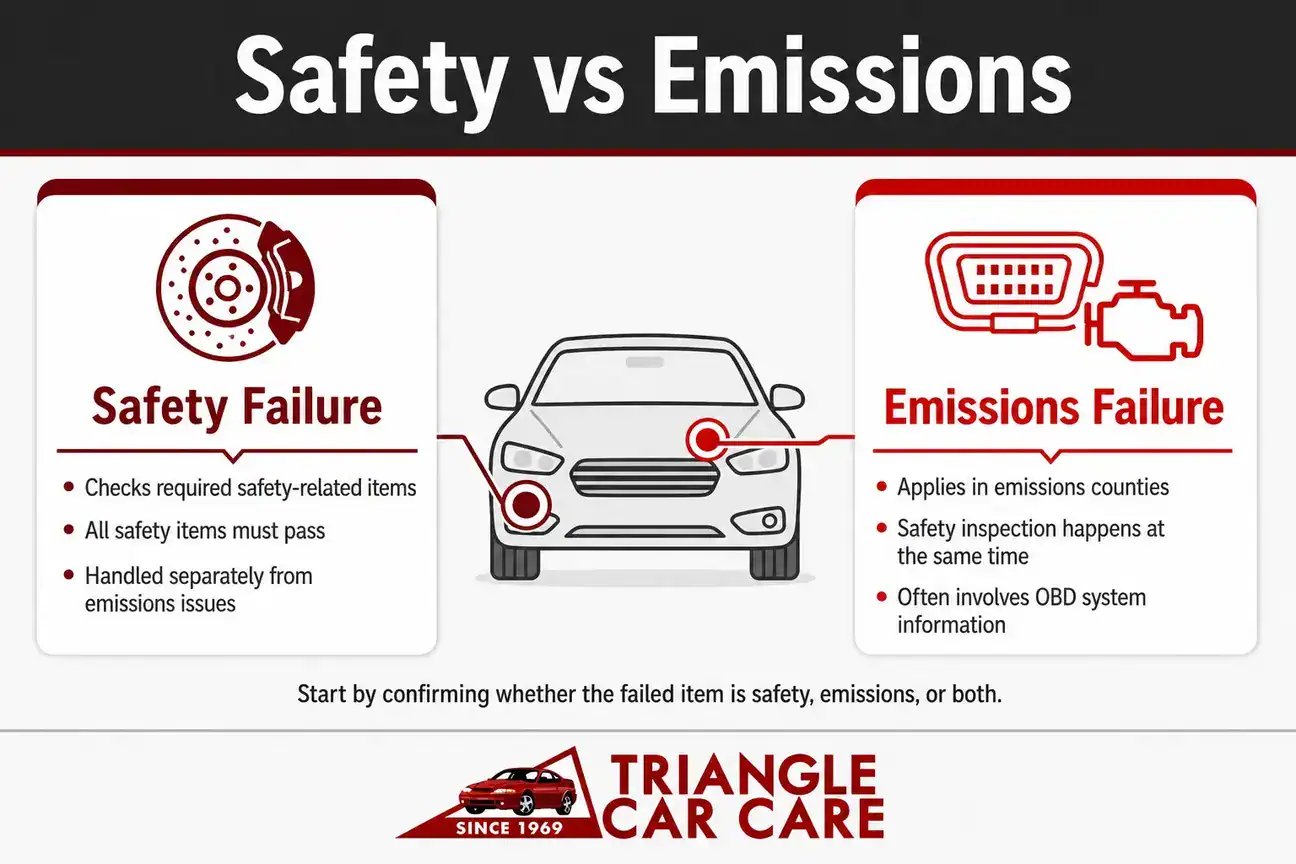
The first thing to check is not a part. It is the type of failure. A safety inspection failure and an emissions inspection failure are handled differently because the inspector is checking different things.
A safety inspection is focused on whether required safety-related items pass. NCDMV says annual safety inspections are required, and vehicles in emissions counties receive the safety inspection at the same time as the emissions inspection when the emissions requirement applies. The NCDMV safety page also states that “All safety items must pass”. That wording matters: a safety item cannot be waived just because an emissions issue is being handled separately.
An emissions inspection is different. For eligible vehicles in emissions counties, the state uses an on-board diagnostic check. NCDMV says vehicles subject to the program “must undergo” an on-board diagnostic emissions inspection. In everyday terms, the inspection equipment communicates with the vehicle’s computer to see whether the emissions system is ready and whether it is reporting faults.
That is why an emissions failure often needs testing instead of guessing. A trouble code may point toward an evaporative-emissions leak, oxygen-sensor reading, catalytic-converter efficiency issue, misfire, fuel-trim problem, or communication concern. But a code is a clue, not a diagnosis. Inspection and testing are what confirm whether the issue is a failed component, wiring concern, vacuum leak, software-related readiness issue, fuel-system problem, exhaust leak, or something else.
What the inspector is checking before an inspection retest
Before an inspection retest, it helps to understand the general inspection categories. You do not need to become an inspector, but you do want to know whether the failure sounds like a visible safety concern, a computer-reported emissions concern, or a symptom that needs separate diagnosis.
For safety, the inspection looks at required items such as brakes, lights, steering, tires, horn, windshield wipers, directional signals, and other items covered by North Carolina inspection rules. For emissions, eligible gasoline vehicles in the affected counties are checked through the OBD system. NC DEQ describes the emissions inspection program as an OBD test plus a visual safety and tamper inspection, and says emissions inspections are required in the 19 emissions counties while the program remains in force.
Here is the practical way to sort the result:
| What the result mentions | Likely inspection category | What to check first | What usually comes next |
|---|---|---|---|
| Brake, tire, steering, light, horn, wiper, windshield, mirror, or visible leak concern | Safety | Look at the failed item listed on the report | Inspection and repair of the specific safety system before retest |
| Check engine light, OBD not ready, stored fault code, catalyst, evaporative system, oxygen sensor, misfire, or communication issue | Emissions | Note the warning light status and any recent battery disconnect or repair | Diagnostic testing before another inspection retest |
| Both safety and emissions items listed | Both | Separate the visible safety issues from computer-reported emissions issues | Correct safety concerns and diagnose the emissions concern |
| Inspection cannot be completed because a system will not communicate | Often emissions-related, but may involve power, network, or module concerns | Note any battery, charging, warning-light, or previous repair history | Electrical and scan-tool diagnosis |
A failed result is not a reason to panic. It is a reason to slow down and separate what is known from what still needs testing. If the report says a tire did not meet requirements, that points the next step toward tire condition. If it says the OBD system is not ready, the next step is not simply replacing a sensor. It is finding out why readiness monitors have not completed or why the computer is reporting a problem.
NC inspection failed? 7 essential checks to avoid risk
Use these seven checks to organize your next move. They are not repair instructions, and they are not a substitute for inspection by a qualified technician. They are a safe way to understand what the failed result may be telling you before you schedule service or return for an inspection retest.
Check 1: Read the inspection result carefully
Confirm whether the listed item is safety, emissions, or both. If the wording is unclear, ask the shop to explain what failed and what must be addressed before retesting. Do not assume a failed inspection identifies the failed part. It identifies the item or system that did not pass.
Check 2: Check whether a warning light is on
A check engine light can matter for emissions. Brake, ABS, airbag, charging, oil-pressure, temperature, and other warning lights may also point to safety or drivability concerns that need diagnosis. A warning light is useful information, but it still needs inspection and testing before anyone can confidently say what caused it.
Check 3: Look at lights, wipers, horn, and mirrors
These are simple visible checks you can do without tools. Do not disassemble anything; just note what does not work normally. If something works only sometimes, tell the shop that it is intermittent. Intermittent electrical symptoms often need a different diagnostic approach than a part that has failed completely.
Check 4: Look at tire condition and pressure
Check tire pressure against the door placard, not the number molded into the tire sidewall. Also look for obvious damage, exposed cords, uneven wear, or a tire that appears very low. Tire concerns can affect safety, inspection results, steering feel, braking, and ride quality.
Check 5: Pay attention to braking and steering symptoms
Pulling, grinding, reduced braking, a sinking pedal, steering looseness, or clunks should be treated as symptoms that need inspection and testing. If braking or steering feels reduced or unreliable, get to a safe place and arrange towing or professional help instead of continuing to drive.
Check 6: Think about recent battery or repair work
A battery disconnect, jump-start, or recent code clearing can leave readiness monitors incomplete, which may affect an emissions inspection. If the vehicle failed for OBD readiness, tell the shop about any recent battery, charging-system, or repair history.
Check 7: Note when the symptom happens
Cold start, hot idle, highway speed, braking, turning, after refueling, or with the A/C on are useful clues for diagnostic testing. The more clearly you can describe the condition, the easier it is for the technician to decide what to test first.
These seven checks help you have a better conversation with the shop. They do not prove the cause. For example, a low tire may explain a pull, or it may only be one clue. A check engine light may involve one code or several related conditions. A failed inspection result tells you where to look first, not which part to buy first.
Common safety inspection failure points to understand
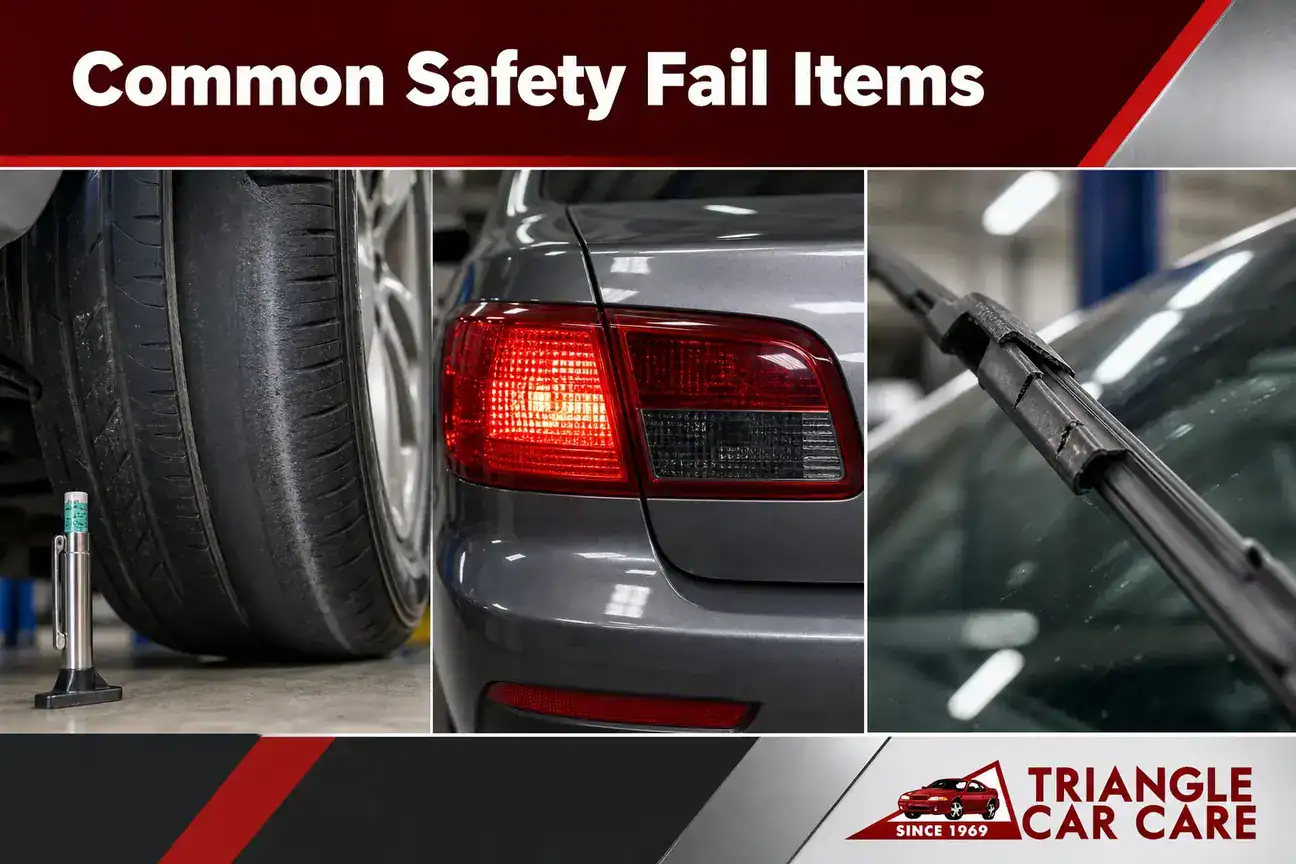
A safety inspection failure usually involves something the inspector can see, operate, measure, or evaluate under the state inspection process. Drivers often notice some of these issues before inspection day, but not always. A brake light can be out without the driver knowing. A tire can wear unevenly on the inner edge where it is hard to see. Wipers may seem fine until heavy rain makes the problem obvious.
Lights, signals, horn, and wipers
Exterior lighting is one of the first areas many drivers think to check. Headlights, brake lights, turn signals, license-plate lights, and hazard lights all matter because other drivers depend on them. If a light works sometimes and not others, note that. Intermittent problems can involve a bulb, socket, wiring, switch, moisture, or another electrical issue.
Wipers and washer operation matter because visibility is a safety issue. A torn blade, inoperative washer, or streaking severe enough to block vision can become more than an inspection inconvenience in a sudden storm. Simple observation is fine for a driver. Repairing electrical or linkage concerns should be left to proper inspection and testing.
Brakes and brake symptoms
Brake concerns deserve a conservative approach. A safety inspection failure involving brakes might relate to worn components, hydraulic concerns, parking brake operation, warning lights, or other items that inspection identifies. The failed report is the starting point, but the brake system still needs inspection to confirm what is actually happening.
If you notice grinding, reduced braking, a sinking brake pedal, pulling when braking, a burning smell near a wheel, or a brake warning light, get to a safe place and arrange towing or professional help. Do not keep driving to “see if it clears up.” Triangle Car Care provides brake inspection and repair, but it does not provide towing or roadside rescue.
Tires, steering, suspension, and alignment clues
Tire condition can affect inspection and road safety. Look for obvious damage, very low pressure, uneven wear, exposed cords, bulges, or a tire that keeps losing air. Tire pressure is a safe driver check when the tire is cool and you use the door placard for the correct pressure. Do not work under a vehicle supported only by a jack.
Steering and suspension issues can also show up as a safety inspection failure or as symptoms that deserve attention before inspection. Clunks, looseness, wandering, uneven tire wear, or a vehicle that does not track normally may point toward suspension, steering, tire, or alignment concerns. Triangle Car Care handles steering and suspension inspection and wheel alignment when testing shows those services are appropriate.
Windshield, mirrors, and visibility
Visibility items are easy to overlook until inspection day. Mirrors, windshield condition, wipers, defrost performance, and lighting all contribute to what the driver can see and what other drivers can see. If the inspection result mentions a visibility item, do not assume it is minor just because the engine runs normally. Visibility is part of safe operation.
Common emissions inspection failure points
An emissions inspection failure usually means the vehicle’s emissions-control system did not meet the OBD inspection requirement, the system was not ready, a required check could not be completed, or the visual safety/tamper portion raised a concern. The important part is that emissions failures are often system problems, not single-part answers.
Eligible gasoline vehicles in the emissions counties are inspected through the OBD system. Hybrids and plug-in hybrids with gasoline engines are required to receive emissions inspections in emissions counties while the current rule applies, subject to current state exemptions. Battery electric vehicles are safety-only under the DEQ guidance. Because eligibility depends on vehicle type, model year, fuel type, county, and exemptions, check current state guidance before assuming your vehicle is exempt.
Check engine light inspection concerns
A check engine light inspection issue is one of the most common reasons drivers connect inspection failure with diagnostic work. If the light is on, the vehicle’s computer has detected a fault or condition that needs attention. That does not mean the code names the failed part.
For example, a code related to an oxygen-sensor reading may be caused by the sensor, wiring, an exhaust leak, a fuel-control problem, or another condition that affects the reading. A small evaporative-emissions leak code may involve a loose fuel cap, a valve, a hose, a seal, wiring, or other system concerns. A misfire code may involve ignition, fuel, mechanical condition, air leaks, or controls. The code narrows the search; diagnostic testing confirms the cause.
If a check engine light inspection failure appears right after the battery was disconnected or codes were cleared, readiness monitors may not be complete. Clearing codes just to pass inspection is not a repair, and it can make the vehicle not ready for inspection. It also erases information that may help a technician understand the original problem.
OBD readiness and recent battery work
An emissions inspection can fail or be rejected if required OBD readiness monitors have not completed. This can happen after a battery replacement, dead battery, jump-start, module reset, or code clearing. The vehicle may need normal operation under the right conditions before monitors run, but if a fault keeps returning, the vehicle may never become ready until that issue is diagnosed.
This is where an emissions inspection failure can be frustrating for drivers. The car may seem to run normally, but the computer may still be reporting that a system is not ready or that a fault exists. A technician can review codes, monitor status, freeze-frame data, fuel trim, sensor activity, and other information to decide what needs testing next.
Visual tamper concerns and emissions equipment
Do not remove, bypass, disable, or modify emissions equipment to try to pass inspection. If an inspection raises a visual tamper concern, the next step is to understand what the inspector found and what must be corrected under current rules. Tunes, defeat devices, missing equipment, or altered components can create inspection and legal problems beyond a simple retest.
If a vehicle has an exhaust leak, unusual odor, or suspected emissions-system modification, the correct path is inspection and testing, not guessing. Triangle Car Care’s exhaust system repair service can help when inspection points toward an exhaust concern, but the cause still needs to be confirmed on the vehicle.
When diagnostic testing should come before an inspection retest
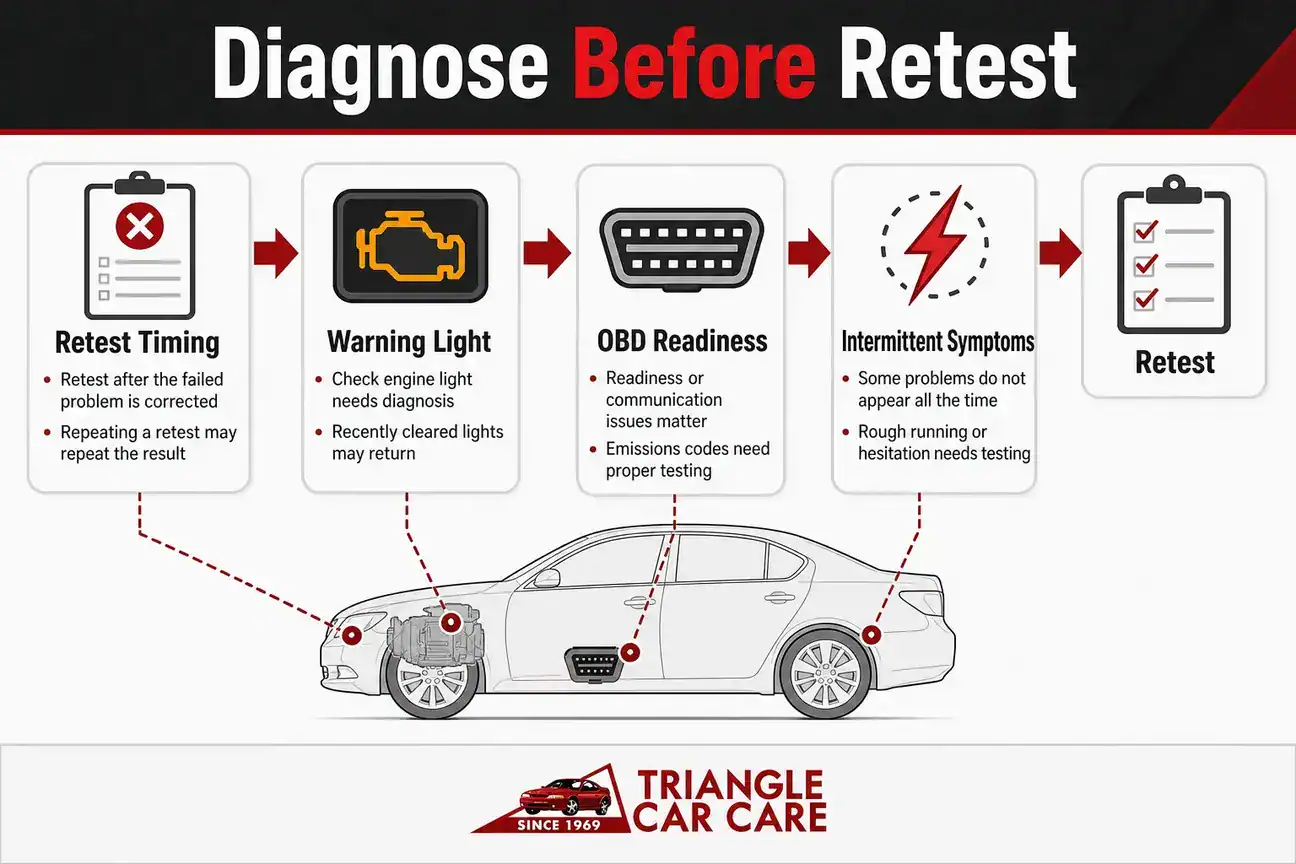
An inspection retest makes sense after the problem that caused the failure has been corrected. Retesting without repair or diagnosis may only repeat the same result. That is especially true when the failure involves a warning light, trouble code, readiness monitor, intermittent electrical concern, or symptom that the vehicle does not show all the time.
You should consider diagnostic testing before an inspection retest when any of these are true:
- The check engine light is on or recently came back after being cleared.
- The inspection report mentions OBD readiness, communication, or emissions-system codes.
- The vehicle stalls, runs rough, hesitates, misfires, smells strongly of fuel, or has poor drivability.
- A warning light appears for brakes, charging, temperature, oil pressure, steering, traction, or another safety-related system.
- The battery recently died, was disconnected, or was replaced.
- The same issue has returned after a previous repair attempt.
- The vehicle has an intermittent symptom that only happens under certain conditions.
A strong diagnostic process starts with the failure result and the driver’s description. From there, a technician may inspect the related system, scan for codes, check data, verify power and ground, look for visible damage, test components, inspect wiring, or road test if appropriate. The right steps depend on the symptom and the vehicle. There is no one universal path for every emissions failure or safety failure.
Cost and timing depend on what failed, what testing is needed, whether the problem is intermittent, parts availability, and whether more than one system is involved. Triangle Car Care does not quote inspection repairs from a blog article because a failed result is not a diagnosis. If repairs are needed, ask what warranty terms apply. The shop offers a 24-month/24,000-mile warranty on most qualifying work, and coverage varies by service and repair.
When to stop driving after a failed inspection
A failed inspection does not automatically mean you must stop driving immediately, but some symptoms do. If you have reduced braking, a sinking pedal, steering loss, overheating or steam, an oil-pressure warning, a flashing check engine light, heavy smoke, a strong fuel odor, or major fluid loss, get to a safe place, shut off the engine when appropriate, and arrange towing or professional help. Do not drive to the shop with a symptom that could affect safe operation.
A check engine light inspection concern needs special judgment. A steady check engine light often means the vehicle has stored a fault that needs diagnosis. A flashing check engine light is more urgent and can indicate a condition such as a misfire that may damage the catalytic converter or affect drivability. Treat a flashing light as a stop-driving warning: get to a safe place and arrange help.
Brake, steering, overheating, smoke, fuel odor, and major-fluid-loss symptoms are not inspection paperwork problems. They are safety problems. If the car does not brake, steer, cool, or run normally, do not try to nurse it through an inspection retest. Have the unsafe condition addressed first.
What Raleigh drivers should tell the shop before retesting
Good information saves time and helps the technician reproduce the issue. Before scheduling service in Raleigh, write down the failed inspection result and what you noticed before or after the inspection. If you are not sure whether it was a safety or emissions issue, bring the paperwork or describe the exact wording.
Useful details include:
- Whether the failure was a safety inspection failure, an emissions inspection failure, or both.
- Whether the check engine light or another warning light is on, flashing, intermittent, or recently cleared.
- Whether the battery was replaced, disconnected, jump-started, or went dead recently.
- When the symptom happens: cold start, hot idle, braking, turning, highway speed, after refueling, with A/C on, or in stop-and-go traffic.
- Whether you hear grinding, squealing, clunking, rattling, hissing, or exhaust noise.
- Whether you smell fuel, burning, exhaust, coolant, or oil.
- Whether the problem started after a repair, maintenance visit, pothole hit, curb strike, or weather event.
Wake County drivers also need to keep the emissions transition in mind. The rules are changing, but the change is not something to guess at. Use current NCDMV and NC DEQ guidance for your vehicle, and do not assume an upcoming change applies to today’s renewal.
If your failed result points to an inspection item or diagnostic concern, you can request an appointment with Triangle Car Care or call 919-787-0966. Share the inspection result, symptoms, warning lights, and when the issue happens. The shop confirms appointment times; submitting a request is not a confirmed appointment.
Repair authorization, warranty terms, and written records
Inspection failures often lead to repair decisions, so it is fair to ask clear questions before work begins. What failed? What testing is needed before the cause can be confirmed? What repair is being recommended, and why? What happens if additional issues are found during inspection and testing?
For consumer repair expectations, the FTC explains that “There is no ‘standard warranty’ on repairs,” and drivers should get warranty terms in writing. That is a good reminder not to assume every repair warranty is the same. At Triangle Car Care, ask which terms apply to your specific repair, including whether the 24-month/24,000-mile warranty on most qualifying work applies.
North Carolina also has consumer information related to written repair estimates. The state statute says the Motor Vehicle Repair Act covers written estimates for repairs above a defined threshold, and drivers can review N.C. Gen. Stat. § 20-354.3 for the legal wording. This article is not legal advice, but written communication helps keep everyone clear on the approved work.
How Triangle Car Care approaches a failed inspection
Triangle Car Care is an independent auto repair shop on Glenwood Avenue, serving Raleigh since 1969. The shop works on most makes and models and has ASE-certified personnel. For inspection-related visits, the practical goal is simple: separate the inspection result from the diagnosis, then confirm what the vehicle actually needs.
That matters because a failed result may involve more than one system. A vehicle can have a brake light out and an OBD readiness issue. It can have a tire wear concern and a check engine light. It can fail for an emissions reason while also having a separate drivability symptom. Treating every clue as one problem can lead to wrong assumptions.
When an emissions inspection failure involves a code, Triangle Car Care can evaluate the code as part of the larger system. When a safety inspection failure involves brakes, steering, suspension, lights, or other safety items, inspection and testing help confirm what is worn, damaged, disconnected, inoperative, or out of adjustment. When the result is unclear, the first step is to review the paperwork and the vehicle’s current symptoms.
Before you go back for an inspection retest
Before returning for an inspection retest, make sure the failed item has actually been addressed. For a safety issue, that means the failed safety item has been corrected and the related system functions properly. For an emissions issue, that means the fault has been diagnosed, the repair or correction has been completed, and the OBD system is in the proper state for inspection.
Do not rely on clearing a check engine light. If the underlying condition remains, the light may return. If monitors are not ready, the vehicle may still not pass. If a repair was made, ask whether the vehicle’s computer data supports returning for retest or whether more operation or additional checks are needed.
For simple checks, you can confirm bulbs, wipers, horn operation, tire pressure against the door placard, and whether warning lights are illuminated when the vehicle is running. Do not open hot cooling-system caps, do not perform brake or steering repairs from online instructions, and do not work around hybrid or EV high-voltage components. Those jobs belong with trained professionals.
If your NC inspection failed and you are not sure whether the next step is repair, diagnosis, or a retest, bring the result to Triangle Car Care. A calm, evidence-based conversation usually beats guessing, especially when a warning light or intermittent symptom is involved.
Disclaimer: This article is general automotive information, not a diagnosis of your vehicle. Follow your owner’s manual, and have a qualified technician inspect the vehicle when a symptom could affect safe operation.
Frequently Asked Questions
What is the difference between a safety failure and an emissions failure?
A safety failure means a required safety item did not pass inspection. An emissions failure usually means the vehicle’s onboard emissions system reported a fault, was not ready, could not communicate properly, or raised a visual emissions concern. Safety items must be corrected before passing; emissions failures often need diagnostic testing to confirm the cause.
Does a check engine light automatically fail a North Carolina emissions inspection?
For an eligible vehicle subject to North Carolina’s OBD emissions inspection, an illuminated check engine light generally means the vehicle will not pass the emissions portion under current rules because the system is reporting a fault or condition. The final inspection result still depends on current NC requirements, vehicle eligibility, and exemptions. Clearing the light is not the same as repairing the problem.
Can I retest without repairs after a failed inspection?
You can ask the inspecting station what the failed result means, but retesting without correcting the cause often leads to the same result. If the failure was a simple visible item, correction may be straightforward. If the failure involved a warning light, trouble code, readiness monitor, or communication problem, diagnostic testing usually comes first.
What happens if my vehicle fails a safety item?
The failed safety item must be addressed before the vehicle can pass inspection. If the item involves braking, steering, tires, visibility, lighting, or another safety system, do not treat it as paperwork. If the symptom affects safe operation, get to a safe place and arrange towing or professional help.
Which vehicles in Wake County need emissions inspection as of now?
As of the article date, eligible vehicles registered in Wake County still follow the current emissions-inspection requirement. Eligibility depends on factors such as fuel type, model year, vehicle type, and state exemptions. Because the program is in transition, check current NCDMV and NC DEQ guidance for your exact vehicle.
Do hybrid and electric vehicles follow the same inspection rules?
No. Rules can differ by vehicle type. Hybrids and plug-in hybrids with gasoline engines are required to receive emissions inspections in emissions counties while the current rule applies, subject to current state exemptions. Battery electric vehicles are generally safety-only under current state guidance. Confirm current requirements for your vehicle before scheduling.
When should I get diagnostic testing before I go back for a retest?
Get diagnostic testing first if the check engine light is on, the inspection report mentions OBD readiness or codes, a warning light is flashing, the vehicle runs poorly, the battery was recently disconnected, or the same issue returned after a previous repair attempt. Testing helps confirm the cause instead of guessing at parts.
Sources


